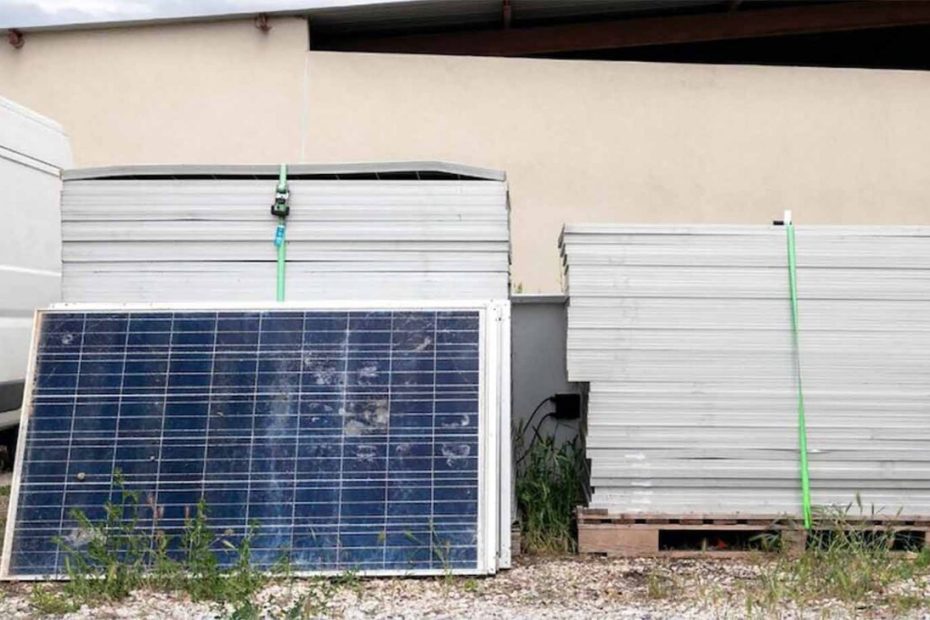
A Melbourne-based e-waste recycling company has been fined almost $20,000 after it was found to have shipped undeclared e-waste to Singapore, including solar inverters and lithium-ion batteries.
The Australian government’s department of climate change, energy, the environment, and water (DCCEEW) announced on Wednesday that it had fined Weeebytes Pty Ltd $19,800 for the illegal export of hazardous waste.
A container was intercepted by Singaporean authorities on 24 March 2025 and found to contain e-waste hidden behind other goods and not properly declared by Weeebytes.
The undeclared e-waste reportedly included large quantities of crushed hard drives, printed circuit boards, solar inverters, lithium-ion batteries, electrical power sources, and old transmitters.
Image Credit: DCCEEW
Image Credit: DCCEEW
Weeebytes was said to be aware of export requirements for hazardous waste but failed to obtain an export permit under the necessary statutes. In addition to the nearly $20,000 fine, Weeebytes was also required to return the container to Australia and arrange for the lawful disposal of the e-waste at their its expense.
“The Australian government takes the export of hazardous e-waste without a permit very seriously,” said a DCCEEW spokesperson.
Weeebytes bills itself as a “certified eWaste recycling company” that aims to to “divert all e-waste from landfills to protect our environment.” Its website displays four separate ISO certificates.
The company also claims to partially dismantle and process collected e-waste goods at their facility to recover recyclable materials, tracing ownership through the downstream recycling process.
In a statement released on Wednesday, DCCEEW warned it was “cracking down” on the illegal export of regulated waste by strengthening its monitoring and detection capabilities.
“We are conducting more port inspections, inspecting license holders and working with partners such as Australian Border Force, Department of Agriculture, Fisheries and Forestry, and state Environment Protection Agencies to identify suspicious consignments earlier,” said a government spokesperson.
“Individuals or organisations found to have illegally exported regulated waste can face significant penalties.”
The announcement further highlights the increasingly urgent need for a mandatory national stewardship scheme in Australia for e-waste, not least of all for growing piles of end-of-life solar and battery waste.
Currently, there is only one mandatory national stewardship scheme, for used motor oil, as well as two co-regulatory arrangements designed to recycle TVs and computers as well as plastics and packaging.
Several government-accredited but industry-led voluntary schemes also exist for hand-held batteries, mobile phones, newspapers, tyres, plastic paint pails, large plastic bags, and plastics and packaging.
The federal government in January finally addressed industry calls for a national stewardship scheme for solar panels, introducing a $25 million pilot program to establish up to 100 panel collection sites across the country.
It has taken years for a federally supported solar recycling program to get off the ground, despite proposals such as the one offered up by the Smart Energy Council (SEC) earlier this decade. The federal and state governments also agreed back in August to finally work on a new mandatory recycling scheme for solar modules, though it has taken longer than necessary to reach a pilot only stage.
The lack such programs has also contributed to the struggle industry-led solar recyclers have faced to stay in business. In November, Sircel, Australia’s largest established e-waste recycler, was put into administration, having recently turned its focus to solar panels.
The new solar division was not the cause of the e-waste company’s financial distress however, and the company’s operations are continuing to be run as business-as-usual, Sircel said in a statement sent to Renew Economy.
Sircel also disputed the need for administrators.
Another market hopeful, Reclaim PV, an Adelaide company, went bankrupt in 2023.
If you would like to join more than 29,000 others and get the latest clean energy news delivered straight to your inbox, for free, please click here to subscribe to our free daily newsletter.
Joshua S Hill
Joshua S. Hill is a Melbourne-based journalist who has been writing about climate change, clean technology, and electric vehicles for over 15 years. He has been reporting on electric vehicles and clean technologies for Renew Economy and The Driven since 2012. His preferred mode of transport is his feet.
Share this:
Facebook
X
LinkedIn
Reddit
Email
Print