Large scale solar farms grabbed a record share of Australia’s main grid over the weekend, peaking at more than 30 per cent for the first time – before being shunted aside as the nation’s huge array of rooftop PV took precedence.
It’s a familiar story for large scale solar. Rooftop PV has eaten into the coal power generator’s midday lunch, but it is also having an impact on large scale solar, forcing heavy levels of curtailment during the day that can reach up to 50 per cent for some installations, depending on their location.
On Sunday morning, at 8.10 am (AEST) large scale solar – according to data from GPE NEMLog – reached a record 30.6 per cent share of supply on Australia’s main grid, the National Electricity Market. That smashed the previous record of 27.9 per cent by 10 per cent.
That previous record had only just been set four days prior, also at 8.10am, breaking a milestone that had stood since December last year.
The early morning records are significant because they tell the tale of solar at the moment. Large scale solar farms mostly feature single axis trackers, allowing the panels to be oriented towards the east to catch the early morning sun, before following that giant fusion reactor across the sky during the day until the late afternoon.
Rooftop solar is mostly orientated towards the north, although the shape of individual building rooftops means that some rooftop PV is also faced east and west. It means that the collective output of rooftop PV doesn’t reach full capacity until later in the morning.
On Sunday, there was a clear picture of what happens next. Utility scale solar reaches a peak in the early morning, then as rooftop PV output increases, large scale solar is progressively curtailed.
Screenshot
At the time of the record market share on Sunday, utility scale solar was feeding 7,150 megawatts (MW) into the grid, and more than 900 MW was being curtailed. At 12.05pm, utility scale solar’s output had been cut back to 5,257 MW and 3,668 MW was being curtailed, according to data from Open Electricity.
Coal, meanwhile, had been injecting 10,600 MW into the grid before large scale solar woke up, and had its output reduced to as low as 5,200 MW in the middle of the day by the combined impact of utility scale and rooftop PV.
Coal generators are now learning how to dance around the so-called solar duck, either by ramping down to just 20 per cent of their rated output, or switching off altogether in a process known as “two shifting”.
The answer for big solar is different. They need storage. It’s one of the reasons why new large scale solar projects are being built with integrated batteries installed behind the meter. As solar-battery hybrids, they will be able to store that otherwise curtailed output and keep it for the evening peaks.
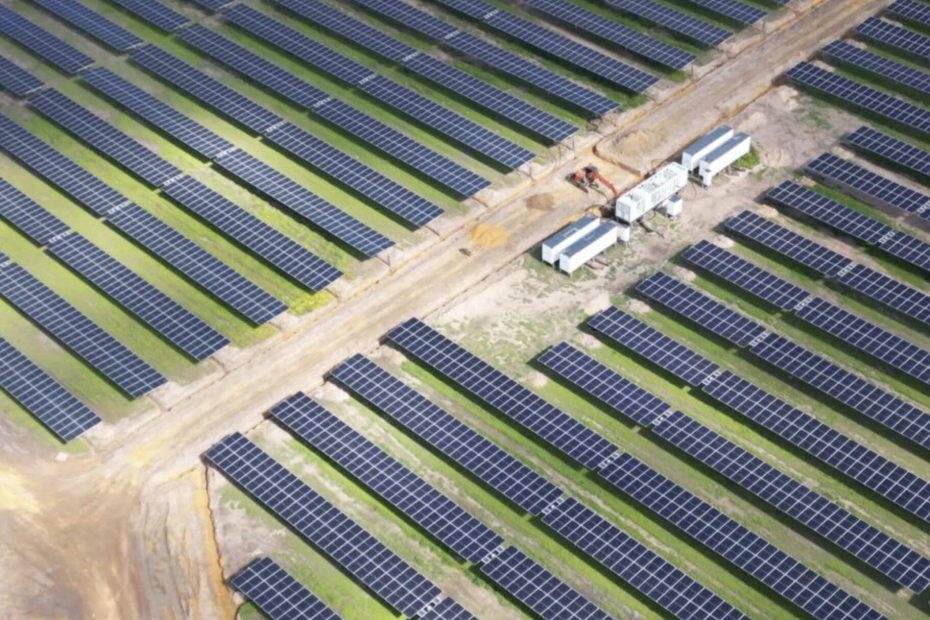
It means that, having sacrificed the midday lunch to rooftop PV, big solar can now start to eat the dinner of coal fired power. Australia’s first solar hybrid plant has been operating at Cunderdin (pictured above), where it regularly feeds power into the grid during the more profitable evening peaks, and on occasions through the night.
The first solar hybrid in the NEM, a relatively small facility at Quorn Park, has just had its first batteries installed and will start operating in the new year. It will be followed by several dozen new solar-hybrid project totalling multiple gigawatts and gigawatt hours of storage that may change the dynamics of the grid once again.
On Monday morning, the share of large scale solar in NSW also hit a new record share of 46.8 per cent in that state at 7.05 am, beating a previous record of 42.2 per cent reached on November 2. The rolling 7-day average share of big solar for the entire NEM also reached a new peak of 10.1 per cent, up from 9.6 per cent in January.
If you would like to join more than 28,000 others and get the latest clean energy news delivered straight to your inbox, for free, please click here to subscribe to our free daily newsletter.
Giles Parkinson
Giles Parkinson is founder and editor-in-chief of Renew Economy, and founder and editor of its EV-focused sister site The Driven. He is the co-host of the weekly Energy Insiders Podcast. Giles has been a journalist for more than 40 years and is a former deputy editor of the Australian Financial Review. You can find him on LinkedIn and on Twitter.
Share this:
Facebook
X
LinkedIn
Reddit
Email
Print