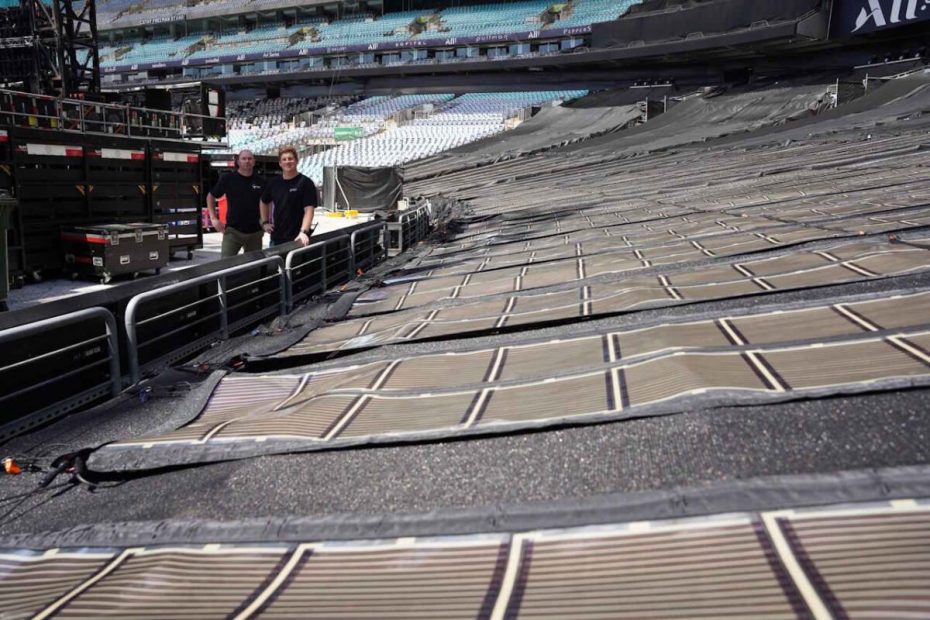
The homegrown printed solar technology of Newcastle-based company Kardinia Energy has secured a $2.1 million federal government grant to help fund a commercial-scale pilot.
Kardinia Energy’s flexible and lightweight panels are made by printing carbon-based semi-conducting polymers – a kind of advanced electronic ink – onto paper thin, clear recyclable plastic sheets using conventional printing machines.
This makes them much cheaper and more environmentally friendly to manufacture than traditional silicon solar panels and allows them to be installed more easily – and more flexibly – using basic adhesives like tape or velcro.
The printed solar panels had their first large-scale demonstration in 2017 on the roof of the University of Newcastle, where the technology’s inventor Paul Dastoor and his team were based.
They have since been tested in the wild on shade structures in Sydney, on a Tesla road-trip around Australia, and – last year – on tour with UK band Coldplay.
This year, the team at Kardinia Energy hopes to take a big step closer to commercialisation of the technology, starting with a pilot manufacturing facility. The federal government’s funding aims to ensure the Newcastle-born technology can be delivered at scale from its home base.
“It’s extraordinary technology with applications in all parts of the energy system,” federal minister for science and industry Tim Ayers said. “I’m looking forward to seeing the next stage of this development moving towards commercial production and manufacturing here in Australia.”
In a statement on LinkedIn, Kardinia Energy said it was grateful for the recognition and support, which highlights Australia’s position at the forefront of clean energy innovation.
“This grant represents a significant milestone in our journey toward commercialisation and reinforces our commitment to providing sustainable, low-cost energy solutions that benefit both local industry and global decarbonisation goals,” the company said.
The federal funding follows a $2,255,000 grant from the NSW state government in mid-2025 as part of its Clean Technology Innovation grants.
Joshua S Hill
Joshua S. Hill is a Melbourne-based journalist who has been writing about climate change, clean technology, and electric vehicles for over 15 years. He has been reporting on electric vehicles and clean technologies for Renew Economy and The Driven since 2012. His preferred mode of transport is his feet.
Share this:
Facebook
X
LinkedIn
Reddit
Email
Print