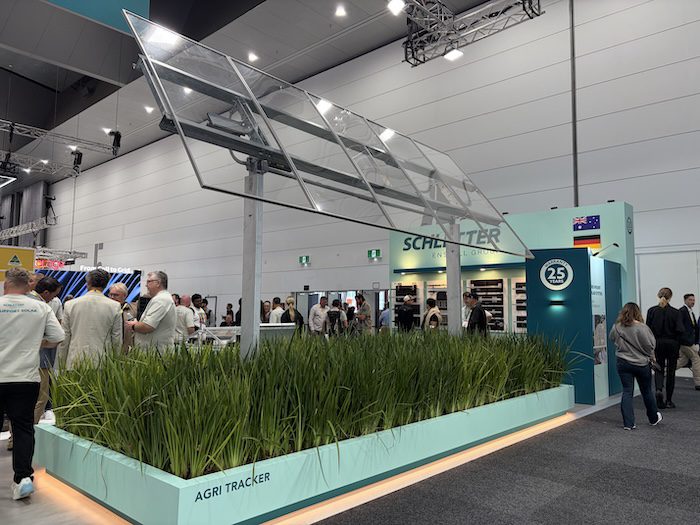
Lush green grasses sit perfectly still under the enormous steel solar tracker, presenting a positively bucolic oasis amidst the hubbub of the busy exhibition centre hosting the biggest All Energy Australia conference yet.
One could almost imagine a cow grazing underneath, which was precisely the point. At All Energy in Melbourne last week, German company Schletter was introducing its cow- and horticulture-friendly solar mount system to Australia.
It’s one of two companies that has its eye on solar that can accommodate cattle – and for the Australian market it’s the first serious move in this direction since a trial at Farrer Memorial Agricultural High in Tamworth in 2020 and farm-level installations by Queensland farmer Caitlin McConnel.
Schletter’s Thomas Dorsch, who is in charge of sales, says the lowest point on the two-leg system on show is about 2.1 metres high, to ensure there is ample headroom for cows.
It’s already being used in Europe, where a “shitstorm” – as Schletter puts it – over using agricultural land to host solar has forced developers to make farming as much of a priority as energy generation.
Australian farmers are now relatively familiar with the idea of grazing sheep under and around solar panels. Cattle, however, remain a mental – or logistical leap too far.
Cows won’t climb on solar farm infrastructure and are unlikely to chew wires, but they do like a good scratch and have enough weight to pose a risk of dislodging or otherwise damaging panels (a problem that in some overseas examples, such as the Silicon Ranch solar farm in Tennessee, has been addressed by providing more rubbing posts).
And yet pressure is mounting on both sides of the equation to find ways for renewable energy to exist alongside farming – and even partner with it, says Farm Renewables Consulting director Karin Stark.
That can mean being more flexible in lifting panels higher off the ground so more farming can be done beneath, but that option is not readily available in Australia yet.
Stark knows of one farmer in Casino, New South Wales (NSW), who was in talks with a solar developer about hosting a project, but wanted an extra 300 mm added to the height of the arrays so he could get his cattle underneath.
The request was a dealbreaker, though, with the developer unable find a way to make it work in its plans.
Cows and cyclones
But if social licence isn’t enough of a factor for solar panels to go higher, insurance might be.
Insurer Tokio Marine GX is warning of “larger and more complex losses” from the expected record-setting El Nino cycle, as it estimates weather-related losses globally for renewables have already touched $US300 million ($A427 million) this year.
Flooded and hail-battered solar farms account for 80-90 per cent of these losses, it said this week.
A New Zealand solar farm has been designed specifically to account for flooding, but it is also in a known river flood zone; other developments may simply need to protect against the one in 200 year weather events that now seem to be occurring every other year.
Rosie Oldfield, cofounder of Australian startup Storm Safe Solutions, says their technology approach can handle cyclones and cows.
“Some parties in Australia that are looking for the cows, we hope to be able to show them an option [after running a trial],” she tells Renew Economy.
“In places like the South Pacific, where they’re looking for dual use and cyclone rated, we can offer them solutions… So early days in terms of the market here, definitely. But the inquiries are coming in.”
She says they have about 300 megawatts (MW) of interest in their ground and roof mounted solar systems. The business plan factored in demand of just 5 MW next year.
An option for putting cattle under solar. Image: Storm Safe Solutions
The startup’s tech, which uses a triangular ground anchor and four posts, has been rated to wind speeds of about 72 metres per second (m/s). Standard trackers are rated to about 48 m/s, says cofounder Martin Oldfield.
The “productive agri land” risk
Whether the pressure in Australia to avoid taking “productive agricultural land” out of operation is high enough, as it has become in Europe, to encourage the use of bigger and more expensive systems is the next question.
Neither Oldfield nor Schletter would say how the cost of their designs will stack up against the shorter, standard systems sold by global companies.
But they did say that scaling up the height doesn’t use markedly more steel, nor do the footings use concrete which all add to the base cost.
Schletter’s Dorsch says concrete for the footings is one of the considerations for the German design – weaker soil needs more concrete – and pricing is difficult as they only introduced the system to the Australian market last week.
Martin Oldfield also says they’re working on getting some funding from the Australian Renewable Energy Agency (ARENA) to run a trial in New South Wales (NSW) with a keen farmer, to test their prototype.
“The whole point is that most people approach solar to optimise the solar yield,” he says.
“We think the big opportunity is for targeting the best land with the best uses. They’ve got the best businesses under them, and to maximise… agricultural use [first] and then solar second.
“It implies different layouts, different priorities, different ways you regulate the light that’s coming through the panels or around the panels.”
At issue, as Stark points out, is that while taller mounting systems have been tested overseas, as has putting calves and young cattle among regular solar panels, Australia needs some proof points for farmers and developers to feel comfortable.
If Schletter only launched its product into Australia two weeks ago, Storm Safe is just as new.
It started as an idea in December 2024 and, after buying the product plans from one of Martin’s pre-COVID suppliers, has spent the time building an Australian supply chain.
May need new solar panels
While vineyards are already keen on the idea of solar shade, protecting the fruit from the harshness of Australian summers, new panels are being designed to let light through for growth.
Martin Oldfield says they’re working with a company designing panels that will allow red spectrum light to go through, but this is tied up in confidentiality agreements.
Charles Sturt University, meanwhile, is working on a panel design that puts gaps between the photovoltaic cells to allow light through to plants underneath.
The panels are made by Sharp EIT and area already used in Europe, and let through between 10 per cent and 48 per cent of light, according to a report by the ABC.
To join more than 29,000 others and get the latest clean energy news delivered straight to your inbox, for free, click here to subscribe to our free daily newsletter.
To support independent media, and help combat the spread of deliberate misinformation and disinformation about the energy transition, you can click here to make a one off donation or become a regular supporter of Renew Economy.
Rachel Williamson
Rachel Williamson is a science and business journalist, who focuses on climate change-related health and environmental issues.
Share this:
Facebook
X
LinkedIn
Reddit
Email
Print