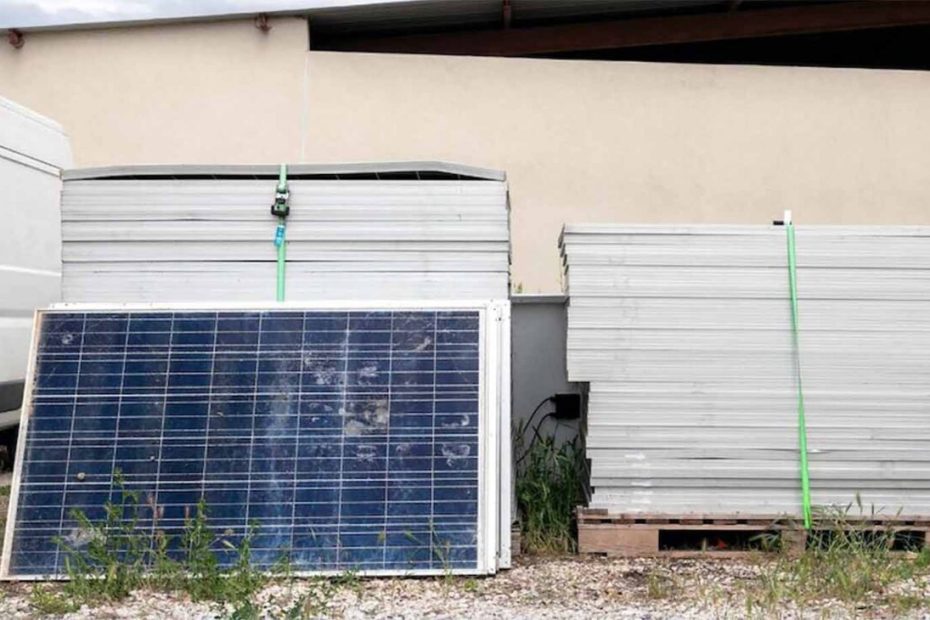
The PV industry has hit back at claims reported in the Murdoch media that solar panels are made up of toxic materials that “will not recycle” and that the reuse and recycling of PV modules is not economically unviable, even while it already employs thousands of people across seven companies in Australia.
The Australian on Tuesday reported on the well documented and unequivocally urgent PV stewardship task that Australia faces on the flip-side of its world-leading solar success story – an issue that industry has been urging successive federal governments to address for more than 10 years.
As the Smart Energy Council (SEC) and many other industry experts have made clear, Australia’s growing stockpile of used solar panels represents both a problem to be solved and a massive opportunity, given the huge value of the resources held in end-of-life panels – many of which are in high demand.
This year, after an enormous amount of campaigning and off the back of an SEC-led trial in Queensland, the federal Labor government has launched a $25 million pilot program to establish up to 100 solar panel collection sites across the country, helping overcome a key hurdle to establishing a sustainable reuse and recovery sector.
At the same time, a federal parliamentary inquiry into solar stewardship is being conducted, following a referral from federal environment minister Murray Watt, and in February put out a call for written submissions to guide its terms of reference.
But according to The Australian, solar waste is an out-of-control dumpster fire of epic proportions that is “polluting the environment by leaching toxic chemicals into landfill with no viable reuse or recycling solutions available.”
And according to The Australian, this is what “the government’s own Department of Climate Change and Energy has warned.”
The article says: “The looming environmental crisis has sparked alarm among local councils and regional communities, which have accused the Albanese government of putting money into the rollout of renewable energy but not the decommissioning end of the process.
“Australia, the world’s largest per capita adopter of solar power thanks in large part to Labor government subsidies, now faces its ‘first significant wave of end-of-life rooftop solar systems’ but can’t process all the ‘hazardous’ waste that would come from this, the department says.”
The reporter comes to this conclusion by cherry-picking from the 50-odd submissions made so far to the afore-mentioned parliamentary inquiry, including from the federal Department of Climate Change, Energy, the Environment and Water (DCCEEW).
The paper then quotes the federal opposition energy spokesman, Dan Tehan, as saying these comments are “proof that solar panels are not renewable” and that the issue of solar panel disposal threatened to “become a huge problem for Australia into the future.”
“All these panels are made overseas using materials which will not recycle,” Tehan said.
“So the government has to front up and tell Australians what they’re going to do with the huge waste that we’re going to be left with from these overseas-produced and manufactured solar panels.”
This is a predictable but nonetheless disappointing and fact-free take from a party that has given bipartisan support to subsidised rooftop solar through the Small-scale Renewable Energy Scheme since it was introduced in 2011.
As SunWiz managing director Warwick Johnston writes here, Australia’s subsidised solar success story was, arguably, set in motion by former Coalition prime minister John Howard’s May 2007 doubling of the Photovoltaic Rebate Program value to $8000.
The Coalition deserves recognition, too, for its part in kicking the can down the road on solar recycling. Solar systems were placed on the federal environment minister’s Product Stewardship Priority list back in 2016 – the year the portfolio changed hands from Greg Hunt to Josh Frydenberg.
As Renew Economy has reported, the SEC handed an industry-based PV “stewardship” proposal to the federal Coalition government back in 2021, which was rejected and nothing proposed in its place.
Instead, the then federal environment minister Sussan Ley used a National Press Club address to put the solar industry “on notice” to find a comprehensive nation-wide solution to the problem, with no offer of support.
Five long years later, a federal government is – finally – listening to industry and seeking sustainable policy-led solutions. The SEC is hoping it will be in time to support an emerging industry of companies keen to captialise on what is often referred to as a huge “urban mining” opportunity.
“Solar recycling isn’t a waste problem; it’s a resource solution. Australia’s biggest silver mine isn’t in the ground – it’s on our rooftops,” says Darren Johannesen, the SEC’s executive general manager of sustainability.
“This is a $6.5 billion opportunity to bolster our mineral security and drive a ‘Future Made in Australia’ through domestic manufacturing.
“Australia’s seven solar recyclers support thousands of jobs, and recover up to 95% of precious materials from panels, including silver, copper, aluminium and silica,” Johannesen told Renew Economy in an emailed statement on Tuesday.
“Despite having the tech, we recycle less than 5% of panels due to a decade of policy delay. The Albanese government’s new pilot program is very welcome, the critical next step is delivering a mandatory product stewardship scheme.”
What the DCCEEW submission says, but The Australian does not report, is that it recognises the huge economic and environmental value in solar reuse and recycling, and is keen to find the best means to capture it.
“Australia is well-positioned to offer a strong foundation for the recycling industry and recycling supply chain, as one of the few countries with panel recycling capabilities,” the submission says.
“To have an effective scheme, we need: a better understanding of the full range of costs – including collection, aggregation, transport and recycling – across different regions and systems, and options to manage these costs; a clearer picture of industry capability and capacity; and investment in recycling infrastructure to accommodate a growing waste stream.”
The submission also says that a preliminary cost-benefit analysis commissioned by the department based on variations of the stewardship model estimated a national scheme would deliver “a significant total net economic and environmental benefit of $7.2 billion.”
A submission from the Australian Council of Recyclers (ACOR) notes that the national recycling industry currently contributes almost $19 billion in economic value on top of environmental benefits like improved resource efficiency and the diversion of material from landfill.
“One job is supported for every 431 tonnes of material recycled in Australia, with these roles offering earnings higher than the national average. The industry operates across homes, businesses, factories and construction sites. It collects, sorts and reprocesses materials, and manufactures new products with recycled content, creating more jobs for Australians.”
Another submission from Andrew Blakers – an award-winning professor of renewable energy engineering at the Australian National University and one of Australia’s celebrated solar research pioneers – addresses some of the PV waste myths being perpetuated by The Australian and the federal opposition.
“A silicon PV panel comprises mostly cover glass and aluminium frame together with small amounts of plastic, silicon and conductive metals,” Blakers writes.
“Excluding the frame, about 90% of the panel weight is glass. Silicon is non-toxic and is the second most abundant element in the Earth’s crust (after oxygen). The conductive metals are small amounts of copper, silver, aluminium and solder.”
A submission from the Australian Aluminium Council says the strategic case for recycling aluminium from solar panels – one of the easiest components to recover – is clear.
“Recycling aluminium uses only 5 per cent of the energy required for primary production and offers strong stewardship benefits,” the submission says.
“A domestic recycling and remelting industry could support more than 1,000 skilled and blue-collar jobs, reinforce Australia’s industrial resilience, and complete the existing value chain from mining through to finished products.”
A CSIRO submission says the national science agency has calculated that a representative new solar panel has an approximate material value of $57; $16 of aluminium frame, $1 of glass, $12 of silicon, $25 of silver and $3 of copper.
“Domestic solar recycling could unlock a new generation of mining in Australia. Solar panels contain comparable copper and silver content to current declining ore grades,” the CSIRO says.
“Per tonne of solar panel materials, the value of aluminium, silver and copper is between $300 and $600.
CSIRO also notes that solar panel glass contains antimony, which is critical to defence, AI and data centres, energy and consumer goods – and was recently included as part of US-Australia Critical Minerals and Rare Earths Framework.
If you would like to join more than 29,000 others and get the latest clean energy news delivered straight to your inbox, for free, please click here to subscribe to our free daily newsletter.
If you wish to support independent media, and accurate information, please consider making a one off donation or becoming a regular supporter of Renew Economy. Please click here. Your support is invaluable.
Sophie Vorrath
Sophie is editor of Renew Economy and editor of its sister site, One Step Off The Grid . She is the co-host of the Solar Insiders Podcast. Sophie has been writing about clean energy for more than a decade.
Share this:
Facebook
X
LinkedIn
Reddit
Email
Print