French giant TotalEnergies has muddied the waters with a Northern Territory Indigenous group, after launching a court bid to remove any native title claims to land under its massive proposed solar and battery hub near Darwin.
The company, via its new subsidiary TE H2, is asking the Federal Court to declare no native titles exist over a piece of land about 48 kms south of Darwin where it’s proposing a giant solar project and battery.
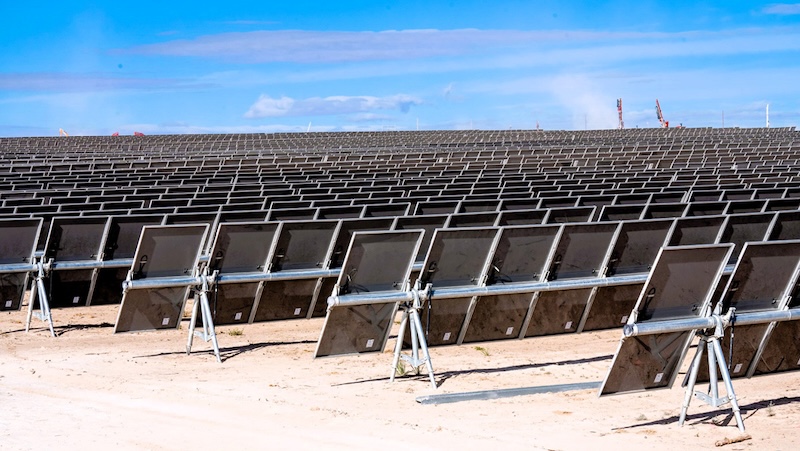
The Wak Wak solar project is a 2.7 gigawatt (GW) solar farm and 6 gigawatt hour (GWh) battery on the Koolpinyah station, a pastoral lease near Humpty Doo and about 48km south of Darwin.
TE H2 hopes to start construction in 2028 and has a longer term plan to use it to power a hydrogen facility in Darwin’s Middle Arm industrial precinct.
But the Federal Court application, lodged on November 28, shocked Wulna families who live in the area and say they only found out about the application last week from the Northern Land Council (NLC).
They now have a three month window from when the application was made to lodge a full or interim native title claim.
The move has also disappointed the NLC, the entity responsible for helping Aboriginal peoples in the Top End of the Northern Territory acquire and manage traditional lands.
“The NLC and native title groups are extremely disappointed that TE H2 has submitted a non-claimant application with the federal court,” a spokesperson for the NLC told Renew Economy.
“The non-claimant application seeks a Court determination that native title does not exist on the project area. This is likely to delay and undermine negotiations towards an agreement for the proposed Wak Wak Solar Farm.”
Non-claimant applications under the Native Title Act are not common in the Northern Territory because “most companies do the right thing,” says Nigel Brown, a Wulna and Larrakia man and CEO of Aboriginal Investment NT.
“The simplest thing they could have done is pick up the phone,” Brown tells Renew Economy.
“Everyone was caught by surprise.
“Right now they are doing about the worst consultation and engagement that you can think of.”
In comments provided to Renew Economy, TE H2 said it’s been talking to some Wulna people for about 18 months about heritage matters, but only managed to set up a meeting with the right group last week.
While while Brown says an option put forward by the NLC is for TE H2 to withdraw the court action now they know who to negotiate with, the company has committed to following through on the application.
“We have to make sure we got the right entity” for an Indigenous land use agreement (ILUA), says TE H2 head of H2 development Rontheo van Zyl.
“[It is] purely a procedural step to make sure that we identify the right entity that we can negotiate an ILUA with,” he told Renew Economy.
“We have been engaging with the Northern Land Council for over two and a half years now, since mid-2023.
“Unfortunately over that time we haven’t been able to come to a resolution as to the appropriate group.
“It’s not our preference to do it this way.”
And while this type of application is used to remove any native title claims over a piece of land, the company claims it’s using it to “confirm the correct entities for future negotiations”.
But that is a claim which incenses Brown.
“Come on guys, it’s 2025, you’ve [TotalEnergies] been around here since 2008, you’re familiar with the systems and process,” he says.
“This is completely inadequate and without any regard and respect for the Wulna people. If this is how you want to dress up renewables, you’re doing a really bad job of it.”
While van Zyl says they’ve struggled to find the right people to negotiate with, the court action has started the project’s relationship with the local Wulna group on a sour note.
“Because they’ve kicked things off in this way with an application that potentially wipes any rights away from Wulna people to what happens on country, we’re starting from below basement levels,” Brown says.
“To get back to a point where we’re confident that future negotiations or discussions are going to be bona fide is going to take a lot of work.”
If you would like to join more than 28,000 others and get the latest clean energy news delivered straight to your inbox, for free, please click here to subscribe to our free daily newsletter.
Rachel Williamson
Rachel Williamson is a science and business journalist, who focuses on climate change-related health and environmental issues.
Share this:
Facebook
X
LinkedIn
Reddit
Email
Print