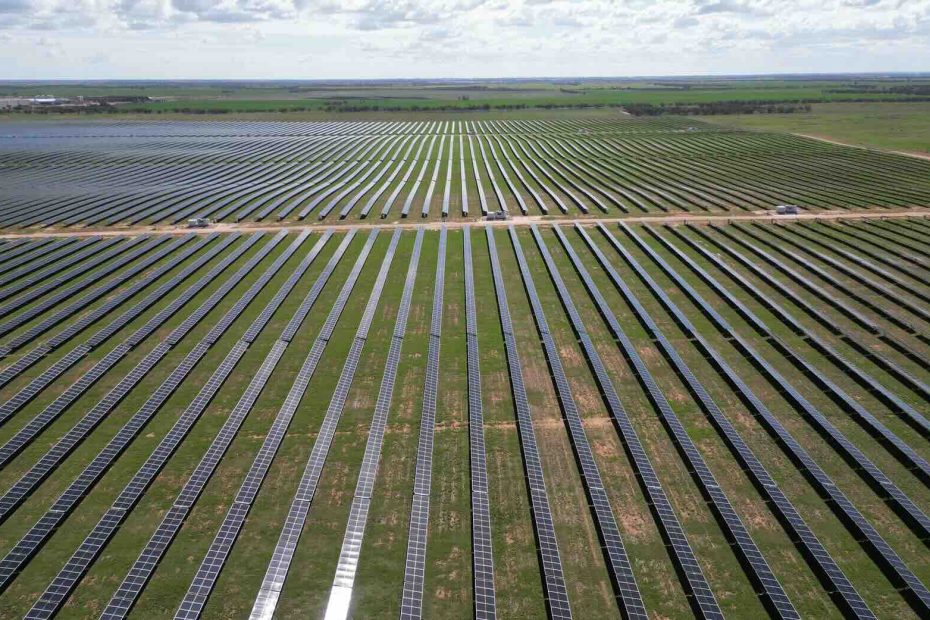
One of the biggest headaches for owners of utility-scale solar farms in the last few years has been the huge increase in negative price intervals in the middle of the day, with some facilities forced to switch off – rather than pay someone else to take their power – more than half the time.
That situation has arisen because solar farms built up to now have not come with their own batteries, their market has been eaten up by rooftop solar on homes and businesses, and because coal generators would actually prefer to pay someone else to take their power, because it’s cheaper and less problematic than shutting down their units.
That situation is starting to change. For a start, most new solar projects are coming with their own batteries connected “behind the meter”, and the first of these have already started operations.
And the massive growth in standalone grid-scale battery storage, which has grown three-fold in terms of storage capacity in just the past year, and the surge in home batteries thanks to the federal rebate, is also creating new demand in the middle of the day, soaking up the excess solar, and keeping prices above zero more often.
According to the latest Quarterly Energy Dynamics report from the Australian Energy Market Operator, economic offloading (when solar farms choose to switch off when wholesale prices fall too far below zero) has declined significantly in the September quarter.
Source: AEMO.
AEMO says economic offloading of grid-scale solar fell by 54 per cent (or 177 MW on average) from the same period last year, and offloading as a percentage of average solar availability plunged from more than 16 per cent to 5.9 per cent.
“This reduction reflected higher grid-scale battery charging and increased daytime operational demand, which reduced the need for grid-scale solar facilities to economically offload generation,” AEMO said.
Elsewhere in the report it notes how the surge in both home and grid scale batteries has underpinned demand, and lifted wholesale prices in the middle of the day. See: Home battery boom and hours of free power are re-shaping how consumers use the grid
The biggest change was in Queensland, the sunshine state, where average offloading for grid scale solar farms declined by 63 per cent, or 139 MW, to average 81 MW.
The falls were also significant in NSW (down 61 per cent or 37 MW), and South Australia (down 24 per cent of 7.5 MW), although Victoria’s economic offloading actually jumped 52 per cent, or 7 MW.
Wind farms are less affected by economic offloading as they tend to produce most of their output outside of daytime hours, although many new wind projects are also bringing their own battery storage to help them capture the most profitable hours.
According to AEMO, wind economic offloading fell in absolute terms to 266 MW, although its share of average wind availability stayed unchanged year-on-year at 5.9 per cent.
South Australia experienced the largest decline (-35 MW, -31%), although its economic offloading may be eased by the delivery of the new transmission link to NSW. Other falls were experienced in NSW (-8.1 MW, -66%) and Queensland (-8.6 MW, -39%), although wind economic offloading increased slightly in Victoria (+6.9 MW, +4.3%).
Source: AEMO.
On the other hand, network curtailment – that imposed by local networks and the market operator as a result of bottlenecks, faults or security issues – actually doubled, to a record average high of 281 MW for both wind and solar.
AEMO says grid-scale solar was the worst affected, with curtailment nearly tripling to 169 MW, or 6.7 per cent of total solar availability. The impact was felt most in NSW, particularly in the south of the state where grid bottlenecks are more common, while solar facilities in the north of Queensland were also impacted for similar reasons.
The situation remain largely unchanged for solar farms in South Australia and Victoria, while wind curtailment for the whole of the main grid increased by around one third, to an average 113 MW, or 2.5 per cent of average wind availability.
For wind, Victoria was worst affected, following by Queensland, while network curtailment in South and Tasmania decreased, and remained unchanged in NSW.
To support independent media, and help combat the spread of deliberate misinformation and disinformation about the energy transition, you can click here to make a one off donation or become a regular supporter of Renew Economy.
Giles Parkinson
Giles Parkinson is founder and editor-in-chief of Renew Economy, and founder and editor of its EV-focused sister site The Driven. He is the co-host of the weekly Energy Insiders Podcast. Giles has been a journalist for more than 40 years and is a former deputy editor of the Australian Financial Review. You can find him on LinkedIn and on Twitter.
Share this:
Facebook
X
LinkedIn
Reddit
Email
Print