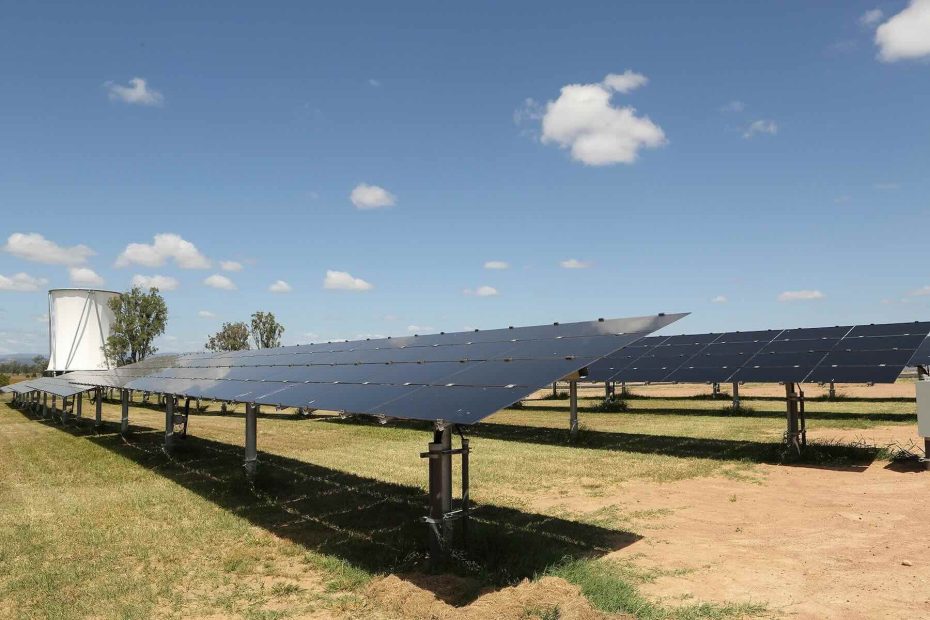
Ultraviolet (UV) rays could knock seven to 10 years off the working life of solar panels in some parts of the top end of Australia, according to new research from the University of New South Wales (UNSW).
UNSW’s Shukla Poddar latest research into UV degradation of solar modules models just how much UV is hitting panels around the world, finding that tilted solar modules in regions with tropical, arid, and semi-arid conditions are more vulnerable.
Crucially, the new paper, published in IEEE Journal of Photovoltaics, also shows how much more UV modules that tilt to follow the sun are likely to get than those fixed in place.
And it factors in real-world changes, such as what impact cloud cover has on “scattering” UV radiation and reflected UV from other surfaces.
UV rays break down materials faster over time than lower energy infrared or visible light, the wavelengths commonly used by solar modules to make electricity.
The new data showing where and under what conditions solar modules will degrade faster should prompt a rethink about what is being installed in those places, Poddar says.
“If we want to have these super high efficient modules in the future, we need to think about how we are testing these modules, or come up with more climate resistant modules,” Poddar told Renew Economy.
“We might have to start thinking about it a little differently from a manufacturing perspective, and a reliability perspective to make sure we are getting the full lifetime of these modules and we are not wasting money by having to replace them if they fail 10 years earlier than expected.”
Current testing under a standard called IEC 61215 means modules are tested with 15 kilowatt hours per square metre (kWh/m2) of UV “dosage” in the 280–400 nanometre (nm) wavelength range and a module temperature of 60 ± 5°C.
It’s roughly equal to just 46 days of field exposure in Arizona in the US.
An updated protocol suggests UV stress testing at a 225 kWh/m2 UV dose, but that’s still only equivalent to about two years in Arizona.
“The current [post-manufacturing] testing system that we have right now only accounts for approximately 55 to 60 days that a module will experience when placed in a desert climate,” Poddar told Renew Economy.
Newer technologies Topcon, heterojunction technology (HJT), and passivated emitter rear contact (PERC) are designed to capture a wider range of wavelengths.
But that has also increased their sensitivity to UV and with less than a decade of in-field data to show, models that can more accurately estimate the impact of UV radiation are critical.
In Australia, this is especially so for the top-most parts of the country, where climatic conditions are precisely in the range the paper says could carve seven to ten years of their operational lifetime.
“Northern Australia records degradation up to 0.15 per cent /year – 0.2 per cent /year, depending on the system type,” the authors of the paper wrote, a loss rate of 3-4 per cent over 20 years.
“This is due to higher temperature, humidity, and irradiation in these areas. Even though regions with arid and semi-arid climate types have lower levels of humidity, they receive higher insolation due to clearer skies and record higher temperatures, which contribute to higher UV photodegradation.”
Catching the wrong kind of rays
Panel systems that track the sun are more vulnerable to UV degradation, and not just because they’re catching more rays.
Clouds and other aerosols can scatter or absorb UV waves, while other surfaces reflect more UV onto tilted panels.
It means that using results generated only from horizontal surfaces in the lab, which don’t account for cloud enhancement or scattering, leads to lifetime predictions that aren’t accurate, the paper shows.
“The UV irradiance incident on a tilted PV module is composed of direct, diffuse, and reflected UV from the top of the module,” it says.
“We can expect similar modules with different mounting, orientation, and technology to have different UV photodegradation rates.
“Modules with similar mounting, orientation, and technology can exhibit significantly different degradation rates due to the geographical variability of the UV spectrum.”
What that means is a panel mounted horizontally on a Sydney roof gets 1.4 times more total UV radiation than the same model mounted in New Delhi, because of variations in altitude, ozone, atmospheric constituents, and other factors.
Self-destruct or self-repair
UNSW hopes the model will offer the solar industry a new way to predict long-term performance and durability.
But that picture is somewhat complicated by research published in January – also by UNSW researchers – that show solar modules can self-repair that UV damage.
In addition to creating all kinds of secondary damage that comes with sun-degraded parts, UV breaks down silicon-hydrogen bonds that are essential to making electricity.
But field tests using ultraviolet Raman spectroscopy proved these bonds can repair themselves in less than 10-20 minutes of “normal” sunlight.
Ziheng Liu, the corresponding author on that study, says it means post-manufacturing testing might be overestimating, not underestimating, the effects of UV on solar panels.
“This approach helps distinguish between true long-term degradation and reversible changes,” Liu said at the time.
“That distinction is essential for accurate lifetime prediction.”
If you would like to join more than 29,000 others and get the latest clean energy news delivered straight to your inbox, for free, please click here to subscribe to our free daily newsletter.
Rachel Williamson
Rachel Williamson is a science and business journalist, who focuses on climate change-related health and environmental issues.
Share this:
Facebook
X
LinkedIn
Reddit
Email
Print