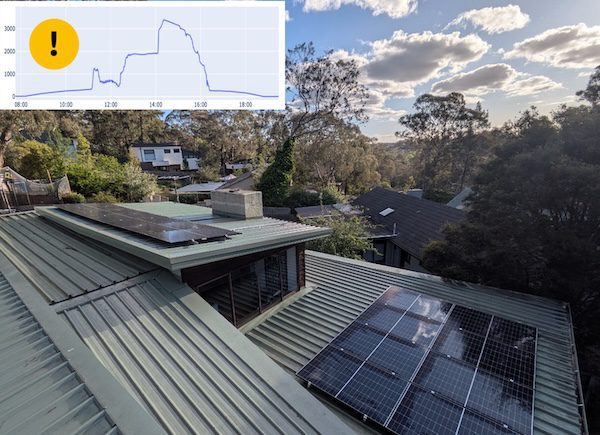
A computer scientist in Melbourne is attempting what no regulator has managed to do yet — reach into Australians’ homes, peek at their rooftop solar data, and use that to more accurately forecast what the generation juggernaut will do next.
The rewards, Julian de Hoog says, will be felt by the market regulator, virtual power plants, and homeowners who can see whether their systems are performing properly.
Rooftop solar has long been the freewheeling maverick of the energy world, torching the business plans of grid-scale generators from solar through to coal plants while bedevilling unprepared network operators and regulators.
Predicting what these huge power plants are doing at any given time of the day is becoming very important, says de Hoog, the founder of Solstice AI.
“That broader regional forecast becomes really valuable to AEMO [the Australian Energy Market Operator] to run the market, but it also becomes really valuable to anybody participating in the market,” de Hoog tells Renew Economy.
“Let’s say sudden cloud cover forms just outside of Sydney. Bands of clouds move across Sydney, and all the solar PV stops generating at the same time. It’s like losing a power plant and that void needs to be filled.
“That’s an opportunity, if you have a battery or a [gas] peaker, that’s your chance to get into the market, because it’s really necessary at that point, and you’re going to get really well reimbursed.”
Rooftop solar in New South Wales (NSW), for example, is the second largest generator in the state at 8.2 gigawatts (GW) of capacity, according to Open Electricity, and will soon overtake coal.
Across the National Electricity Market (NEM), which covers all but Western Australia and the Northern Territory, rooftop solar is the largest generator at 23.9 GW, with the next being black coal at 17.1 GW, Open Electricity data shows.
But Australians’ scepticism of handing over control of their private energy empires means little of this is orchestrated under a virtual power plant (VPP) or other means.
De Hoog says his software, however, can at the very least offer more minute-by-minute insight into what it’s doing now, and what will do in the minutes and even hours into the future.
Satellite imagery finds all of the rooftop solar panels in an area and then they partner with, say, a VPP or an electricity retailer or inverter manufacturers to get the exact data – with homeowner permission – from a proportion of houses in that area.
That data provides a baseline as to how each individual rooftop system performs.
Then, instead of using weather forecasts and user-generated data from the likes of PVOutPut.org, as AEMO does to guess at how much power rooftop solar is exporting into the grid, Solstice AI uses the house-level data.
It can show, for example, that homes in eastern Sydney for example are only performing at 40 per cent, so there must be clouds going across.
“AEMO do their absolute best to [forecast rooftop solar] well, and they have their own systems for doing that. But ultimately, these are just estimates,” de Hoog says.
“[In our system] every single house becomes a solar sensor. It’s telling you how much solar is reaching that house.
“We can skip all these things that are really complicated to model and forecast, like cloud movement and weather and so on, and just use the ground truth, the actual measurements from these houses.”
It sounds simple – get data from houses, model – and something the likes of AEMO which needs to manage the grid should be able to do.
But de Hoog says it’s harder than it looks.
He says each home has an individual “fingerprints” which depends on the angle of the panels, any shading, and even seasonal shading, which means getting a baseline of performance takes more data and longer than just uploading a single data file.
Turning each of those data points, with their own idiosyncrasies, into a geospatial estimate is also complicated, he says.
The risk with using household data for commercial purposes is that Australians, already cynical about the motives of companies towards their often-expensive home investments, will decline to participate.
De Hoog says his tech is not just for big business, however.
VPPs in particular are saying it will be useful for them to be able to find out which houses are underperforming and allow them, or the homeowner, to do something about it.
That’s particularly useful for VPPs which specialise in owning, installing and operating solar-batteries for the home, but also for the bring-your-own-device VPPs which need to justify curtailing exports to the grid.
“If I’m a VPP, I might intentionally choose to curtail solar throughout hours of the day because the price is negative and it’s not good to generate. But then you want to demonstrate to all of your customers how much you’ve saved them,” de Hoog says.
“Another is forecasting engines. Every one of these VPPs has their own forecasting engine, which takes in all of their fleet and how much they’re all generating.
“When you add new sites, you don’t have a history there, and training your forecasting model comes hard. And so we can recreate the history of that house… and suddenly you have a year of data to feed into your forecast.”
If you would like to join more than 29,000 others and get the latest clean energy news delivered straight to your inbox, for free, please click here to subscribe to our free daily newsletter.
If you wish to support independent media, and accurate information, please consider making a one off donation or becoming a regular supporter of Renew Economy. Please click here. Your support is invaluable.
Rachel Williamson
Rachel Williamson is a science and business journalist, who focuses on climate change-related health and environmental issues.
Share this:
Facebook
X
LinkedIn
Reddit
Email
Print