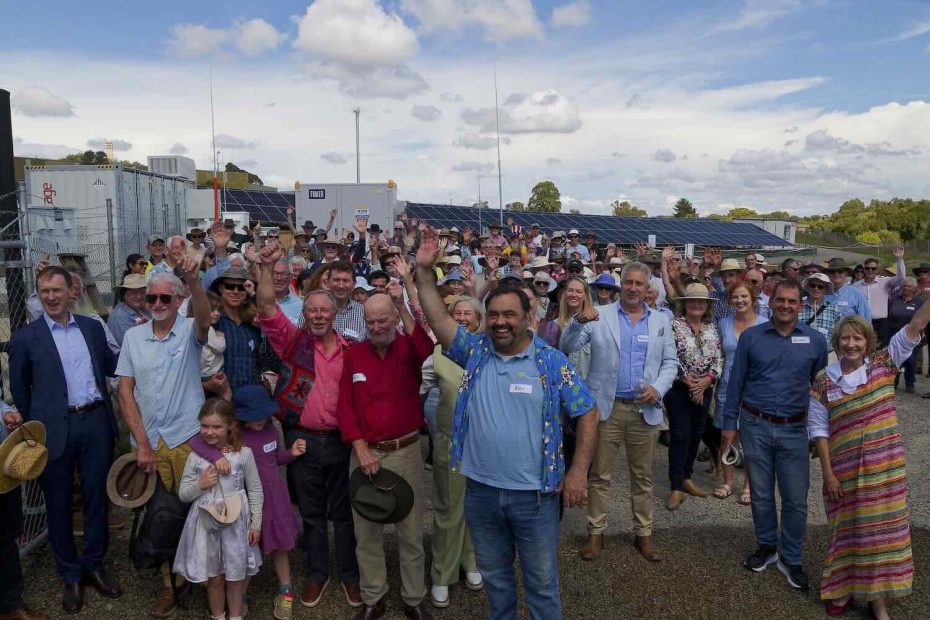
Australia’s first community-owned solar farm – with battery – was officially opened last Saturday, as Sophie Vorrath reported earlier this week.
It’s not big, just 1.4 megawatts of solar and a 4.4 megawatt hour battery, but it’s the community effort that got it built at all that makes this such an uplifting and significant story, particularly in the world that we live in now.
The story of the Goulburn community owned solar farm actually began at least 12 years ago. The regional city’s then elected representatives – current federal Liberal leader Angus Taylor and state MP Pru Goward – were making a lot of noise opposing nearly every large scale renewable project in the region.
But it was the actions of then prime minister Tony Abbott that really jolted the local community into action.
“We really owe the existence of this solar farm to Tony Abbott,” Mhairi Fraser, a member of the Goulburn solar farm co-operative, says in an interview with Renew Economy’s weekly Energy Insiders podcast.
“He was just attacking climate scientists, attacking science … you know, climate change is crap stuff, dismantling a lot of the kind of government institutions that were supporting climate action and emissions reduction and certainly really trying to get rid of the Renewable Energy Target.
“There were a lot of us in Goulburn that were furious and we were frustrated. A lot of us are grandparents and parents and feeling like what is going to happen to the future generations … if we continue to along a trajectory of reliance on fossil fuels.”
And so a bunch of them travelled to Canberra for the first Australian community energy congress. “That was a turning point,” Fraser said. “We thought, why don’t we build a solar farm? Can’t be that hard.”
That was in 2014. The group had conversations with a local construction company, secured some land near the railway station – the solar farm is close to the heart of the city – and soon secured a feasibility grant from the state government. All that proved to be the easier part.
In 2016, the community group, now with another former Liberal leader John Hewson on board, presented the results of the feasibility study to around 250 local community members, showing it was a good idea.
It wasn’t until 2019, however, that the group was finally able to land some funding, a $2.1 million grant from the state government – on condition that a battery was added – that the community had to match.
It quickly formed a co-op, put out a prospectus and within six weeks had commitments for $2.4 million from 288 people, around 80 per cent of the local.
And then covid hit. Prices jumped, it was impossible to secure contractors, and there were a whole heap of challenges that emerged – the discovery that the NSW grant would be taxed by the federal government, the painfully slow process of securing a grid connection, and some strict rules from Sydney Water.
The farm is located on a site that once hosted a fuel depot, alongside the Mulwaree River, and a lot of work was required to ensure there was no run off into that water course.
“Each step was very, very slow, and each step was very, very costly,” Fraser says. “One of the things that Sydney Water required was grass coverage. We had great weeds, we had weeds everywhere. But they wanted grass and we had another mini drought.
“We spread seed around, nothing happened. They wouldn’t let anything progress until the grass grew… so we had to wait and watch the grass grow … we were really tearing our hair out.”
Eventually, though, it did get built. The passing of time meant that solar panels had become cheaper and more efficient, and battery storage costs were also plunging. They were offered a deal to install a much bigger battery, but that required a further matched $400,000 grant from government. It was quickly obtained.
The solar farm and battery began construction in 2025 (destroying much of the grass) and is now in commissioning. “Once it stated construction, it was really quick,” Fraser says. “It’s getting to that starting line that is the hard bit.”
Andrew Bray, the chair of the Goulburn Community Energy Co-operative, says the unique nature of the co-op means that each shareholder has one vote regardless of the size of their shareholding. This removes the risk of takeovers and delivers democratic governance.
“We are grateful for the continuous support of our 288 community investors, who have put their money where their mouth is and stuck with us as we’ve ridden the inevitable challenges of a project of this complexity,” he said at the opening.
“We are delighted that we can start generating returns from the sale of our clean energy and repay our investors’ patience.”
Fraser says the key to developing such projects is the ability to keep the community engaged. The group has been active in local wetlands projects that attracted the support of the wider community, helped solar and battery bulk buy programs and have held numerous other events.
“We had to keep the community engaged,” Fraser says. “That’s a long time for people to stay keen.”
And what are the key elements to drive a community to such an achievement over so many years? Fraser says a strong motivation, the sort of “fire in the belly” that can be lit by the likes of Abbott, but social capital is critical.
“Building social capital is an important part of the project,” Fraser says. “The world is in a very difficult space. Social capital is what we’re going to need, increasingly, in communities, as we hit harder and harder times.
“The world is not in a good place. It’s not a time to put your feet up. It’s time to get the boots on, wind up, push up the sleeves, find your tribe and get on and do it.”
You can hear the full interview with Mhairi Fraser in this latest episode of the Energy Insiders podcast. See: Energy Insiders Podcast: The remarkable story of Australia’s first community-owned solar farm
If you would like to join more than 29,000 others and get the latest clean energy news delivered straight to your inbox, for free, please click here to subscribe to our free daily newsletter.
Giles Parkinson
Giles Parkinson is founder and editor-in-chief of Renew Economy, and founder and editor of its EV-focused sister site The Driven. He is the co-host of the weekly Energy Insiders Podcast. Giles has been a journalist for more than 40 years and is a former deputy editor of the Australian Financial Review. You can find him on LinkedIn and on Twitter.
Share this:
Facebook
X
LinkedIn
Reddit
Email
Print