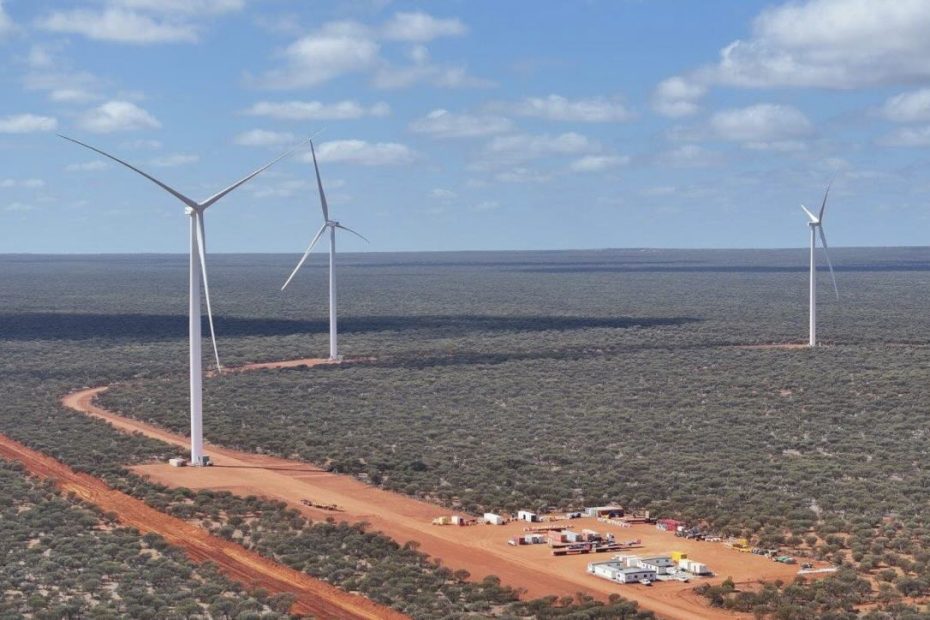
One of the world’s most significant rare earths mines, backed by Australia’s richest person, Gina Rinehart, continues to defy its own expectations and is operating at an average share of 93 per cent renewables so far this year.
The Mt Weld mine, owned by Lynas Rare Earths, in which Rinehart has a significant stake, expected to average around 70 per cent renewables after its new 65 megawatt hybrid power plant was commissioned by Zenith Energy late last year.
But it has done way better than that. According to the company’s annual report, released this week, the mine – along with its processing plants – has been operating at an average 93 per cent from January through to June, “well above” its target rate.
The Mt Weld hybrid plant combines 24 MW of wind, delivered by four turbines, a 7 MW solar farm, and a 12 MW/12 MWh battery, backed up by a 17 MW diesel system.
According to Lynas, the hybrid power plant delivered savings of more than 870,000 litres of diesel in the third quarter alone, compared to the same period a year earlier when it was operating only a diesel plant. It says this has reduced costs, increased operational energy efficiency and reduced emissions.
Lynas says the main future markets for its rare earths are electric vehicles, electrification of industry, and also wind turbines. Its annual report cites one of its biggest business risks would be a slowdown in the clean energy transition.
“Stronger demand is likely to be observed under transition scenarios consistent with more ambitious emissions reduction policies,” Lynas says in its annual report.
“Larger and faster positive opportunities for rare earth producers will emerge with efforts to achieve net zero emissions.” Yet Rinehart – whose stake in Lynas is valued at around $1.7 billion – and the politicians she supports, including One Nation, argue that net zero targets should be dropped.
The performance of the hybrid power plant at Mt Weld is remarkable enough, but more so because it comes from an asset partly owned by Rinehart, one of the foremost critics of renewable energy in Australia.
The main argument against renewables by critics in Australia is that they cannot power a modern economy. But if they can power off-grid mines and processing plants with such high renewable shares, there is nothing stopping them having equally high shares in a bigger grid – the technologies required are basically the same.
The main concern for the market operator is not so much over how much wind and solar is produced – that can be managed with storage and demand management – but over the provision of critical market services, such as the protection of fault current, that provide grid stability.
Inverter companies say their grid forming inverters can do the job, and point to the success of mini grids such as Mt Weld’s, but the market operator and big network are still leaning towards big spinning machines until further testing on a much bigger grid can validate those claims.
The nearest rivals to Mt Weld in terms of renewable performance are the Bellevue gold mine, which achieved between 80 and 90 per cent renewables over the last year from its hybrid plant, including 153 continuous hours of “engines off”.
And the Kathleen Valley mine owned by Lionheart Resources, another company in the Rinehart portfolio, that has averaged around 82 per cent renewables this year.
Zenith Energy, which built and operates all three hybrid power projects, says emote hybrid power systems are achieving levels of renewable integration that exceed many grid-connected industrial operations and still maintain reliable supply in some of the country’s most demanding operating environments.
CEO Matthew Moffat says the results challenged lingering perceptions that high-renewable energy systems could not reliably support energy-intensive industrial operations.
“The national energy debate is often focused on future targets and long-term pathways,” he said in a statement highlighting the hybrid power plants achievements.
“What these operations demonstrate is that high-renewable energy systems are already operating today at commercial scale in some of the most technically demanding conditions in Australia.
“These sites have no tolerance for instability or interruption. If high-renewable energy systems can perform reliably in remote mining operations, it broadens the discussion around what is technically and commercially achievable across the wider economy.”
To join more than 29,000 others and get the latest clean energy news delivered straight to your inbox, for free, click here to subscribe to our free daily newsletter.
To support independent media, and help combat the spread of deliberate misinformation and disinformation about the energy transition, you can click here to make a one off donation or become a regular supporter of Renew Economy.
Giles Parkinson
Giles Parkinson is founder and editor-in-chief of Renew Economy, and founder and editor of its EV-focused sister site The Driven. He is the co-host of the weekly Energy Insiders Podcast. Giles has been a journalist for more than 40 years and is a former deputy editor of the Australian Financial Review. You can find him on LinkedIn and on Twitter.
Share this:
Facebook
X
LinkedIn
Reddit
Email
Print