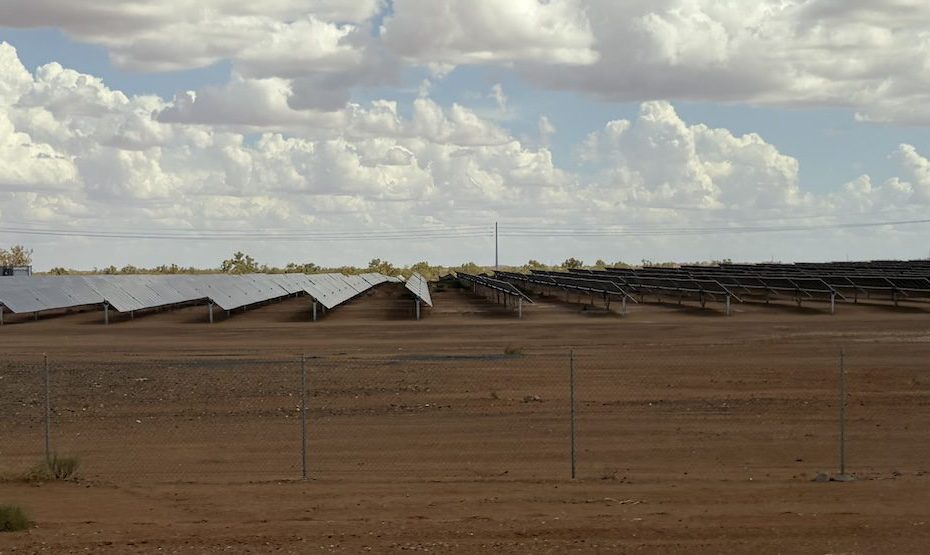
The solar farm at North Star Junction is not what you’d call a standard project.
Spinifex and plains grasses grow high under the panels in some places. Every so often, a taller, tree-like shrub peeks out and over-shadows a row.
The 100 megawatt (MW) solar farm, built on the undulating curves of a former work site, was finished in 2024 and is iron ore miner Fortescue’s first foray into large scale solar.
The lesson learned is that it’s easier to build solar than, basically, anything else.
“It’s so simple,” Fortescue CEO Dino Otranto tells Renew Economy.
“Put a tracker on it, put a panel on and then it’s rinse and repeat. We do that 1,000, sometimes 3,000 times a day.
“It’s a fraction of the workforce [compared to building a mine].”
Costs keep falling
The cost of building solar is already minuscule for Fortescue, at around $40 per megawatt.
That compares to equivalent diesel costs between $120 and $300 a megawatt.
The company wants to get that fee down even further with automation.
The Australian Renewable Energy Agency (ARENA) gave Fortescue $45 million late last year, its largest single investment yet into new solar technologies, to try out different robotic concepts across its solar portfolio.
That consists of North Star Junction, the 190 MW Cloudbreak project which is under construction and where many of these robots are being tested and the approved 644 MW Turner River project next to the junction site.
Otranto also said last week he expects a 440 MW solar project at the Solomon mine to be approved within “the next few days”.
“The real next step in our evolution is you automate that whole process. The automation of a pile driver already exists. Putting a tracker on is very easy to automate, and then the actual installation, the panel is dead simple to automate,” Otranto says.
“All we’d have to do is put that all together. We’ve been successful in automating massive trucks and running them 2000 kilometers away from the Pilbara. So automating a very simple installation like this would be a no brainer.”
Automating solar builds gets around the issue of labour – there aren’t enough people available to work in the Pilbara as it is, let alone wasting human time on work that could be done faster by a robot.
Regenerating the plants
Back at North Star Junction, by mid afternoon the wind is mercifully beginning to pick up and whipping up those grasses and bushes growing under and around the solar farm.
The solar farm site is on a former work site, and the Western Australia Environment Protection Authority (EPA) was keen on Fortescue’s proposal to avoid as much site disturbance as possible.
That meant using raised blade clearing to leave burrows, roots and the top layer of biodiversity in the soil, instead of scalping the site to level it and remove the topsoil.
Following the land’s natural contours so water runoff doesn’t need to be corralled into man-made areas.
All of this will be music to the ears of ecologists, who say that this not only benefits the local environment, but also the solar farm itself.
“[Gardens] increase the amount of organic matter in the soil, and increase the amount of water held in the soil, and reduce our ambient temperature,” says Succession Ecology CEO Briony Horner.
“So how can we use that then to change the way solar farms are generating energy? Solar farms need a reduced ambient temperature. They need enough sun, but they actually benefit from reduced ambient temperature to improve solar panel function.”
Roots, worm holes, and burrows for lizards and other small creatures help water drain away more effectively, which avoids destabilisation around solar foundations, and it reduces costs because it removes an extra layer of work – removing soil and putting it somewhere.
It also makes the prospect of rehabilitation simpler.
As Otranto puts it, a solar farm may only last for 30 years but it’s “light touch infrastructure” where it’s a simple task to pull up foundations and restore or allow nature to take its course.
Unlike a giant hole in the ground which will remain a scar on the earth forever.
Renew Economy travelled to the Pilbara as a guest of Fortescue.
If you would like to join more than 29,000 others and get the latest clean energy news delivered straight to your inbox, for free, please click here to subscribe to our free daily newsletter.
Rachel Williamson
Rachel Williamson is a science and business journalist, who focuses on climate change-related health and environmental issues.
Share this:
Facebook
X
LinkedIn
Reddit
Email
Print