Andrew Forrest’s iron ore and green energy giant Fortescue has been slapped down on multiple occasions for its failure to deliver on its green hydrogen “hopium” – understandably so given that its ambition proved to be well before the technology and the market was ready.
Now, however, attitudes may be about to change. Not for hydrogen, but for 100 per cent renewable power and full electrification. The call to “electrify everything” is about to be delivered most spectacularly at one of Australia’s most profitable companies and one of its biggest energy users.
Forrest has laid down an ambitious target to eliminate the burning of fossil fuels entirely from its giant Pilbara mining operations. Not just in a few decades, but by the end of this decade. And it is now so confident of success that it is fast-tracking, rather than slowing down, the transition. It could be achieved within three years.
Unlike its hydrogen plans, Fortescue has now struck upon the perfect intersection of technology and geopolitics, where the cost of renewables and particularly battery storage has plunged just as fossil fuel prices soar, driven by Donald Trump’s stunningly inept, illegal and highly consequential war on Iran.
The impact on Australian miners from the fossil fuel crisis is already being seen. Diesel prices have jumped by round 50 per cent, and long term supplies remain uncertain. Margins are being crunched.
Some lucky mining companies who had already figured out the economics and chose renewables over fossil fuels for their power supplies are feeling vindicated – like Bellevue Gold and, ironically, the Gina Rinehart lithium play Liontown Resources.
See: Giant gold mine operating with 90 pct renewables says it has virtually eliminated diesel costs
These companies are now sourcing between 80 and 90 per cent of their power needs from wind and solar, and haven’t yet started on their truck electrification campaign.
But what Fortescue is doing is of another scale – its planed investment in wind, solar and storage is 100 times greater than that of either Bellevue or Liontown, and it is also aiming for the complete elimination of diesel from terrestrial transport, including its excavators and bulldozers and its fleet of nearly 400 giant haul trucks.
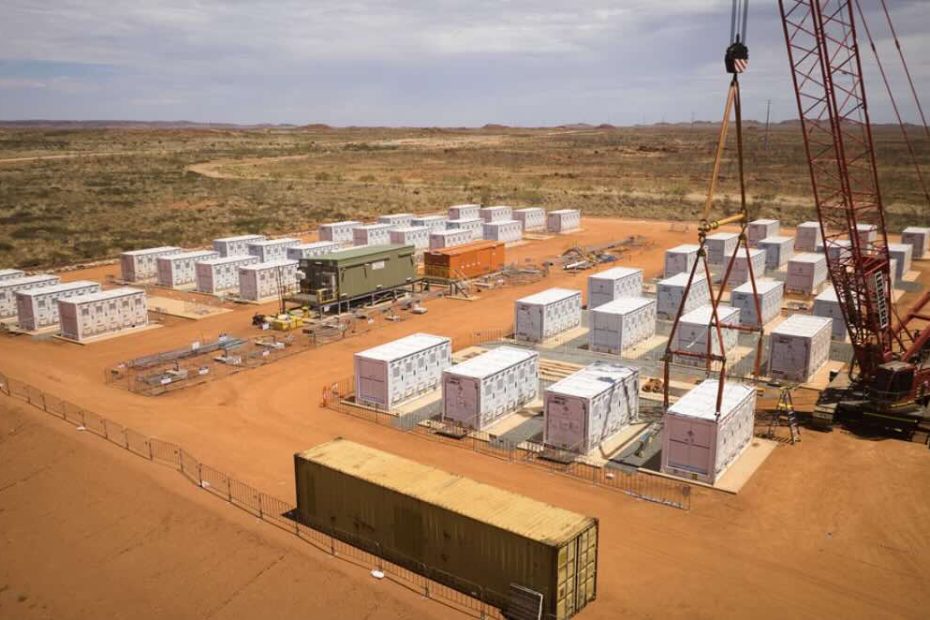
Last week, Fortescue announced that its “green grid”, some 2 gigawatts (GW) of wind and solar backed up by 4.5 gigawatt-hours (GWh) of storage, all linked by a new network, is expected to be up and running some two years early.
Depending on how quickly the fleet of 240 tonne electric haul trucks can be delivered, the burning of fossil fuels – and Fortescue has been burning around 700 million litres of diesel a year – could be eliminated before the 2030 target date.
And, according to CEO Dino Otranto, it makes overwhelming economic sense. “I don’t really care what group you’re with, or what defence strategy you take, you cannot argue with those economics,” Otranto told journalists in a briefing last Friday. “It’s a complete no-brainer.”
But if it is so, why is the rest of the mining industry remaining so skeptical, and so unwilling to follow in its footsteps? Both BHP and Rio Tinto, for instance, have suggested that the technology is not yet there. How can one mob say it isn’t, yet Fortescue be so emphatic in arguing that it is?
Otranto himself asked the question. “I think a lot of people have been taken by surprise by the situation, and it demonstrates, once agin, how vulnerable our supply chains are to foreign interests.
“And I would argue that is not the position that Australia wants to be in. And now we have a solution. And our call out is, why isn’t everyone else following it?”
Later in the briefing we pressed Otranto for an answer to his own question.
“I’ve been in the mining industry for a long time, and one of the criticisms that that we have got over the last generation would be the deployment of capital and the return profile of our industry,” Otranto said.
“I agree with all of my peers that I think, fundamentally, the mining companies are undervalued when you look at the revenue versus the value of our companies.
“You just have to look at some of those statistics that are flying around on some of the valuations of tech companies, who largely have very similar revenues to mining companies, but are valued at 10 to 100 times the value.
“So for us, I think there’s generally a level of conservatism in the deployment of capital in mining. However, I think that’s an opportunity where we can leverage technology, leverage data, and ensure that the deployment of capital comes with a very low risk.
“And again, remember the types of assets that we’re building into perpetuity, they are not mining-life assets that we have.”
Otranto says there have been huge technology advances in terms of solar panel productivity and costs, battery productivity and costs, and now in wind, too, through its own acquisition of the Spanish-based Nabrawind, whose “self-lifting” tower tech offers a unique solution to erecting huge turbines in the remote Pilbara.
“That means that we can deliver that low-cost electron to the market cheaper than any other source of electron,” Otranto says. “And again, I keep pointing to the fact that this is a no-brainer.”
Fortescue is so confident that it is now touting a multiple gigawatt solution – comprising 2 GW of wind and solar backed by 4 GWh of battery storage – that it says it can put together for less than $2.5 billion.
Otranto would not reveal how that translates into a megawatt-hour price, which is not surprising given that the company says it is in negotiations with potential customers for such a package. But it would not surprise if the LCOE came in at around $100/MWh or even lower, with a premium IRR for the operator (Fortescue)
The assumption is that Fortescue will initially piggy-back such an offering on its new green grid in the Pilbara, maybe to support a giant data centre, maybe a venture into green iron.
But here’s another intriguing thought. Given that BHP has already sold its interests in its own Pilbara energy infrastructure into a joint venture with Blackrock, and Rio Tinto is considering a similar move, might they also be potential customers?
Fortescue could become a power supplier to its big iron ore rivals. Maybe even Gina Rinehart’s Roy Hill Mines, given the success of the high renewables grid at Liontown.
Maybe the low cost of renewables could be straw that breaks the back of the corporate feudalism that has dominated the building of energy and rail infrastructure over the last few decades.
Giles Parkinson
Giles Parkinson is founder and editor-in-chief of Renew Economy, and founder and editor of its EV-focused sister site The Driven. He is the co-host of the weekly Energy Insiders Podcast. Giles has been a journalist for more than 40 years and is a former deputy editor of the Australian Financial Review. You can find him on LinkedIn and on Twitter.
Share this:
Facebook
X
LinkedIn
Reddit
Email
Print