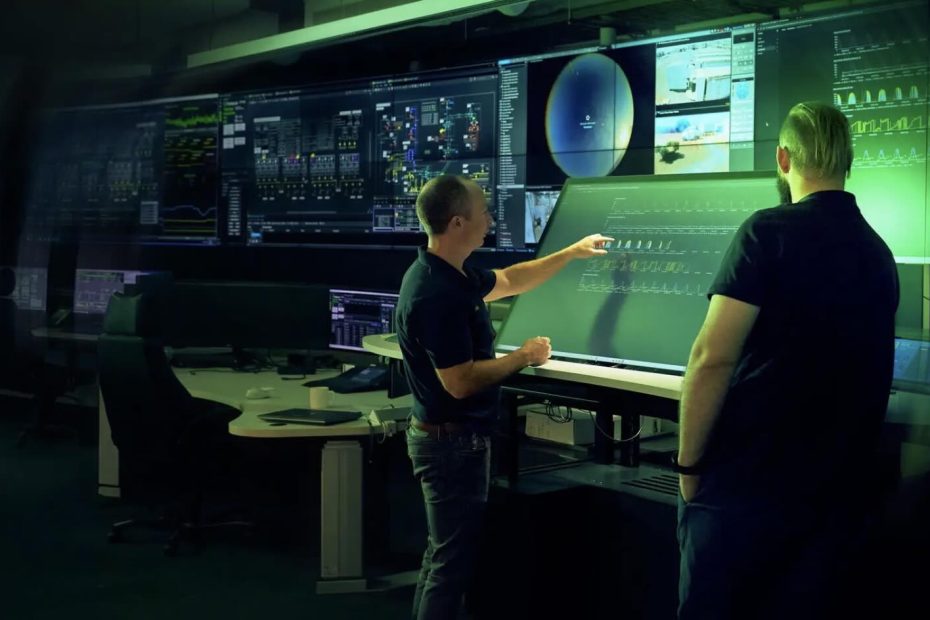
Iron ore miner Fortescue has hailed a “breakthrough moment” for its massive and growing green grid, when its inverter-based power technologies kept the lights on when bushfires caused a major transmission outage and removed all thermal generators from its network.
The incident happened on October 1 last year and was highlighted by CEO Andrew Forrest in a speech to the Smart Energy 2026 conference in Sydney this week. He saw it as validation and a significant milestone in his plans to reach real zero and eliminate fossil fuels on a permanent basis by 2030.
Renewable critics say such a plan is not possible, and that a grid cannot operate solely on wind, solar and batteries, even for short periods. But that is being proved wrong on a daily basis in suburban households, in off-grid communities and in remote mining operations.
The significance at Fortescue is that it is happening at a much bigger scale. The load being supported by solar and batteries in the incident in October – after the loss of all its thermal generation – was around 85 megawatts (MW). By 2030, the load being supported by its completed green grid will be 10 times bigger and up to 800 MW.
Fortescue’s head of operations and engineering, Glen Carrurthers, says the event has challenged decades of conventional thinking in power system engineering.
“For most of my 35-year career in power system engineering, I thought this was impossible,” Carruthers is quoted as saying. “It is a glimpse of the future and, bar the birth of my child, the most exciting thing I have ever witnessed.”
Executive Chairman of Fortescue Dr Andrew Forrest speaks to media during a press conference at the Smart Energy Council Conference and Exhibition, Sydney, Wednesday, May 6, 2026. (AAP Image/Bianca De Marchi) NO ARCHIVING
It’s not the only milestone highlighted by Forrest this week, who also noted that on December 27 last year solar had met all of the grid demand from its hematite plant, and that solar already averages 25 per cent of hematite processing needs and 22 per cent of all Fortescue’s electricity use in the Pilbara.
Fortescue says advanced inverter-based technologies are increasingly performing the system support functions traditionally delivered by fossil fuel-powered infrastructure.
This is important not just for Fortescue, but also has major implications for the wider grid. Battery storage technology companies such as Tesla and Fluence argue that “grid forming” inverters can provide all the system support functions of coal and gas, but the market operator and network companies are not yet convinced.
They are relying on installing giant spinning machines known as synchronous condensers, dozens and dozens of them around the grid at a cost of tens of billions of dollars, even though battery inverters can likely perform the same function at a fraction of the cost.
The issue is also being used as an excuse to delay the closure of the Eraring coal plant. The battery brigade argues that far fewer syncons are needed.
See: Australia’s transition from coal is being held hostage by its obsession with spinning machines
AEMO has planned to conduct a trial with such inverters with a load of around 100 MW on an isolated grid to try and validate the inverter technology claims, but Fortescue might have beaten them to it.
Fortescue says its Green Grid is the world’s first fully integrated industrial green energy system that is designed to eliminate fossil fuels from large-scale industry.
It says it is a fully standalone, islanded power system delivering stable, dispatchable renewable electricity across our operations. Renew Economy understands that its grid will include syncons, but the rating of these has not been revealed.
Screenshot
Fortescue is currently commissioning a 50 MW, 250MWh battery at North Star Junction and a 120MWh battery at Eliwana, and plans a total of 1.5 gigawatts of solar capacity, 800 MW of wind generation, and more than 5GWh of battery energy storage.
More than 400 MW of large scale solar at Turner River is already under construction, and the first unique “self-lifting” wind turbines at Nullagine are expected to arrive this year. Fortescue has also committed $950 million to a separate 200 MW “green grid” to supply third party customers such as data centres or green iron developments.
Fortescue says Artificial intelligence (AI) is also playing a critical role in managing its grid green, supporting real-time weather forecasting and grid responsiveness to changes in renewable generation.
“This event demonstrates that a large-scale industrial network can remain stable, resilient and operational using renewable energy systems alone – a milestone with benefits far beyond Fortescue’s operations,” the company said in a statement.
“As we continue building our Green Grid, we are proving that heavy industry can decarbonise without compromising reliability, stability or performance.”
If you would like to join more than 29,000 others and get the latest clean energy news delivered straight to your inbox, for free, please click here to subscribe to our free daily newsletter.
If you wish to support independent media, and accurate information, please consider making a one off donation or becoming a regular supporter of Renew Economy. Please click here. Your support is invaluable.
Giles Parkinson
Giles Parkinson is founder and editor-in-chief of Renew Economy, and founder and editor of its EV-focused sister site The Driven. He is the co-host of the weekly Energy Insiders Podcast. Giles has been a journalist for more than 40 years and is a former deputy editor of the Australian Financial Review. You can find him on LinkedIn and on Twitter.
Share this:
Facebook
X
LinkedIn
Reddit
Email
Print