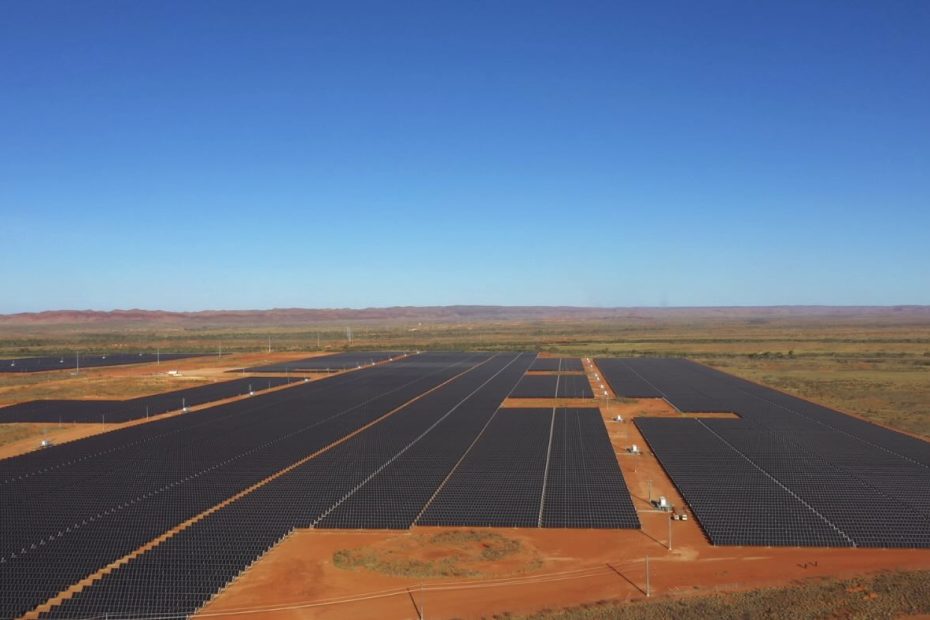
Fortescue Metals is moving full steam ahead on its Pilbara renewable energy plans, this week kicking off construction of Western Australia’s largest solar farm, at least for now, and just the latest piece in the iron ore giant’s ambitious decarbonisation puzzle.
Fortescue said on Monday it has started work on the 440 megawatt (MW) Solomon Airport solar farm which, once complete, will deliver around one-third of the total renewables capacity needed to meet “real zero,” the uncompromising target set by the company’s founder and executive chair, Andrew Forrest.
The Solomon Airport project adds to the 190 MW Cloudbreak solar farm, a project that is under construction – around two-thirds complete – in the Pilbara’s Chichester Range, and the nearby 133 MW Nullagine wind farm, on which construction is also underway.
Construction of a proposed 644 MW solar farm at Turner River is expected to get underway later this year, having secured federal environmental approval in January and applied for the state green tick last month.
And there is the 100 MW North Star solar farm, completed in 2024 on a former work site, that marked Fortescue’s first foray into large scale solar.
Once operational, Fortescue says the Solomon, Cloudbreak and Turner River projects – together with the existing 100MW North Star Junction solar farm – will deliver around 1.3 gigawatts (GW) of solar capacity.
“Across the Pilbara, we’re using the region’s sun and wind to generate green power for our sites,” says Fortescue chief Dino Otranto.
“We’re building the solar and wind farms, connecting them through our high-voltage transmission network and backing them with battery storage to provide 24/7 firm power.”
Through Pilbara Energy Connect, Fortescue has also installed more than 480 km of high-voltage transmission lines across the Pilbara – part of a renewable energy network that will extend to more than 620 km, once complete, linking the company’s energy assets to its operations and rail network.
Together, these projects represent one of the largest renewables deployments by any heavy industry company in Australia. Alongside the ongoing electrification of Fortescue’s heavy industrial machinery and transport, it’s an accomplishment that sets it apart from most others – and shows what can be done when the will is there.
“Importantly, each successive solar project is being delivered more efficiently than the last,” Otranto said on Monday.
“As technology improves and we gain scale, our installed capital intensity continues to come down – strengthening the economics of replacing diesel and gas with renewable energy.”
As Renew Economy reported last month, following a visit to Fortescue’s Pilbara operations, the cost of building solar is already minuscule for the company, at around $40 per megawatt, compared to diesel costs of between $120 and $300 a megawatt.
But the company continues to strive to get costs down even further, including through an Arena-backed trial of different robotic concepts across its solar portfolio.
“The real next step in our evolution is you automate that whole process. The automation of a pile driver already exists. Putting a tracker on is very easy to automate, and then the actual installation, the panel is dead simple to automate,” Otranto says.
“All we’d have to do is put that all together. We’ve been successful in automating massive trucks and running them 2000 kilometers away from the Pilbara. So automating a very simple installation like this would be a no brainer.”
If you would like to join more than 29,000 others and get the latest clean energy news delivered straight to your inbox, for free, please click here to subscribe to our free daily newsletter.
Sophie Vorrath
Sophie is editor of Renew Economy and editor of its sister site, One Step Off The Grid . She is the co-host of the Solar Insiders Podcast. Sophie has been writing about clean energy for more than a decade.
Share this:
Facebook
X
LinkedIn
Reddit
Email
Print