Renewable energy retailer Flow Power has sealed what is being hailed as a “foundational” offtake deal that is helping to lay the foundations for a new breed of solar and battery hybrids that will likely change the shape of large scale PV generation in Australia.
Melbourne-based Flow Power said on Monday that is has signed a small but significant power purchase agreement with Octopus Australia’s proposed Blind Creek solar farm and big battery, helping to bring the $900 million project to financial close as it begins construction in New South Wales.
The Blind Creek project, located around 30 km north-east of Canberra, will combine 300 megawatts (MW) of solar with a 243 MW, 486 megawatt-hour (MWh) co-located, and DC-coupled, battery energy storage system (BESS), making it one of the biggest and most advanced examples of the hybrid technology in Australia.
DC-coupled means the solar can charge the battery behind the meter without the loss of power through conversion from DC to AC. This enables storage of solar in the middle of the day, when prices are often low or even negative, and pushes it into the evening demand peaks, when prices are higher.
As Renew Economy has reported, the biggest DC-coupled solar battery hybrid currently operating in Australia is at Cunderdin, in Western Australia, which often injects a steady output of around 45 MW each evening until 9.30pm local time, well after the sun has set solar generation has finished for the day.
Octopus Australia just last week turned the first sod at the much bigger Blind Creek project, which it describes as a “bankable energy product” that will strengthen grid reliability in southern New South Wales and help the state’s coal stations retire.
Blind Creek marks the second DC-coupled solar battery hybrid built in Australia by Octopus, which also has been building the smaller Fulham facility in Victoria, is sized at 80 MW of solar and 64 MW, 128 MWh of battery storage.
Flow Power, meanwhile, was behind the first demonstration of utility-scale DC-coupled solar and storage in Australia, with the April 2023 launch of its small Berri project in South Australia that is helping banking giant Westpac meet its target of sourcing 100 per cent renewable electricity.
Last year, Flow added DC-coupled battery storage to its Cootamundra Solar Farm in New South Wales and this year, just last week, the renewables gentailer bought the shovel-ready Dunedoo Energy Project in regional NSW, with 55 MW solar and 60 MW BESS.
Flow says that while its offtake deal with Octopus is “quite small,” relative to the size of the Blind Creek project – it has contracted 40 MW of firmed generating capacity – it nonetheless has been “fundamental” to delivering financial close for the huge project.
“What we … love about working with partners is we can have what might be … a smaller off-take, similar to what we’re seeing here with Blind Creek, but it can still be fundamental to getting a very large project over the line,” Flow Power COO Byron Serjeantson told Renew Economy on Monday.
“So … you kind of imagine that our off-take, we can leverage it further by working with partners and and helping get big projects built, even if we’re only taking a small but foundational stake in them.”
Serjeantson says the deal with Octopus Australia is also “a really innovative” offtake product that, for a company whose bread and butter is retailing 100 per cent renewable energy, “really simplifies” access to these types of cutting edge projects.
“Its … innovation was in its simplicity,” Serjeantson tells Renew Economy. “We think that this is going to make it easy for businesses of all shapes and sizes [to contract firmed renewable energy].
“[They don’t] necessarily need to have a dedicated energy advisor or consultants to help them understand the how this product works. It’s really simple, and that’s where the beauty lies in it.”
And, of course, the economics of DC-coupled solar and storage is also a major drawcard for Flow, which has been a pioneer of coordinating cheap renewable power supply deals – starting back in 2017 with a “first-of-its-kind” PPA with Ararat wind farm in Victoria.
“We’re a really strong believer in the technology and the economics that [solar-battery hybrid] delivers,” says Serjeantson.
“We’ve been so pleased with how [our own early-stage] projects have been performing… and so that’s why we’re especially excited about what Octopus is doing here, taking that on a very large scale.
“When we look across the market at the various sources of energy generation, at the moment we see the economics of these solar-hybrid projects as being very strong, particularly compared to other types of generation,” he adds.
“[It’s] a really great solution for delivering renewables… when it’s needed and and especially having that storage to …bring down the peak price events in the evening is another big win for consumers.
“Because when you look at the the average market prices throughout the year, a lot of that cost is just driven by peak events in the evenings, which might not happen very often, but when they do happen, it’s very expensive for the for the energy system.
“The economics of [Blind Creek] is actually brilliant for anyone who is an energy user in New South Wales and looking to find a cheaper source of generation – not only cheaper, but obviously 100% renewables.
“Octopus has done a really fantastic job at creating a project of such significant scale and delivered with such efficiency that, yeah, it’s hard to beat. I think the economics of this, particularly when you put it next to other sources of generation.”
Not many details of the deal are being made public, with Octopus Australia describing terms including the length of the contract, the price for power and the precise amount of power contracted as “commercially sensitive.”
But Octopus Australia co-managing director Sonia Teitel says the key innovation of the contract is that the committed block of firmed clean power in the evening “super peak” is backed by the combination of solar stored in the behind-the-meter battery.
“Because the Blind Creek project is one of the first solar hybrids to market, globally this contract structure has never been realised before,” Teitel said in an email response to Renew Economy on Monday.
“This is the market creating projects and products that will replace coal. And I’m really proud that the Octopus Australia team is at the forefront of this.”
Octopus says Flow Power’s leadership in Australia – it started out retailing to businesses back in 2017 but now offers a residential renewables product that will be extended beyond Victoria this year – has made it a natural partner for Blind Creek and for the company’s broader business.
“From the outset, our teams have been aligned on building a cleaner energy future grounded in innovation and customer value,” Teitel said in a separate statement on Monday.
“Blind Creek is the kind of next generation project Australia’s market needs, and Flow Power’s foundational partnership is key to making that possible,” Teitel says.
“We’re thrilled to be working together to bring more scalable, future-ready renewable projects to market.”
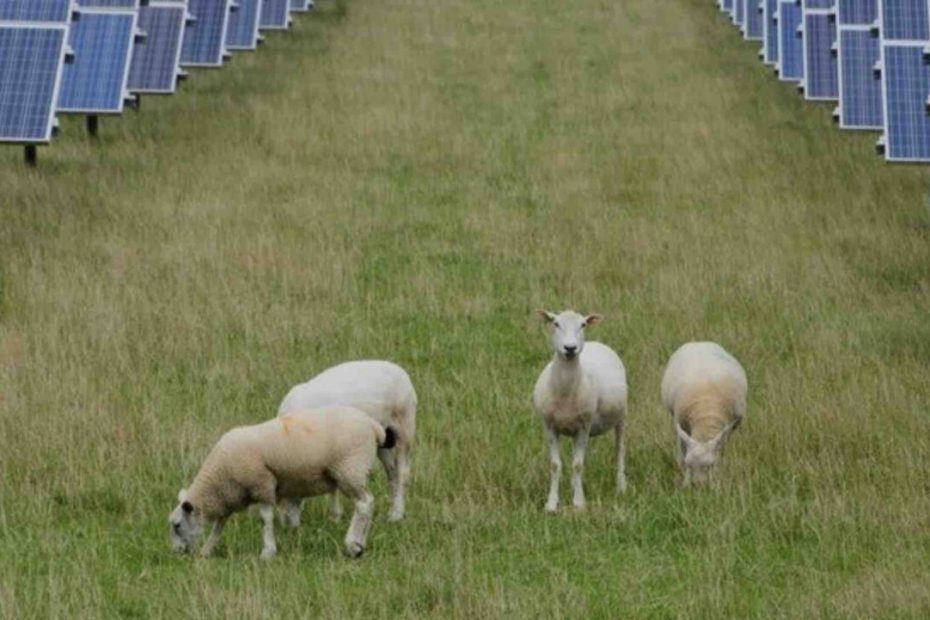
Octopus says Blind Creek is notable for a number of innovations in its development, including that it was initiated in partnership with local sheep farmers and has been designed to allow animal production to continue on the land – and to boost the land’s grazing capability.
It has also attracted financial backing from a range of big-hitting investors, including Australian super funds Hostplus and Rest, the federal government’s green bank the CEFC, Big-Four Australian bank Westpac and Dutch pension giant APG.
“This project shows what happens when global capital, Australian super and regional farming families align under stable government policy. You get real infrastructure, real clean electricity and real jobs,” Octopus Australia CEO Sam Reynolds said last week.
“Octopus Australia’s strategy is designed precisely for this, to align long term capital with regional communities and deliver bankable projects.”
Octopus Australia says the contract with Flow Power will kick in at the start of commercial operations. Practical completion of the Blind Creek project is expected in mid 2028.
If you would like to join more than 29,000 others and get the latest clean energy news delivered straight to your inbox, for free, please click here to subscribe to our free daily newsletter.
Sophie Vorrath
Sophie is editor of Renew Economy and editor of its sister site, One Step Off The Grid . She is the co-host of the Solar Insiders Podcast. Sophie has been writing about clean energy for more than a decade.
Share this:
Facebook
X
LinkedIn
Reddit
Email
Print