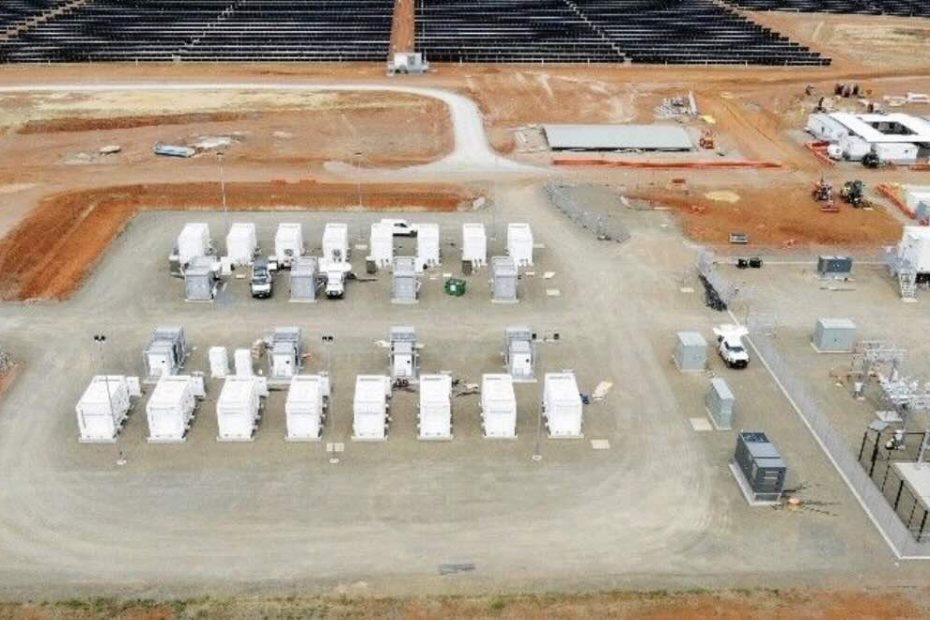
The big batteries have arrived on site at what is expected to the first true solar-battery hybrid project to joint Australia’s main grid, signalling another major step in the country’s green energy transition.
Potentia, the renewable and storage joint venture owned by Italy’s Enel Green Power and Japan’s Inpex, says 16 BYD battery units, each weighing around 27 tonnes, arrived at its Quorn Park project about 10 kms north-west of Parkes, in western NSW.
The $190 million Quorn Park facility will boast 98 megawatts (99MW) of solar and a 20MW /40 MWh Battery Energy Storage System (BESS) and, quite remarkably, will be the first true solar-battery hybrid in the main grid, known as the National Electricity Market.
Some solar farms have featured co-located battery projects – such as Gannawarra in Victoria, Tailem Bend in South Australia, Western Downs and Wandoan in Queensland, and Darlington in NSW.
But these solar and battery installations have separate connections to the grid, and usually separate operating profiles and different off-takers.
A solar-battery hybrid shares the same connection point, and as the country’s first such project at Cunderdin has demonstrated – can dodge negative prices and network curtailment by filling up the battery and discharging into the evening when demand and prices are higher.
See: The solar farm that winds down at dusk, charges up for dinner and is still generating at midnight
The Cunderdin project has been regularly injecting power from after sunset up until around midnight, and has on occasions continued to inject a small amount thought the evening.
Quorn Park won’t be the last because nearly 20 solar-hybrid projects – many of them at a much larger scale, have won underwriting agreements through the federal government’s Capacity Investment Scheme.
Potentia has its own much bigger solar hybrid project planned in NSW, the Tallawang project combing 500 MW of solar and 500 MW, 1,000 MWh of battery storage that has won one of those CIS deals and also has access rights in the Central West Orana renewable energy zone.
It is also developing solar hybrid projects at Narrandera in NSW and Mologa in Victoria, as well as a number of stand-along battery projects, including one that will be located next to its Bungala solar farms in South Australia, still the biggest in the state and subject to heavy curtailment.
The technology is popular because battery costs have fallen significantly, solar too to a lesser extent, and the technology is modular and more easily deployable and financeable than large wind projects, which have run into issues over social licence, rising costs and the need for increasingly expensive transmission.
The Quorn Park facility is expected to be registered and energised before the end of the year and then roll through its commissioning process before reaching full production in 2026.
Potentia says the BESS will play a critical role in strengthening local grid stability, storing excess solar generation, and ensuring clean, reliable energy is available when it’s needed most. It has a partial contract with retailer Zen Energy.
The project is being built by Beon Energy Solutions, using BYD battery technology.
For more information, please see Renew Economy’s Big Battery Storage Map of Australia
If you wish to support independent media, and accurate information, please consider making a one off donation or becoming a regular supporter of Renew Economy. Please click here. Your support is invaluable.
Giles Parkinson
Giles Parkinson is founder and editor-in-chief of Renew Economy, and founder and editor of its EV-focused sister site The Driven. He is the co-host of the weekly Energy Insiders Podcast. Giles has been a journalist for more than 40 years and is a former deputy editor of the Australian Financial Review. You can find him on LinkedIn and on Twitter.
Share this:
Facebook
X
LinkedIn
Reddit
Email
Print