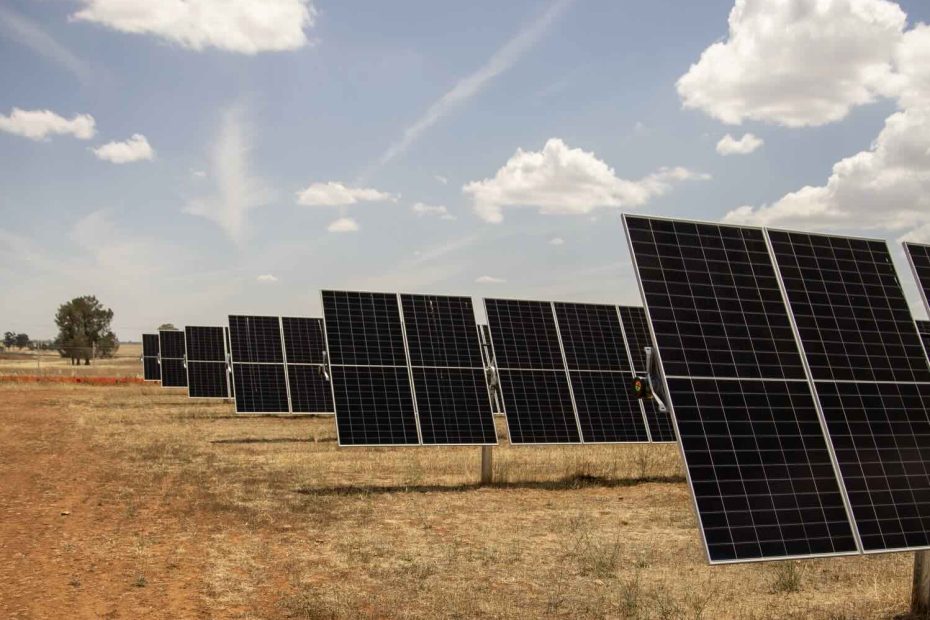
The first large scale solar-battery hybrid facility has started sending power into Australia’s main grid, including in the evening peak after the sun has set, heralding a radical change in the make-up and shape of the country’s electricity system.
The $192 million Quorn Park facility – near Parkes in western NSW – combines an 80 megawatt (MW) solar farm with a 20 MW, 40 megawatt hour (MWh) battery behind the same connection point.
This allows for the solar output to be stored rather than curtailed or sent out into an oversupplied market, and it can then be fed into the grid in the more lucrative evening and other demand peaks.
Quorn Park is only sending small amounts of power to the grid right now as it begins its commissioning process, expected to take several months. But it is the start of something big that is likely to fundamentally reshape the way power is produced and consumed in the grid in Australian.
Around two dozen solar-battery hybrid projects – some of them with more than 50 times the storage of the Quorn Park facility – have won underwriting agreements or other contracts, and are being built or are about to begin construction. Dozens more, some of them twice as big again, are hoping to follow.
See: Why solar battery hybrids are the new go-to technology for the green energy transition
The change is being driven by the plunging cost of battery storage, the surplus of low cost solar in the middle of the day, and the difficulties in getting wind projects over the line because of high costs and higher planning hurdles and social licence issues.
Potentia Energy, the owner of Quorn Park, is also about to start construction on the Tallawang solar battery hybrid in the central west of NSW, which will combine 500 MW of solar with a 500 MW, 1,000 MWh battery. It has other projects in mind.
Solar farms and battery projects have often been built side by side, but with separate connection points so they operate independently, which means they have to accept market prices for charging (in the case of the battery), and exporting (in the case of the solar and the battery).
The fact that they can now be accommodated behind the same meter is due to a lot of work changing Australia’s strict grid connection rules, and has presented as many complexities as the introduction of big batteries nearly a decade ago, and grid forming inverters in recent years.
And it seems that Quorn Park is still finding its way, as can be expected with a first of its kind project. As Watt Clarity identified, a “non compliance” notice was sent out by the Australian Energy Market Operator on Tuesday – not a major drama as it happens often enough with existing coal generators, but a bug to be ironed out.
On Thursday evening, Quron Park was injecting small amounts of power into the grid up to 8pm (grid time, or AEST) and is expected to be able to send power to the grid even later in the evening when fully commissioned, and if needed and the market signals are right.
The Cunderdin facility in Western Australia was actually the first true solar-battery hybrid in Australia (apart from remote off-grid mines), but W.A. is not part of the main grid.
Still, it is demonstrating each day how solar at its 100 MW solar farm can be stored rather than curtailed, and then sent into the grid after the evening dinner, when demand can be higher. It often continues to send power to the grid through the night, albeit at lower rates.
See: The solar farm that winds down at dusk, charges up for dinner and is still generating at midnight
That pattern is going to impact the generators that traditionally make their money out of the evening peaks, particularly coal and gas, as ITK principal and the co-host of Renew Economy’s Energy Insiders podcast, David Leitch, writes this week.
Quorn Park has 20 MW and 40 MWh of storage. Another 4,500 MW of solar capacity with 15,000 MWh of behind the meter battery storage won underwriting agreements through the last two generation tenders under the federal government’s Capacity Investment Scheme.
And there is more in the pipeline, with the NSW government announcing a review of the design of its scheme to ensure that solar-battery hybrids can be properly supported. It is not excluding wind, but policy makers and regulators now know that the solar-battery wins on price and ease of deployment.
The total impact of these solar-hybrid projects will be significant, not just on the business models of the remaining legacy thermal generation, but also on the ability of grid operators to allow these coal and gas generators to be closed down.
See Renew Economy’s Big Battery Storage Map of Australia for more information.
If you would like to join more than 29,000 others and get the latest clean energy news delivered straight to your inbox, for free, please click here to subscribe to our free daily newsletter.
Giles Parkinson
Giles Parkinson is founder and editor-in-chief of Renew Economy, and founder and editor of its EV-focused sister site The Driven. He is the co-host of the weekly Energy Insiders Podcast. Giles has been a journalist for more than 40 years and is a former deputy editor of the Australian Financial Review. You can find him on LinkedIn and on Twitter.
Share this:
Facebook
X
LinkedIn
Reddit
Email
Print