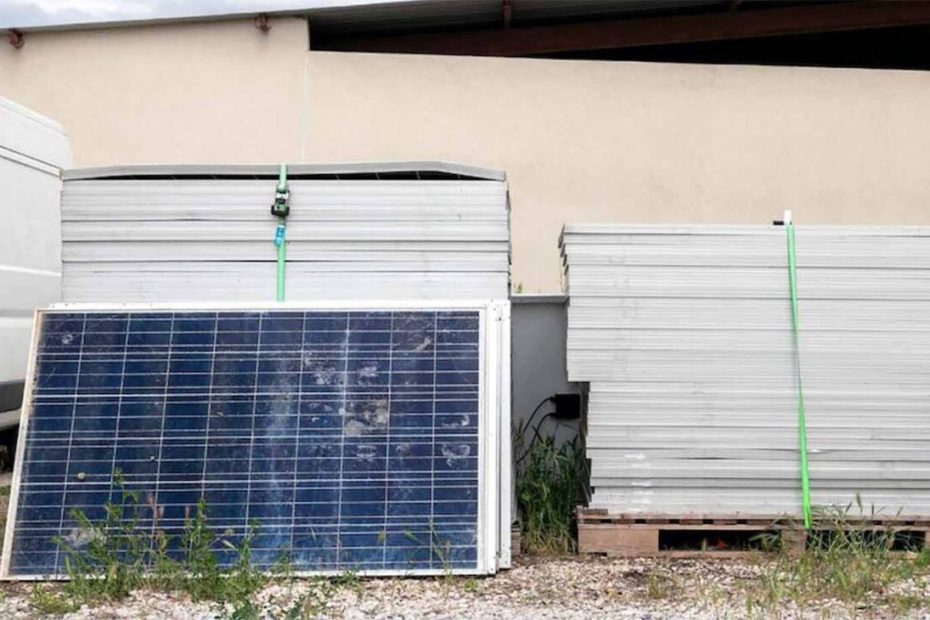
A recycling fee could solve more than just a future waste problem for the solar industry, as manufacturing innovations to get the price of panels down actually make it less viable to recycling in the future.
As panels modernise, the content of valuable metals such as copper and silver is decreasing in order to reduce the cost of the panels, which in turn reduces the value to recyclers, RMIT professor Xavier Mulet told the federal inquiry into solar recycling in August.
But not everyone agrees, and the boss of at least one recycler says the solution is to do what the government is already proposing: subsidise the $10-20 fee charged for collecting panels for recycling.
“My hands-on experience will actually show that we’re getting an increase in silver currently,” John Hill, the founder of Brisbane-based recycler Pan Pacific, told the inquiry this week.
“It’s almost back to where it was 20 years ago.”
The issue was uncovered by the federal inquiry into solar panel reuse and recycling, set up just weeks after the Albanese government announced its now-stalled $25 million pilot program that would establish up to 100 used panel collection sites across the country.
But whether it means more help from government, more research, or even if it is a problem at all depends entirely on who you talk to.
Australia’s solar panel recycling industry remains a work in progress, after the promised, and long fought for, pilot collection program stalled in May following a complaint about the process to choose a scheme administrator.
Since then, statements from the federal Department of Climate Change, Energy, Environment and Water (DCCEEW) have claimed the pilot is in the hands of the lawyers and it can do nothing.
And while less silver in a solar panel seems like a side issue from the very real distress of recycling businesses now trapped in a holding pattern, it’s actually another reason to get moving on a scheme soon, says one company boss.
“Those early panels also contain a lot more silver than today’s panels. As the efficiency of producing panels has got better out of China,” Simon Linge, head of materials recovery company LIvium, told the inquiry when it met in Melbourne in August.
“They’re using a lot less silver and it’s obviously driven by cost out.
“The economics for recycling that new generation of panels becomes even more challenged, and that’s why we always say there needs to be a fee up front to make the economics stand up.”
Lower amounts of high value materials such as copper and silver mean more panels will need to be recycled, and those materials sold on into competitive markets, to achieve the same level of profits, researchers from RMIT say.
Mulet – who is the director of RMIT’s Advanced Materials, Manufacturing and Fabrication Enabling Impact Forum – says the right number of panels to recycle in order to make money is changing as the make-up of modules changes.
He told the inquiry in August that their analysis into what it will take to get panels out of landfill and into a circular economy shows that silver and aluminium are the most valuable parts of a silicon-based panel, given there isn’t a market yet for high-grade recycled silicon in Australia.
While aluminium isn’t going anywhere, manufacturers have steadily reduced the amount of silver they use in a panel as prices have rocketed and supplies tightened.
“So that number as to what is the right percentage to recycle is changing depending on the age of the panels that you’re recuperating.
“If you’re able to recuperate more silver from an older panel, then you need to recycle a smaller percentage in order to be able to recuperate your investment.”
But the ever-optimistic Hill disagrees with the premise entirely.
In practice, it’s copper and aluminium that bring in the dollars for Pan Pacific, Hill told Renew Economy earlier this year, forecasting these to earn $1.1 million and $1.9 million respectively last financial year.
Furthermore, and if manufacturers add more copper, that is only a good thing for recyclers like his.
“There are companies out there that are still trying to go back to the full copper cell. I believe that they will probably achieve that with a blend of silver,” he said.
To join more than 29,000 others and get the latest clean energy news delivered straight to your inbox, for free, click here to subscribe to our free daily newsletter.
Rachel Williamson
Rachel Williamson is a science and business journalist, who focuses on climate change-related health and environmental issues.
Share this:
Facebook
X
LinkedIn
Reddit
Email
Print