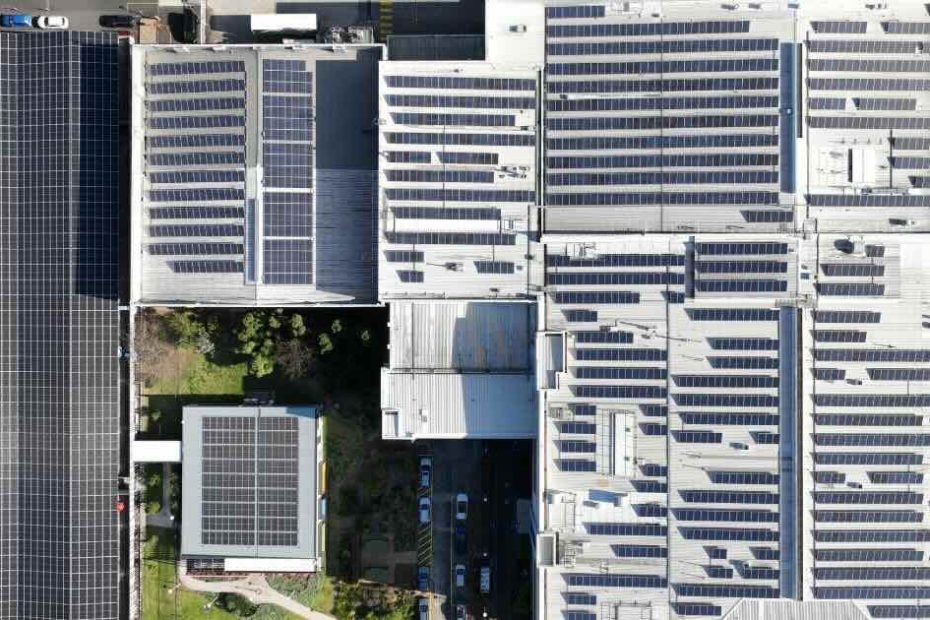
The federal rooftop solar rebate has officially expanded to include systems sized between 100 kilowatts and 1 megawatt, extending a roughly 20 per cent discount on the cost of PV installation to farms, factories, community organisations and all sorts of commercial and industrial businesses in-between.
Federal energy minister Chris Bowen said on Thursday that mid-scale solar systems “installed from today” are eligible for support under the the Small-scale Renewable Energy Scheme (SRES), where they meet scheme’s requirements.
The radical change to the SRES, which has been in place in one form or another since 2001 and capped at 100 kW as the SRES since 2011, comes into play less than two months after it was announced by Bowen.
The expansion – long campaigned for by industry and lobby groups – is designed to capture the “missing middle” of Australia’s rooftop solar potential, with an estimated 80 gigawatts (GW) of untapped capacity believed to exist on the nation’s factories, warehouses, farming sheds and large industrial premises.
“That’s an opportunity we should miss no longer,” Bowen said in August.
“This reform will reduce the upfront cost of installing a mid-scale solar system by around 20 per cent, making it easier for businesses and farmers to invest in cheaper, cleaner energy,” the minister said in a statement on Thursday.
“At a time when global energy markets remain volatile, more solar means lower exposure to international price shocks and greater energy security for Australian businesses.”
Bowen has said that a business could, under the expanded SRES, save about $68,000 on the installation cost of 250kW solar system, and a further $50,000 a year on reduced energy bills.
A 850kW system, big enough to support a factory or a large retail complex, could get an upfront discount of around $232,000.
“We’ve seen what rooftop solar can do for household bills. We want more businesses to get those benefits too, from farms and factories to shops and warehouses,” Bowen said on Thursday.
“Putting more solar on business rooftops means more Australian energy powering Australian industry, helping cut running costs and exposure to volatile fossil fuel prices.”
Staged start?
The Clean Energy Regulator, which oversees the SRES, says that while legislated amendments to the SRES apply to eligible mid-scale solar systems installed from 1 October 2026, applications for small-scale technology certificate (STC) for mid-scale systems will not open until mid to late November 2026.
“This allows time to implement the required systems and processes,” the CER website says. “Assessment of STC applications will begin after this time.”
The regulator has told Renew Economy that the period between installation and the opening of STC applications only affects when an application can be submitted and assessed; it does not affect eligibility for systems installed.
“While businesses will experience a small lag in receiving STCs and the associated financial incentive, eligible mid-scale solar systems will continue to receive the full benefit of the fixed five-year deeming period used to calculate STC allocations,” a CER spokesperson said in an emailed response.
“The fixed deeming period has been designed to provide industry with sufficient time to understand the eligibility requirements and prepare applications without any reduction in STC entitlement.
“Many systems in this size range would otherwise have participated in the Large-scale Renewable Energy Target (LRET), where certificate creation occurs progressively as electricity is generated,” the spokesperson says.
“By contrast, the STC framework provides access to 5 years of certificates upfront, meaning the short delay before applications open is expected to have only a minimal impact on participants.”
As it stands, the mid-scale SRES is expected to be a different beast to the small-scale SRES and Cheaper Home Batteries. That’s because the larger a rooftop solar project gets, the longer it takes to deliver – and the more regulatory and network standards that need to be met.
It’s also because there aren’t as many companies around that specialise in C&I solar projects.
Smart Commercial Energy, one of Australia’s leading C&I companies based in New South Wales, says that solar projects up around the one megawatt mark can take around six months to complete, including in the early planning stages.
“You don’t go out next week and stick a megawatt of solar on a roof,” Smart Commercial Energy chief sales officer Jon Vlatko told Renew Economy in August.
“It takes a long time. There’s [company] boards involved. There are multiple stakeholders; decentralised decision making across multiple offices, sometimes even internationally. And then there’s often early works agreements and switchboard upgrades and structural roof upgrades and all sorts of things.”
And then there are the complexities and delays that arise on the side of the distribution network service providers (DNSPs), who have their own sets of processes and standards to navigate to connect larger rooftop systems to the grid.
To this end, Bowen says his department is preparing a rule change request for the Australian Energy Market Commission aimed at making it easier for businesses to connect larger solar systems to the electricity network.
The CER also notes that solar systems between 100 kW to 1 MW will be able to choose between applying for the upfront financial benefit under the SRES through STCs, and participating in the Renewable Electricity Guarantee of Origin (REGO) and gaining REGO certificates.
“Participants should carefully consider which scheme best suits their circumstances before applying, as certificate eligibility under one scheme may affect eligibility under another,” the regulator says.
“For example, if you choose to apply for STCs for your mid-scale solar system, you will not be able to create REGO certificates for the deeming period.”
The CER says it encourages industry to read the transitional guidance when making, installing and designing mid-scale solar PV systems to ensure all eligibility and evidentiary requirements are met.
“Mid-scale solar is an extension of the existing SRES. Existing SRES eligibility requirements, processes and guidance continue to apply unless otherwise specified in the regulations.”
If you would like to join more than 29,000 others and get the latest clean energy news delivered straight to your inbox, for free, you can click here to subscribe to our free daily newsletter.
If you wish to support independent media, and accurate information, please consider making a one off donation or becoming a regular supporter of Renew Economy. Please click here. Your support is invaluable.
Sophie Vorrath
Sophie is editor of Renew Economy and editor of its sister site, One Step Off The Grid . She is the co-host of the Solar Insiders Podcast. Sophie has been writing about clean energy for more than a decade.
Share this:
Facebook
X
LinkedIn
Reddit
Email
Print