Widespread uptake of consumer energy resources will be key to meeting Australia’s decarbonisation goals, but how can we ensure this energy revolution leaves no one behind?
By 2030, Australia needs to reduce its carbon emissions to 43 per cent below 2005 levels, and by 2035, we need to cut those even further to 63–70 per cent. Currently, we’re sitting at 29 per cent, and the Federal Government has said that while these targets are ambitious, they’re very much achievable – and the weight of this challenge has fallen squarely on the energy sector’s shoulders.
Along with the announcement of the targets, the Federal Government shared a roadmap for how we’re going to achieve them. The very first priority in its Net Zero Plan is decarbonising the energy system, followed by increasing household and industrial electrification. This not only means that in five years Australia needs to take renewable energy from 40 per cent of total generation, to 83 per cent, but as we electrify, the grid also needs to be able to support this new demand.
According to the Net Zero Plan, Australia’s pathway to net zero emissions by 2050 involves a rapid deployment of firmed large scale clean electricity generation and transmission, but it also hinges on the installation of well-integrated consumer energy resources (CER). As Australia moves towards a decarbonised future, rooftop solar and household batteries will be essential to not only replace the capacity of retiring coal-fired power stations, but in empowering consumers to take ownership of their energy.
However, it’s also vital that the benefits of the future energy system are shared equally between all consumers, and the team at Fronius Australia said there’s much to be done, but they’re ready to play their part.
Power to the people
According to the Australian Energy Market Operator (AEMO), total installed rooftop solar and other distributed solar capacity in the National Electricity Market (NEM) is required to reach more than 36GW by 2029–30 under its 2024 Integrated System Plan (ISP) Step Change Scenario – which projects that rooftop and other distributed solar could contribute more than 20 per cent of total annual generation in the NEM.
Integrating CER into the electricity system is also an opportunity to support a cost-effective and faster energy transition, system reliability, and lower energy bills for all consumers. In its Net Zero Plan, the Federal Government pledges to continue to drive investment in CER to reduce pressure on the grid, but what exactly is required to do that?
To date, around 8.5 per cent of all renewable energy generated in Australian households is powered by Fronius inverters, which means a lot of homes are already relying on Fronius technology to capture and manage their energy, often without even realising it.
This gives the team a unique perspective on how the residential sector is evolving, and what the next stage of self-sufficiency could look like for households, and together with its customers, partners and society, Fronius is supporting households to take control of their energy future.
Running the numbers
Collectively, rooftop solar is now the second largest source of renewable electricity generation in Australia. It equates to 25GW of installed capacity and accounted for 31 per cent of all renewable energy generated across the country in 2024. That year, an estimated 3.2GW of new rooftop solar PV capacity was installed across Australia, 17 with small-scale solar contributing 32.5TWh, or 11.5 per cent, of total national electricity generation (an annual increase of 16 per cent). However, only a third of those installations during 2024 had a home battery attached.
According to the Clean Energy Council, solar saves an average family $1500 on their annual bill, and this almost doubles if you add a battery. But for everyone to reap the benefits there’s a big gap that needs to be addressed.
According to the Australian Bureau of Statistics (July 2025), there are approximately 11 million households in Australia, of those, four million already have a solar system installed – but at the end of December 2024 just 4.5 per cent had an accompanying home battery.
There are currently more than 400,000 Fronius inverters installed in Australia, totalling 3.2GW capacity. Of these, 56,000 are GEN24 inverters. With the UP.storage software upgrade, a GEN24 becomes a GEN24 Plus hybrid inverter, so customers can add a battery and, if required, enable full backup. This software path gives customers genuine flexibility in how they design their solar system. They can start with solar only, and if they decide to add a battery later, it’s as simple as a software update. Because their systems are battery ready from day one, it’s not only more cost-effective to upgrade later but it’s more sustainable too. In October 2025, Fronius also launched its own battery and now offers Australians a full ecosystem to support their electrification goals.
However, there’s more that needs to be done to ensure that no-one is left out of this renewable future.
Energy for everyone
Data from Energy Consumers Australia (ECA) reports that around one-in-five households are vulnerable to, or experiencing, energy hardship – and most of them have very high energy bill. These vulnerable families have the most to gain from the savings provided by CER, but they’re also the most prohibited by the upfront cost of installation. Similarly, Australians who rent, or live in apartments don’t have the same capacity to install a solar system as those who own their own home.
To tackle this issue, the Federal Government’s Cheaper Home Batteries Program has helped Australian households install almost 30,000 batteries. Since the program commenced on 1 July 2025, and even before the Reserva battery was launched, Fronius has seen strong uptake of its products linked to this rebate, including more than 1000 GEN24 to GEN24 Plus upgrades.
The Federal Government is also working with states and territories to provide financial support, including through the $100 million Community Solar Banks program, to provide shared solar for those who can’t install their own systems. These incentives are a lifeline for vulnerable Australians, however, in order to be eligible for this support, consumers need to ensure they’re choosing battery systems, inverters and components listed on the Clean Energy Council (CEC) approved product list, and some grants also require the system to demonstrate a payback period for the system and installation cost within a certain timeframe.
Implementing a solar battery system is a major investment and consumers also need to be confident that their new solutions will stand the test of time and can support their needs as technology evolves.
Fronius’ 24 Hours of Sun vision and its experience in both technology and installer training give it unique insight into how residential self-sufficiency can be realised, and it’s the company’s goal to show Australia what’s possible if households are empowered with the right tools, knowledge, and support. These principles are at the heart of Fronius’ Energy Ecosystem, which is designed to offer households a complete, future-proof solution for clean energy, and give customers the confidence that they’re installing a system that works the way they need it to.
At its core are Fronius inverters, which can be upgraded from solar only to battery-ready with a simple software update.
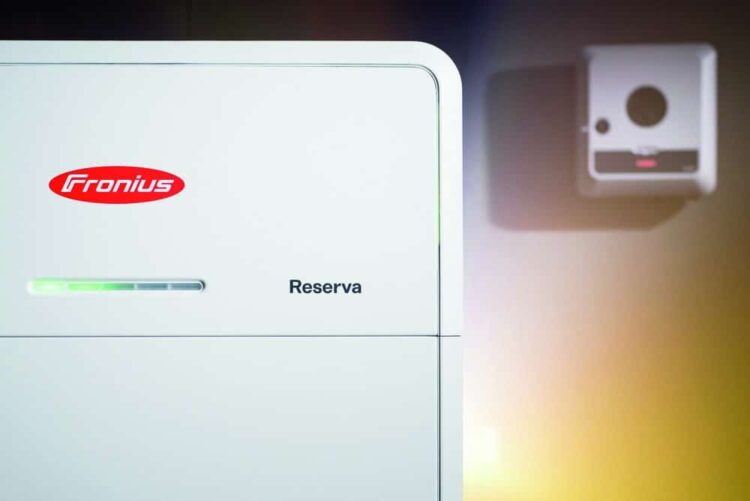
The new Fronius Reserva Battery stores excess energy for later use, while Ohmpilot directs surplus solar into hot water, and Wattpilot smartly charges electric vehicles.
To truly empower customers to take control of their energy usage, the Fronius Smart Meter tracks energy flows in real-time, which Solar.web makes it easy to monitor and optimise performance. For added energy security, Fronius also offers blackout protection solutions that work with additional components to keep the power on when the grid goes down.
Fronius’ goal is simple: to the next generation with a world worth living in. For that we need a sustainable energy supply, and Fronius is standing ready to help every Australian to get started on this path and to contribute their part.
For more information, visit fronius.com/en-au/australia. Visit Fronius at stand HH113 at All Energy next week.