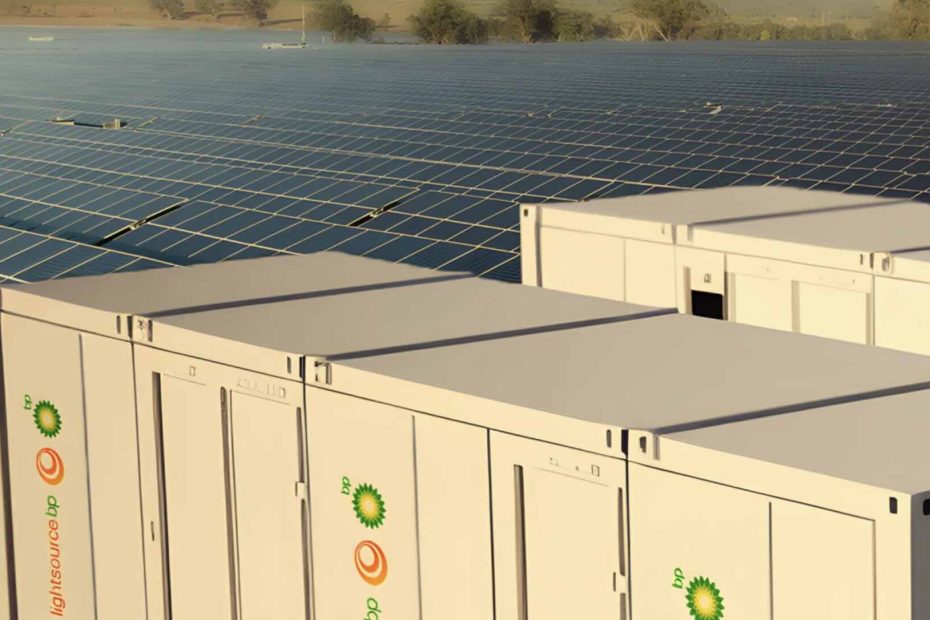
The head of Lightsource bp in Australia has hailed a “new phase” in the global power sector after announcing the start of construction of a major new solar and battery hybrid project that will help power one of the country’s biggest energy consumers.
The Lower Wonga hybrid project near Gympie in Queensland combines 380 megawatts (MWdc) of solar and 281 MW and 843 megawatt hours (MWh) of battery storage, making it one of the largest solar-battery hybrids in the country.
Lightsource has already begun construction of one of the first solar-battery hybrids, the 49 MW/562 MWh, long-duration DC-coupled battery energy storage system that will integrate with its 585 MWdc Goulburn River solar farm near Merriwa, New South Wales.
But the significant of Lower Wonga, along with the 600 MW (720 MWdc) and 2,400 MWh Smoky Creek and Guthrie’s Gap solar and battery hybrids currently being built by Edify Energy – is their ability to power giant energy users.
They will supply Rio Tinto’s giant Boyne Island smelter and associated refineries in Gladstone – and Lightsource bp says it represents a blueprint for the way industrial users think about energy.
“The global power sector is entering a new phase,” says Adam Pegg, the chief operating officer for Asia-Pacific at Lightsource bp said.
“It’s no longer just about building renewable generation – it’s about how solar and storage are now the lowest-cost sources of energy, to support growing demand from data centres, industry, and the electrification of transportation.
“Lower Wonga reflects that shift. Solar provides the lowest-cost scalable electricity, while battery storage allows that energy to be shifted to periods of higher demand, strengthening flexibility and reliability across the grid.
“Combining solar generation with storage strengthens the energy security value of renewable energy, enabling customers to benefit from long‑term, predictable energy costs over the life of the project.”
The deal with Rio Tinto was announced in March at the same time as a $2 billion package from the state and federal governments to help the mining giant transition away from its ageing Gladstone coal fired power station – to be shut down in 2029 – to a mix of renewables and firm power.
Rio Tinto, which is spending on $7.2 billion transitioning the Gladstone facilities from coal to green power, is to take 40 per cent of the output of Lower Wonga.
It has also signed off-take deals with the neighbouring Smoky Creek and Guthrie’s Gap solar-battery hybrids, and two other projects that have yet to begin construction, the 1.4 GW Bungaban wind project (with battery storage), and the 1.1 GW Upper Calliope solar farm.
The decision by Rio Tinto to power its smelters and refineries with renewables – in its eyes the only choice it could make – is significant given the political divide over energy choices, and the insistence by Australia’s loose coalition of far right political parties – One Nation, the Nationals and the Liberals – that it should continue to burn coal.
Rio Tinto says the future of the Gladstone smelter, which directly employs around 1,000 people in the region and is Queensland’s biggest single energy user, has been on “thin ice” for years, according to Rio Tinto, as it struggled to remain economically competitive in a decarbonising global market.
The 1,680 megawatt (MW) coal-fired power station that currently supplies the smelter – and which began operations in 1976 – is slated to close in 2029, at the same time as the current lot of power contracts for Rio’s Boyne smelter and Yarwun and Queensland alumina refineries expire.
It is now clear that mining companies are the driving force behind new renewable projects in Australia, given that Fortescue is well on its way to delivering several gigawatts of large scale wind, solar and battery storage as part of its plans to reach “real zero”, and burn no fossil fuels, at its giant iron ore operations in the Pilbara.
Data centres could also emerge as another key source of demand from new projects, with US-giant Iren announcing this week that it will build an 800 MW facility – by far the country’s largest – in South Australia because it will have reached its target of 100 per cent “net” renewables by that time.
It is also expected to sign PPA’s with wind and solar projects, part of the expectation from state and federal governments that data centres “bring their own clean energy”, and do not end up becoming a lifeline for coal and gas fired power stations.
Lightsource bp describes Lower Wonga as “one of the most significant hybrid renewable energy developments” in its global portfolio. It says it will support delivery of lower-cost electricity while helping the system respond more effectively to changing demand patterns.
The project has also secured support under the Australian Government’s Capacity Investment Scheme (CIS), which essentially eliminates downside risk, making it easier for project developers to obtain finance and offer competitively prices deals with customers.
A joint venture between Intel Energy Solutions and Gotion Hi-Tech Australia has been appointed as the engineering, procurement and construction partner to deliver the project, bringing a strong track record of delivering utility-scale renewable energy infrastructure.
Lightsource bp says the project is expected to support around 400-500 jobs, alongside opportunities for local businesses, contractors, and suppliers. It is expected to be operational in late 2028.
If you would like to join more than 29,000 others and get the latest clean energy news delivered straight to your inbox, for free, please click here to subscribe to our free daily newsletter.
If you wish to support independent media, and accurate information, please consider making a one off donation or becoming a regular supporter of Renew Economy. Please click here. Your support is invaluable.
Giles Parkinson
Giles Parkinson is founder and editor-in-chief of Renew Economy, and founder and editor of its EV-focused sister site The Driven. He is the co-host of the weekly Energy Insiders Podcast. Giles has been a journalist for more than 40 years and is a former deputy editor of the Australian Financial Review. You can find him on LinkedIn and on Twitter.
Share this:
Facebook
X
LinkedIn
Reddit
Email
Print