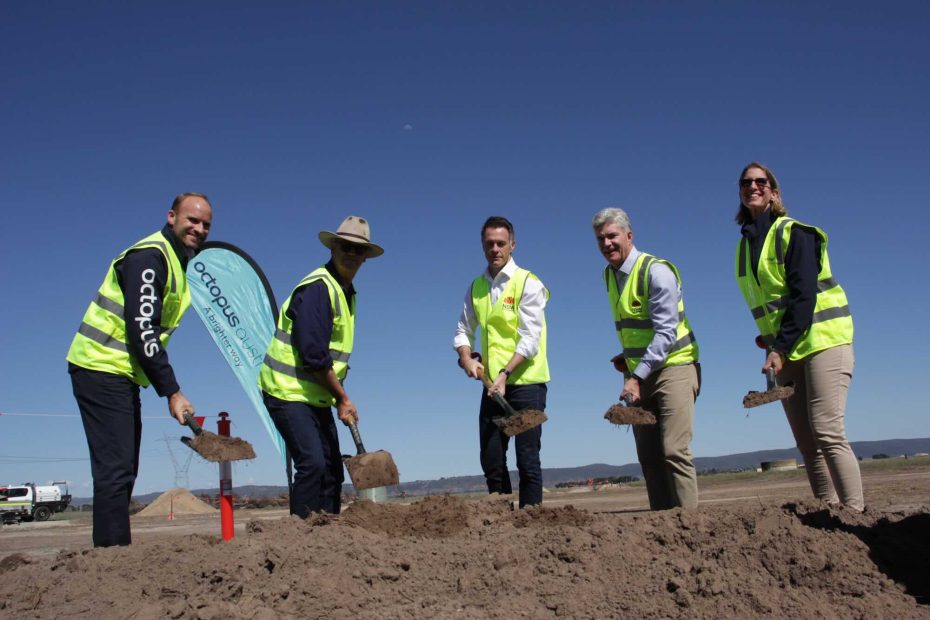
The first sod has been turned at what will be one of the biggest DC-coupled solar battery hybrid projects to be developed in Australia – a project that is expected to push PV power well into the evening demand peaks, changing the shape of solar’s generation profile.
Octopus Australia’s Blind Creek project, located around 30 km north-east of Canberra, will combine 300 megawatts (MW) of solar with a 243 MW, 486 megawatt-hour (MWh) co-located, and DC-coupled, battery energy storage system (BESS).
News of the milestone for the $900 million project was shared on Tuesday by the New South Wales government, with the state premier Chris Minns joining Octopus Australia, and picking up a shovel, to officially mark the start of construction.
Described by Octopus Australia as a “bankable energy product” that will strengthen grid reliability and help the state’s coal stations retire, BLind Creek will connect via a new substation into the transmission backbone between Sydney and Canberra.
Construction of the solar-battery hybrid will support up to 300 full-time equivalent jobs at its peak, with around half of the required workers expected to be sourced from the local Bungendore and Monaro regions.
“The Blind Creek project is creating local jobs, and it will help deliver the replacement energy that households and businesses rely on,” premier Minns said on Tuesday.
“This is the kind of project New South Wales needs as we replace ageing energy infrastructure. We need to keep the lights on, keep costs as low as possible, and to keep regional communities with us along the way.”
Octopus Australia says Blind Creek was initiated in partnership with local sheep farmers, and has been designed to allow animal production to continue on the land – and to boost the land’s grazing capability.
Investment in the project has come from Australian super funds Hostplus and Rest, the federal government’s green bank the CEFC, as well as Big-Four Australian bank Westpac and Dutch pension giant APG.
“This project shows what happens when global capital, Australian super and regional farming families align under stable government policy. You get real infrastructure, real clean electricity and real jobs,” Reynolds said on Tuesday.
“Octopus Australia’s strategy is designed precisely for this, to align long term capital with regional communities and deliver bankable projects.”
Blind Creek marks the second DC-coupled solar battery hybrid built in Australia by Octopus, which has been building the smaller Fulham facility in Victoria, is sized at 80 MW of solar and 64 MW, 128 MWh of battery storage.
Octopus says the $850 million Blind Creek project will have the capacity to provide power to the equivalent of 120,000 homes.
“This innovative (DC-coupled) configuration allows solar energy generated during the day to be stored in the batteries when energy prices are low, and dispatched in the evening peaks when demand and pricing is high,” the company said in a statement last year.
“This allows the delivery of more valuable electricity to the market and maximises returns for investors.”
If you would like to join more than 29,000 others and get the latest clean energy news delivered straight to your inbox, for free, please click here to subscribe to our free daily newsletter.
Sophie Vorrath
Sophie is editor of Renew Economy and editor of its sister site, One Step Off The Grid . She is the co-host of the Solar Insiders Podcast. Sophie has been writing about clean energy for more than a decade.
Share this:
Facebook
X
LinkedIn
Reddit
Email
Print