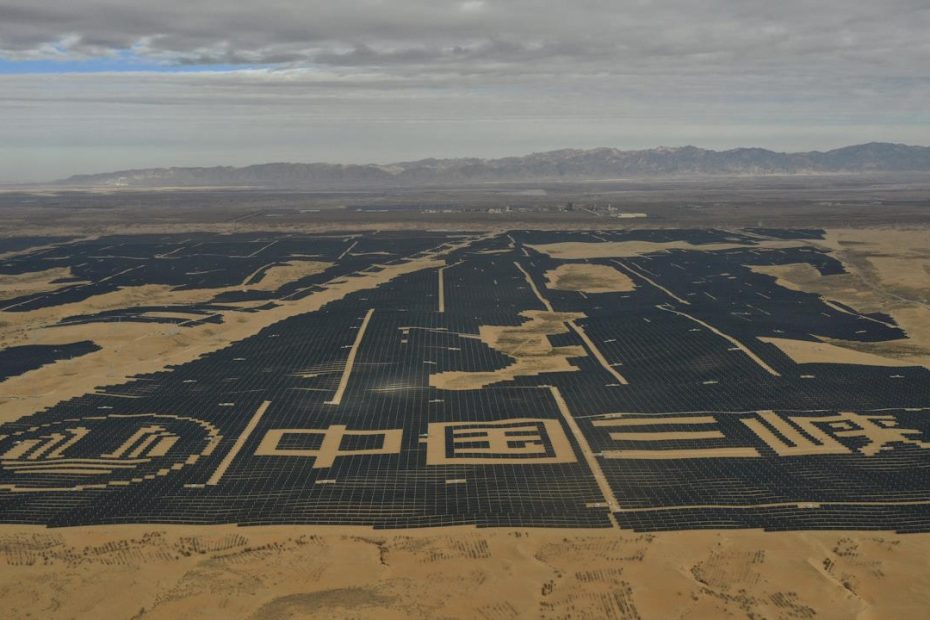
China’s efforts to cover its deserts with solar panels are creating a cool refuge that is allowing plants to grow in previously inhospitable locations, according to a new study out of the Chinese Academy of Sciences in Lanzhou.
The study, published in the Ecological Indicators journal, shows that a cool island effect depends on how the solar farm is designed, the climate it’s in, and the season.
Solar panels have been shown to create heat islands in more vegetated or humid locations, where land surface temperatures are usually lower than in deserts and the landscape has more things in it.
But in China’s Gobi desert, a landscape of sand, gravel, sparse grasses and rehabilitated lands, the uniformity of the terrain combined with the very high average land surface temperature means solar panels can cool the land under and around a project.
The study used satellite images capturing land surface temperatures from 2022 to figure out the scale of daytime cooling at eight solar farms mainly in Xinjiang, Inner Mongolia, Gansu, and Qinghai.
It found the highest daytime cooling effect of 3.1ºC at a farm near Wuzhong City in Ningxia province and the lowest of 0.2ºC at a project near Hongshagang Town in Gansu, and the solar farms were better at creating a cool island effect in summer.
China is aiming to build 455 gigawatts (GW) of solar in the Gobi desert and other desertified regions by 2030.
The projects are one part of the state’s decades-long “war on sand” as it tries to stop creeping desertification and worsening dust storms with vegetation and afforestation programs.
Desert greening
The cool island effect extended to between 120 m and 540 m on average around a solar farm.
Previous research cited in this study show Dune-esque “desert greening effect” from solar farms, as lower evaporation and higher humidity and soil moisture change microclimates enough to encourage plants to grow.
This effect extends out past the bounds of desert solar farms into the surrounding area to create a “refuge effect” – but not much is known yet about this phenomenon.
If solar farms in more lush regions cause a slight heat island – when measured using ambient air temperatures – as higher rainfall and denser plant life lower surface temperatures, then covering desertscapes with a roof which absorbs radiation does the opposite, the paper’s authors say.
The biggest cause of a cool island effect was putting things in the desert to add texture to the landscape.
“Previous research has suggested that the regularly shaped bodies of water or green spaces, such as circular or square, promote more uniform evaporation and air circulation than irregularly shaped water bodies or green spaces,” the paper says.
“[This is] likely because regular shapes reduce airflow resistance, enabling air to flow smoothly over the landscape surface, thereby enhancing evaporation and transpiration and providing a superiorly stable cooling effect.”
Adding solar panels to a flat desert-scape created “energy exchange corridors” that reduced the amount of radiation the gravel or sand had to absorb and added shade.
This in turn allows more vegetation to grow.
“In relatively dry and hot areas, the cool island effect can function as a restoration tool, establishing a ‘local ecological refuge’ to enhance carbon sinks in arid regions,” the paper says.
“To optimise cool island effect, it is advisable to prioritise increasing shape complexity, sustaining a certain number of patches, and augmenting shape indices while also avoiding regular geometric layouts.
“Regarding scale, it is recommended to control the area of individual units by utilising a decentralised cluster approach instead of a super-large-scale power plant. In alpine regions, regulating the distance between panels and optimising tilt angle can alleviate negative impacts of the CIE on vegetation.”
If you would like to join more than 29,000 others and get the latest clean energy news delivered straight to your inbox, for free, please click here to subscribe to our free daily newsletter.
If you wish to support independent media, and accurate information, please consider making a one off donation or becoming a regular supporter of Renew Economy. Please click here. Your support is invaluable.
Rachel Williamson
Rachel Williamson is a science and business journalist, who focuses on climate change-related health and environmental issues.
Share this:
Facebook
X
LinkedIn
Reddit
Email
Print