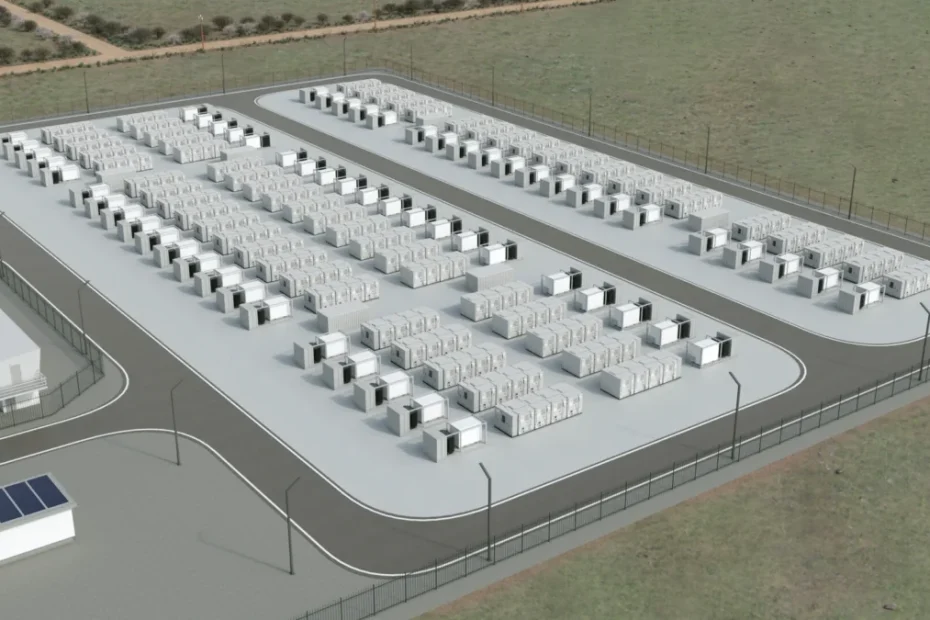
An offshoot of global fund management giant Carlyle Group has dropped plans for a major solar farm in Australia’s most advanced renewable state, and decided instead to at least double the size of what will now be a standalone battery.
The UK-based Revera Energy, controlled by Carlyle, has planed to build a 500 megawatt solar farm near Robertstown, near the start (or end point) of the new transmission link from NSW, Project EnergyConnect.
However, in a submission to the federal government’s EPBC process, Revera says it sees no point in developing a new solar farm in South Australia at the moment, and wants instead to focus on a 500 MW, 2,000 MWh battery at the same site.
“Solar farms are not currently assessed as economically viable in South Australia,” the company writes in its submission.
“No further development to the (up to) 500 MW photovoltaic solar farm is therefore underway. Revera will continue to monitor key valuation parameters, with a view to reassess developing the (up to) 500 MW photovoltaic solar farm stage if material improvements arise.”
The decision is not a surprise, given that South Australia is already at an average share of 75 per cent wind and solar, and aims to reach 100 per cent “net” renewables by the end of next year. The “net” means that it will import and export as needed.
More importantly, South Australia also has the world’s highest penetration of rooftop solar, regularly accounting for up to 100 per cent of state electricity demand, and sometimes more. The surplus means that the state’s few operating solar farms are often forced to turn off because of negative prices.
Solar-battery hybrids are often seen as a cure to this, allowing the solar output to be stored behind the same connection point, and then sent into the grid at the more profitable evening peaks.
But it seems Revera wanted to operate the solar and battery projects as separate facilities, meaning those behind the metre advantages are not captured.
Revera has taken a similar approach to its Bungama facility, near Port Pirie and also in South Australia, (see image above) where it has forged ahead with the first 150 MW, 300 MWh state of a big battery, but has not yet pushed forward on a planned adjoining solar farm.
The Robertstown solar and battery project obtained planning approval back in 2018, although this was modified in 2023 with a bigger battery, presumably as battery storage costs fell and the market opportunities improved.
Now Revera says only the standalone battery is considered an “economically viable project”, and it plans to build it in two stages, both rated at 250 MW and 1,000 MWh. It will connect into the Robertstown substation via an underground transmission link.
Solar and battery hybrids have become a prominent part of the landscape of the Australian electricity grid, with nearly two dozen projects in development, even though only one is operating at large scale, and the first in the NEM (Quorn Park) is still in commissioning.
South Australia secured one solar-battery hybrid project in the recent Capacity Investment Scheme auctions, but – unlike other states – most of its successful projects have been wind.
And three of these four projects – Neoen’s 300 MW Goyder North, Tilt Renewables 274 MW Palmer wind, and Aula’s 247 MW Carmody Hill – have landed power purchase agreements and are now under construction or poised to start.
Revera has other large scale renewable projects in the pipeline in South Australia, including the Yoorndoo Ilga solar (300 MW) and battery (250 MW, 1,000 MWh) project, and the Cape Hardy green hydrogen project on the Eyre Peninsula that will initially combine wind, solar and battery storage, as well as an up to 50 MW electrolyser.
If you would like to join more than 29,000 others and get the latest clean energy news delivered straight to your inbox, for free, please click here to subscribe to our free daily newsletter.
If you wish to support independent media, and accurate information, please consider making a one off donation or becoming a regular supporter of Renew Economy. Please click here. Your support is invaluable.
Giles Parkinson
Giles Parkinson is founder and editor-in-chief of Renew Economy, and founder and editor of its EV-focused sister site The Driven. He is the co-host of the weekly Energy Insiders Podcast. Giles has been a journalist for more than 40 years and is a former deputy editor of the Australian Financial Review. You can find him on LinkedIn and on Twitter.
Share this:
Facebook
X
LinkedIn
Reddit
Email
Print