If ever you see a document published by the Australian Energy Market Operator that includes the words “load shedding”, you don’t need a vidid imagination to know what comes next.
It’s the same nearly every year with AEMO’s annual Electricity Statement of Opportunities, its 10-year demand and supply forecasts, and it was the same this week with the release of another important document, its Transition Plan for System Security, on how to keep the lights on as the grid switches to renewables,.
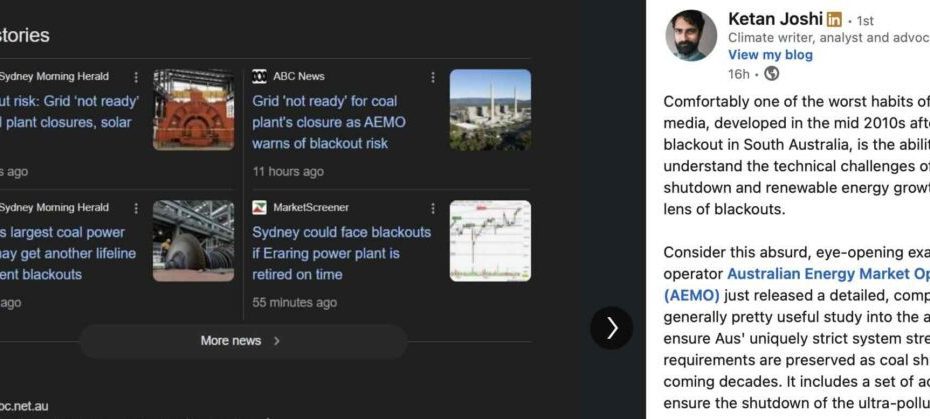
“AEMO warns of NSW blackouts if Eraring closes in 2027, trumpeted the AFR on Monday, Blackout risk: Grid ‘not ready’ for coal plant closures, solar surge, headlined the SMH.
And it wasn’t hard to predict what would follow, with the Coalition piling in to say this proves the transition to renewable is not possible, and coal should be kept online for longer, or even for ever.
Labor’s botched energy policy ‘unacceptable’, says Ley, as AEMO boss warns of blackouts, said The Australian, and Bowen has ‘egg on face’ after AEMO warning, Tehan says, headlined Sky News.
As Ketan Joshi noted in a LinkedIn post (screenshot above) this is not exactly what the market operator was saying in its detailed 160-page report on some of the key technical details of the transition.
It’s not the technology transition that is in question, it’s about the timing of that transition, and how that transition is managed.
South Australia, as we noted in our reporting of the document, is proof that the technologies do work, and the AEMO transition report makes that abundantly clear.
See: Australia’s most advanced renewable grid is its most secure, but NSW must scramble as it nears “no coal” scenario
The state leads on almost all aspects of Australia’s green energy transition – a world-leading share of wind and solar, highest penetration of rooftop PV, the first and most big battery projects (per grid size), and likely will be the first gigawatt scale grid to run with its “engines off”.
And it is also arguably the most secure state grid in the country. Which does not mean that it does not import or expert when needed, but – as AEMO notes – it is the only one that is not facing a shortfall of critical grid services such as system strength.
And that’s because it has already closed the last of its coal-fired generators – nearly a decade ago now – and learned to modify its grid management and install the technologies required – syncons, grid forming inverters, and different grid management protocols such as the rooftop PV kill button.
Other states have simply been too slow to act, despite the advanced notice of their own coal closures. They are now caught out by a global supply crunch that means machines like syncons and new gas turbines may take years to be delivered, and are a lot more costly because of it.
Even more confusing for the decision makers is the emergence of grid forming battery inverters – a potential substitute for syncons that energy authorities and the technology promoters say can deliver the same grid services, on time, and at a fraction of the cost. What’s not to like?
The problem lies in the fact that AEMO, and the transmission companies responsible for maintaining system strength, are caught betwixt and between.
They seem ready to accept that GFM (the shorthand version of grid forming inverters) can deliver what they say on the tin. The problem is that what’s at stake is so fundamental (keeping the lights on and powering the economy) that they are reluctant to put all their eggs in that basket until they have more proof that this is so.
The 160 page Transition report has been widely welcomed by the energy industry – it is detailed, comprehensive and open, a warts and all assessment of what’s at stake, and what could go wrong with any missteps, and the things that can and should be done to address it.
For that, experts say, AEMO should be congratulated. What many experts would like to see is a commitment to more trials, and more understanding about how GFM can deliver the advertised services – and more fundamentally, how it can work within the existing operating envelope and technologies.
This goes back to the oft-cited analogy that changing the electricity grid – arguably the world’s most complicated machine – from synchronous generation to inverter-based technologies is like switching engines on a plane, while it’s in the air.
AEMO is clearly keen to keep at least one of those engines operating as is, but it is being urged also to do more work on building “digital twins”, that can highlight how the IBR technologies and GFM can perform in fault current conditions – the key area that remains of concern to the market operator engineers.
The Transition report is effectively an amalgam of previous work, but it also comes after the publication of several key consultant reports looking at the performance of GFM, including one by Estik that highlights GFM can deal with fault levels, but do so differently to synchronous machines.
AEMO, in its report, highlights the fact that GFM responses can lead to adverse outcomes, such as the tripping of relays. But experts say these are not insurmountable problems. But they do need to be mitigated, at least through digital twin studies, if not while the plane is in the air.
Tesla, the biggest provider of batteries and GFM in Australia has argued in a new White Paper that its grid forming battery inverters can deliver grid services such as “system strength” quicker and at significantly lower cost than synchronous condensers.
See: Tesla says its battery inverters are smart enough to keep the lights on: AEMO is not yet convinced
It argues that grid-forming batteries provide a more reliable and resilient source of synthetic inertia than synchronous condensers, which rely on mechanical components and “can experience a total loss if taken offline for maintenance due to even minor faults,” Tesla wrote.
“While grid-forming batteries can be tuned to provide similar responses to syncons, it’s important to recognise that they are different technologies,” Tesla wrote.
“Technical assessments should focus on power system outcomes, rather than replicating the characteristics of legacy synchronous sources of inertia.”
Bruce Miller, one of Australia’s most respected power engineers, and principal consultant at PSC consulting, says he is not a big fan of syncons, saying they are useful in specific applications, such as raising fault levels at HVDC junctions which is necessary for HVDC which use thyristors to ensure they switch off and on correctly.
“Syncons are very good at providing fault level where you think you don’t have enough. I’m not a big fan of using them for inertia/frequency control reasons – batteries can do a better job,” Miller told Renew Economy.
“People talk about using syncons to stabilise the grid. In fact, I think in many situations they can make it worse.” He notes that it wasn’t so many years ago that the industry was looking for ways to reduce fault current, because of the damage it could do to switch gear.
“People were trying to find ways of reducing fault level – now they say there is not enough.”
Miller says it is a matter of people getting use to the new technologies and learning how to avoid potential issues – such as grid oscillations – which have been an issue in some cases.
“As people get to grips with the new technologies and learn how to model those dynamic and fix those dynamics, then we will get to the stage where we will switch the rotating machines off the grid,” Miller says.
“It is clear that when you do the maths you won’t need spinning machines.”
Smaller grids like those powering mine sites and processing plants are proof of that. See: Off-grid gold miner achieves record renewables with 101 consecutive hours with engines off
“The problem is that at a gigawatt scale, no one has done this before. Australia has to be the first to do this, and people are rightly cautious about that.”
If you wish to support independent media, and accurate information, please consider making a one off donation or becoming a regular supporter of Renew Economy. Please click here. Your support is invaluable.
Giles Parkinson
Giles Parkinson is founder and editor-in-chief of Renew Economy, and founder and editor of its EV-focused sister site The Driven. He is the co-host of the weekly Energy Insiders Podcast. Giles has been a journalist for more than 40 years and is a former deputy editor of the Australian Financial Review. You can find him on LinkedIn and on Twitter.
Share this:
Facebook
X
LinkedIn
Reddit
Email
Print