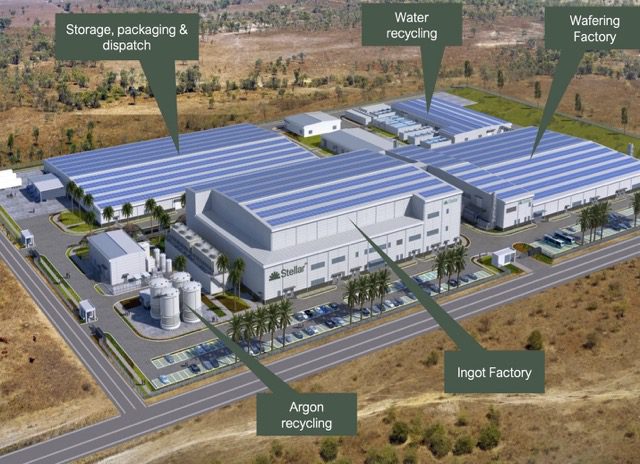
A $400 million factory in Townsville that could make 2 gigawatts (GW) a year of silicon wafers for solar panels is “technically and commercially achievable”, according to the initial findings from a study backed by the federal renewable energy agency.
The findings are part of a government push for Australia to seize opportunities along the massive solar industry supply chain, building local resilience from its own natural resources rather than remaining totally dependent on the Chinese PV industry infrastructure.
The finding come rather as silicon wafer prices slide upwards as China, which is home to 97 per cent of solar wafer makers, weeds out unprofitable operators, part of an ongoing increase expected from this year onwards.
The study was commissioned last year to investigate whether a company called Stellar PV could make Australia-made silicon wafers economically viable.
Stellar PV’s answer, delivered to the agency late last year and published on its website last month, is that it is.
The study was paid for by the Australian Renewable Energy Agency (ARENA) as part of the $1 billion federal Solar Sunshot program, itself designed to claw some parts of the solar industry back into Australia.
The $4.47 million went towards helping Stellar PV to find a site near Townsville, shortlist equipment suppliers, and start early designs and costs for a 2 GW “ingot pulling and wafering facility”, and start looking for buyers.
The next stage for what’s dubbed Project Clean Wafers’ will be a feasibility study, Front-End Engineering Design (FEED), and other work needed for planning applications, which Stellar PV says will be finished this year.
Stellar PV’s plan is to use a globally standard system called the Czochralski (Cz) method. That melts polysilicon into 500kg ingots, which are then squared off into the bricks from which wafers are shaved.
The company says it will make one type of high efficiency N-Type wafer at any size an offtake partner wants.
At what price
The big question will be whether the benefits outlined in the study — avoiding the massive US tariffs on Chinese-made goods, materials traceability and sustainability — will encourage buyers to pay a premium for made-in-Australia.
Stellar PV’s study suggests an Australian-made wafer could compete with cheaper Chinese versions by production credits under the Solar Sunshot scheme.
Similar credits in the US brought the price there down to $US0.51 per wafer, the report noted.
But that rate is still more than double where prices stood at the end of December for China-made wafers, even after a price increase, according to reports in PV Magazine Global.
Furthermore, it’s Chinese expertise that will get Australia’s first wafer factory off the ground.
Chinese company KIDE will design and build the factory, following work its already done for the likes of LONGi, Jinko and JA Solar.
“Chinese experts will support the roll out of the technology by coming to Australia over the short and long term, to provide expert knowledge transfer and allow Stellar PV to rapidly upskill Australian staff,” the report says.
“Australia is supportive of skilled migration for advanced manufacturing, and the Townsville region has access to a favourable visa program that allows sponsorship of overseas workers under more flexible rules than standard skilled migration.”
Will Queensland support it?
The factor not addressed in Stellar PV’s report however, is the Queensland government’s skepticism towards projects that don’t fit into a biomedical-defence-biofuels remit.
In its first year, the Crisafulli government pulled funding for the flagship green hydrogen project Central Queensland Hydrogen Project (CQ-H2) and for a battery research commercialisation hub.
While the report notes Queensland support for advanced manufacturing, it also claims the energy roadmap unveiled last year “promotes affordable, reliable, and sustainable energy while attracting private investment in new generation and storage”.
These assertions have since been disproved by the rapid exist of major investment and a focus on gas and coal power at the expense of renewables.
US headwinds
Part of the business case outlined in the ARENA study relies on the US and manufacturing growth outstripping its own wafer making capacity, however.
“The U.S. currently has only two wafer manufacturers. Corning’s 6 GW facility became operational in October 2025,1 and Q-Cells is constructing a 3.3 GW wafer line that is not yet online,” Stellar PV says in its study.
Much of this supply has already been contracted.
Other proposed projects have been cancelled.
CubicPV scrapped a project in 2024 citing the falling price of wafers and high construction costs in the US, while Norwegian company Norsun is now wavering on the Tulsa, Oklahoma project that it cancelled all of its European projects for.
Stellar PV expects a supply chain gap of 22 GW “in the next few years” that it could fill.
The Biden-era Inflation Reduction Act (IRA) sponsored a massive surge in renewable energy, and solar panel manufacturing was part of this.
While some elements of the IRA that supported US solar manufacturing are being wound back, such as the investment tax credit, the ripple effects from the massive incentive package are still being felt.
Solar cell production capacity grew to more than 60 GW between 2024 and late 2025, the Solar Energy Industries Association noted last year.
However, policy changes including the targeting of clean energy technologies in the IRA and random tariff threats by US President Donald Trump are putting headwinds in front of that expansion.
If you would like to join more than 29,000 others and get the latest clean energy news delivered straight to your inbox, for free, please click here to subscribe to our free daily newsletter.
Rachel Williamson
Rachel Williamson is a science and business journalist, who focuses on climate change-related health and environmental issues.
Share this:
Facebook
X
LinkedIn
Reddit
Email
Print