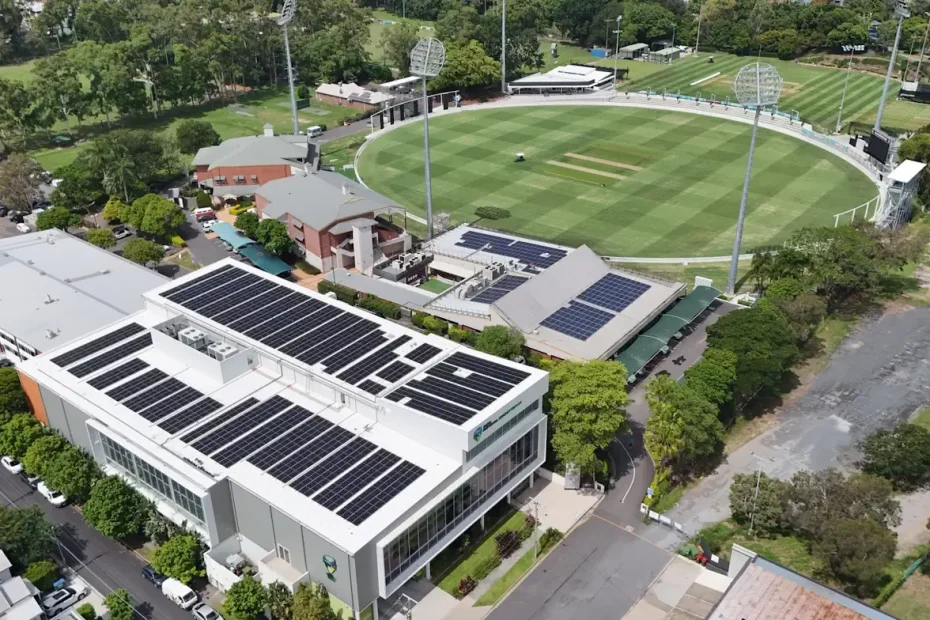
The federal Labor government has announced a major change to the long standing solar rebate system, increasing the installation cap from 100 kW to one megawatt as part of efforts to supercharge Australia’s “missing middle” and tap into the huge PV resource on factory and farm rooftops.
The radical change is to be announced by federal energy and climate minister Chris Bowen in a speech to the National Press Club on Wednesday. Excerpts from the speech, including the new changes to the SRES scheme, were released in advance.
The move taps into the huge momentum on the consumer side of the energy market that has been driven by the phenomenal success of the home rebate program, the introduction of the Solar Sharer “free power” offer, and the continuing strength of the household rooftop PV market.
However, Australia still has tens of gigawatts of untapped solar potential sitting on the rooftops of commercial and industrial buildings, and Bowen hopes the rebate can change that, and is also calling on regulators to ensure that distribution networks provide quick approvals to such installations.
“The lesson from Cheaper Home Batteries and EVs is clear to me: with the right policy settings Australians will respond enthusiastically in ways which when added up can lead to globally leading outcomes,” Bowen says in the released speech notes.
“Utility scale solar is going well. Rooftop household solar continues to break records. But, to be very frank, there is a missing middle in Australia’s energy transition.”
Bowen said industry estimates put the potential rooftop PV capacity on factories, warehouses and farming sheds, and large industrial premises, at more than 80 gigawatts (GW). But only 5.6 GW had been installed so far, compared to more than 22 GW on the rooftops of homes.
“That’s an opportunity we should miss no longer,” Bowen said.
Changes to the SRES had been expected, but Bowen has decided to go the whole hog, looking for energy transition wins as his flagship renewable platform, the Capacity Investment Scheme, remains stalled, particularly for large-scale wind projects.
The initiative has been welcomed by energy experts and environmentalists.
“ACF has long championed the expansion of federal schemes to better unlock rooftop solar for commercial premises. Rooftop solar is a win-win – it’s good for nature, and good for people,” said the Australian Conservation Foundation’s national climate policy adviser Annika Reynolds.
The Smart Energy Council, which on Monday released a major report on the unrealised potential of the commercial and industrial solar market, and how it could be fulfilled, says the expanded SRES will be “a permanent bill slasher” for farms, factories and warehouses.
“Over 10 million Australians have slashed their power bills with solar, now it’s businesses turn to do the same,” said Rob Potter, the SEC’s head of policy and advocacy and a lead author of the report.
“[This is] just the just the kickstart [that the commercial and industrial sector] needed. It didn’t need huge subsidies. It didn’t need huge grants. It just needed a little bit of a nudge, which is what the minister has delivered,” Potter told this week’s Solar Insiders podcast (to be published on Wednesday).
“There’s been experts in the area sort of suggest that within the first six months [of the expanded SRES] there might be about 300 MW of commercial industrial solar installed,” Potter says.
“But then over the next 20 years, as we sort of suggest, it will be effectively 30 GW of capacity that’s actually installed. And then other experts even go further to say, look, the total potential, even after that 20-year sort of time horizon, is around 60 to 80 GW of potential general generating capacity.
“So it’s a real game changer. Something that it doesn’t … remove the need for the build-out of transmission and also large-scale solar, batteries and wind, but it does plug that gap that we’re seeing in in the delay of the transmission build out.
“We congratulate the government for listening to the people actually building this industry, from property owners and retailers to the installers and developers who told us, in detail, where the current settings were holding back investment,” Potter says.
Bowen estimates that the new initiative will slash the installations costs for factories, farms and other industries by around 20 per cent. He said a retailer could save about $68,000 on the installation cost of 250kW solar system, and a further $50,000 a year on reduced energy bills.
“A larger operation might opt for an 850kW system – that’s enough to support a manufacturing facility, a large retail complex or a logistics warehouse. The upfront discount would be around $232,000,” he said.
“Each year they’d be generating about 1,173 MWh, seeing savings of around $175,000 in their energy bills.”
Bowen also said many of the delays in installation on commercial rooftops had been caused by network service providers, and said this was “unacceptable.”
He has asked the Australian Energy market Commission to consider a rule change to require DNSPs to approve commercial and industrial solar “much more expeditiously and efficiently” than they have been doing.
There is also a push for DNSPs to be more proactive about communicating with their C&I customers about which parts of the grid are best suited to adding solar capacity.
Potter said one owner of a large industrial precinct had told him that they had been approached just once in 15 years by a DNSP about the installation of large or medium scale solar.
“Once!” said Potter. “So we hope that, yes, we’ll go through a formal rule change process, and we’d like to assist the minister in how that goes out with some industry insights.”
Meanwhile, the rollout of large scale renewables continues to be an issue, with BNEF this week predicting that Australia will fall short of its 2030 target of 82 per cent renewables because of the lag in wind farm developments, even as solar and battery investments hit record levels.
The ACF’s Reynolds echoed many of the comments made at last week’s Australian Clean Energy Summit in saying that the key issue for the renewables industry was certainty about the closure dates of the remaining coal fired generators.
“We urge the Albanese government to explore every possible lever to firming up the closures of remaining coal and gas clunkers in Australia,” Reynolds said.
“Pressing down on the accelerator for renewables alone is unlikely to get Australia to 82% renewables by 2030 which is what we need for a safe climate and an energy independent grid.”
To join more than 29,000 others and get the latest clean energy news delivered straight to your inbox, for free, click here to subscribe to our free daily newsletter.
To support independent media, and combat AI slop, you can click here to make a one off donation or become a regular supporter of Renew Economy.
Giles Parkinson & Sophie Vorrath
Share this:
Facebook
X
LinkedIn
Reddit
Email
Print