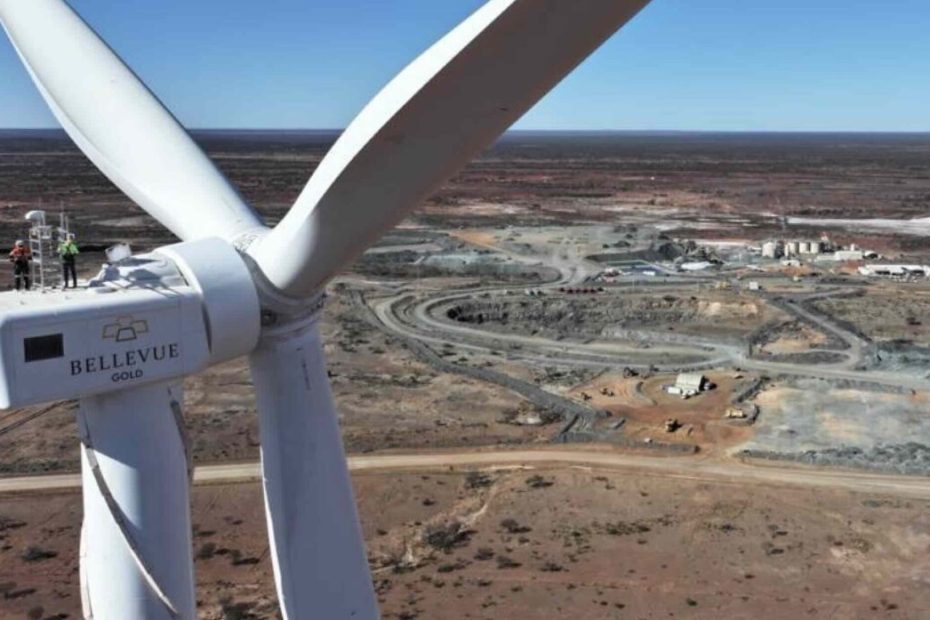
The off-grid Bellevue gold mine in a remote part of Western Australia has established a new benchmark for its renewable hybrid power supply, achieving its best ever share of 93.8 per cent wind and solar over the month of February.
The spectacular return follows other high renewable outcomes for at least two other off-grid mining operations – Mt Weld and Kathleen Valley, which both have the distinction of being backed by Gina Rinehart, Australia’s richest person and one of the country’s most vocal renewable energy critics.
Bellevue Gold has already achieved a first for the industry, reaching “net zero” greenhouse gas emissions in the last financial year, thanks to its high share of renewables, and offsets for its transport emissions, which it hopes to cut down and eliminate as electric options emerge.
In its latest quarterly report, Bellevue Gold says its 90 megawatt (MW) hybrid power station, achieved an average wind and solar share of 85.2 per cent in the March quarter, including the 93.8% renewable energy share in February.
“Following this strong performance, Bellevue is on track to meet the upper end of the forecasted 80-90% renewable energy for FY26,” the company said in a statement.
“As well as reducing emissions, the high fraction of renewable energy has inherently decreased Bellevue Gold’s exposure to fluctuations in the diesel and LNG markets, and provides extra resilience to any potential supply chain shocks.”
Bellevue says diesel makes up just 1.3 per cent of its total costs, one of the lowest fractions in the mining industry, who usually cite a 15 per cent share, possibly higher given the higher costs following the Middle East crisis.
“We also benefit from our very low exposure to diesel prices due to our highly successful renewable power generation strategy,” managing director Darren Stralow said.
Bellevue’s off-grid power system, delivered by Zenith Energy, features four wind turbines with a combined capacity of 24 MW, a 27 MW solar farm, a battery energy storage system (BESS) of 15 MW/33-megawatt-hours (MWh), as well as 24 MW of thermal generation.
Liontown Resources’ system at Kathleen Valley – also delivered by Zenith Energy – features 30 megawatts (MW) of wind capacity, 17 MW of solar and a 17 MW, 19 MWh battery. It achieved a share of 80 per cent renewables in the first quarter.
But both the Bellevue and Kathleen Valley achievements were bettered by Mt Weld, owned by Lynas Rare Earths, which achieved a stunning share of 95.7 per cent renewables over the March quarter.
That was way more than the 70 per cent renewables share that had been anticipated after the completion of the new hybrid renewables facility, combining 7 megawatts (MW) of solar, 24 MW of wind from four newly installed turbines, and a 12 MW/12 MWh battery. It is also delivered by Zenith Energy.
If you would like to join more than 29,000 others and get the latest clean energy news delivered straight to your inbox, for free, please click here to subscribe to our free daily newsletter.
If you wish to support independent media, and accurate information, please consider making a one off donation or becoming a regular supporter of Renew Economy. Please click here. Your support is invaluable.
Giles Parkinson
Giles Parkinson is founder and editor-in-chief of Renew Economy, and founder and editor of its EV-focused sister site The Driven. He is the co-host of the weekly Energy Insiders Podcast. Giles has been a journalist for more than 40 years and is a former deputy editor of the Australian Financial Review. You can find him on LinkedIn and on Twitter.
Share this:
Facebook
X
LinkedIn
Reddit
Email
Print