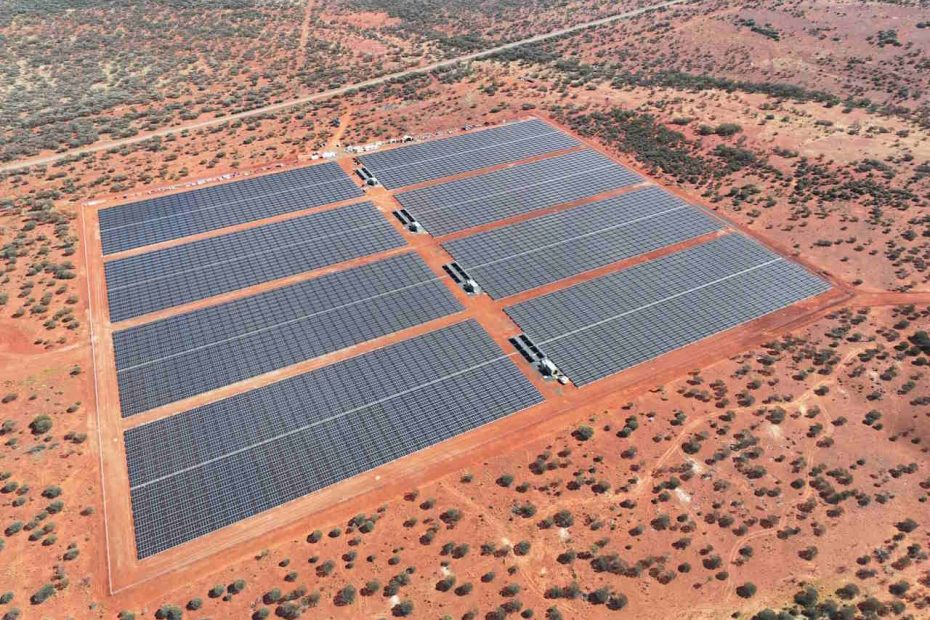
The new Bellevue gold mine operating in a remote, off-grid region of Western Australia says it has operated with a renewable energy share of around 90 per cent in the last month, shielding it from the surge in diesel costs and supply concerns that have afflicted other miners.
Bellevue has already established itself as an industry leader with its 90 megawatt renewable hybrid power plant, constantly operating at a share at or near 90 per cent renewables, including one period of nearly five consecutive days of “engine off.”
That has delivered substantial cost savings, and the achievement of becoming the world’s first “net zero” gold mine. But in the context of Donald Trump’s war in the Middle East, and the fossil fuel supply crisis it has caused, it is now delivering even bigger rewards.
In an update on its March quarter operations, released to the ASX on Wednesday, Bellevue Gold said its power station continues to operate with industry leading renewable energy rates of around 90 per cent in March.
“Bellevue’s direct exposure to diesel costs continues to be one of the lowest in the sector,” it said. “Diesel purchases represented around 1.3 per cent of Total Project Costs during the financial year to 28 February 2026. Bellevue is not currently impacted by any diesel supply issues.”
That 1.3 per cent is even lower than the four to five per cent claimed by another leading miner with a high share of renewables on its off-grid power system, Liontown Resources.
That company, one of the main lithium plays by Australia’s richest person Gina Rinehart, a vocal opponent of renewables, sources more than 80 per cent of its power needs at its new Kathleen Valley mine from its combined wind, solar and battery system.
“We are 80% renewable,” Liontown CEO Tony Ottaviano said in March an analyst briefing marking its December half results.
“That gives us a very big, big advantage. So most of our power is generated by renewable sources. So on average, our total diesel cost is about 4% to 5% of our overall cost base. So it’s not a significant amount. So we’re pretty confident from that perspective.”
A recent report by brokers Bell Potter estimated that diesel can represent 15 per cent of total costs for an off grid mine, even before the recent 50 per cent spike in costs to around $3 a litre.
Bellevue’s off-grid power system, delivered by Zenith Energy, features four wind turbines with a combined capacity of 24 MW, a 27 MW solar farm, a battery energy storage system (BESS) of 15 MW/33-megawatt-hours (MWh), as well as 24 MW of thermal generation.
Liontown’s system at Kathleen Valley – also delivered by Zenith Energy – features 30 megawatts (MW) of wind capacity, 17 MW of solar and a 17 MW, 19 MWh battery, and was commissioned last year.
See also: “We are 80 pct renewable:” Wind and solar shield Gina Rinehart’s big lithium play from fossil fuel crisis
If you would like to join more than 29,000 others and get the latest clean energy news delivered straight to your inbox, for free, please click here to subscribe to our free daily newsletter.
If you wish to support independent media, and accurate information, please consider making a one off donation or becoming a regular supporter of Renew Economy. Please click here. Your support is invaluable.
Giles Parkinson
Giles Parkinson is founder and editor-in-chief of Renew Economy, and founder and editor of its EV-focused sister site The Driven. He is the co-host of the weekly Energy Insiders Podcast. Giles has been a journalist for more than 40 years and is a former deputy editor of the Australian Financial Review. You can find him on LinkedIn and on Twitter.
Share this:
Facebook
X
LinkedIn
Reddit
Email
Print