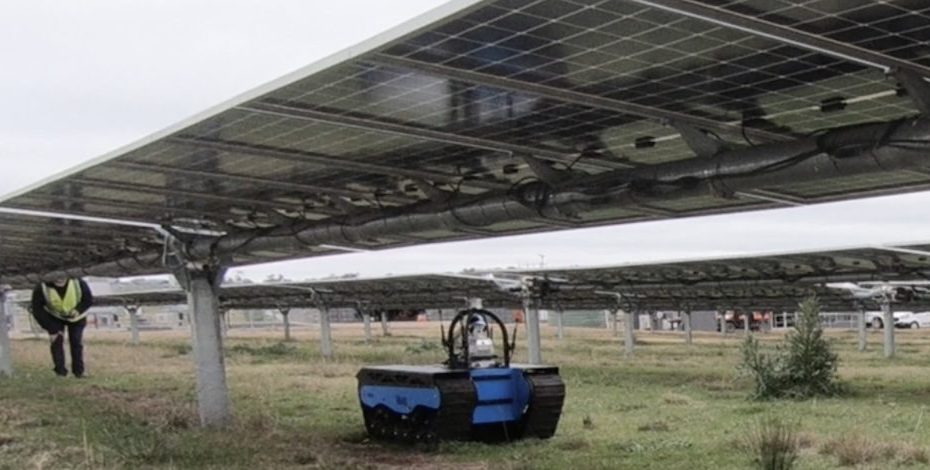
Australia’s national science agency has repurposed robots originally designed for the mining industry to track across thousands of kilometres harsh terrain and inspect the hundreds of thousands of solar panels that make up large-scale PV projects, hunting out any faults they might have.
The team of CSIRO robotics and solar engineers said on Wednesday that an autonomous robot – dubbed “Bear” – had successfully navigated a series of small-scale trials and would soon be tested at a larger solar farm, and the results compared to a human assessment.
The robots have been programmed to autonomously navigate solar farms in all terrains and conditions, to build precise maps to digitise site conditions, avoid hazards and develop a holistic scene understanding.
They then detect faults in a project’s panels – in bigger solar farms, there can be upwards of 500,000 – including dust build-up, insect nests or bird droppings, physical damage, loose nuts or bolts, hotspots in panels or electrical connectors, and wiring that needs repair.
The suite of sensors equipped on the robots include Light Detection and Ranging (LiDAR) for accurate 3D perception, RGB cameras for visual inspection, and thermal infrared cameras to identify electrical faults and hotspots.
Kenrick Anderson, a senior photovoltaic engineer at CSIRO, says the project is not just about improving efficiency and safety at solar farms, but automating a job that for humans classifies as unskilled labour, but is repetitive and can be gruelling and even dangerous in harsh Australian conditions.
“We’re really focused on trying to replace unskilled roles, the backpacker labour where it’s really screaming out for, we need more people in this space,” Anderson told Renew Economy.
The technology also supports the creation of skilled regional jobs, shifting the focus to targeted technical work in solar farm maintenance, as well as robotics support and data analysis.
“We’re also looking at quality assurance,” he adds. “We’d be confident saying that a robot could replace – using technology and sensors – a full-time worker in that job and they would also do it a bit quicker, too, so the farms can have their reports back quicker.”
Anderson says early detection of things like panel hotspots – which are caused by micro-cracks in the silicon – and electrical issues are crucial to to maintain panel performance, enhance stability of energy output and extend asset lifespan.
“Hotspots decrease the efficiency of a PV panel over time, because of the electrical and thermal imbalance they cause within the module. If solar farms cost less to run, and can be more consistent in their energy output, this increases the stability of the grid.”
Safety is also an issue. Anderson says on rare occasions – and if not detected early enough – hotspots and wiring faults can cause fires at solar projects. “So picking them up is important to asset owners,” he says.
Peyman Moghadam, a senior principal research scientist at CSIRO says that beyond the very specific role of the robots like Bear, the work reflects the agency’s broader vision for next-generation robotics accelerate the energy transition and support the path to net zero.
“We are not just collecting images or 3D data,” Moghadam says. “We are building the foundations for intelligent solar operations, where data from robots, fixed sensors and field systems can be combined.
“This supports better proactive maintenance decisions and more resilient performance over time.”
“We have been doing robotics for many, many years in mining, defense and agriculture,” adds Anderson. “So it was kind of an opportunity… [to] bring that experience … to the [renewable energy] sector and see what we can do.”
If you wish to support independent media, and accurate information, please consider making a one off donation or becoming a regular supporter of Renew Economy. Please click here. Your support is invaluable.
Sophie Vorrath
Sophie is editor of Renew Economy and editor of its sister site, One Step Off The Grid . She is the co-host of the Solar Insiders Podcast. Sophie has been writing about clean energy for more than a decade.
Share this:
Facebook
X
LinkedIn
Reddit
Email
Print