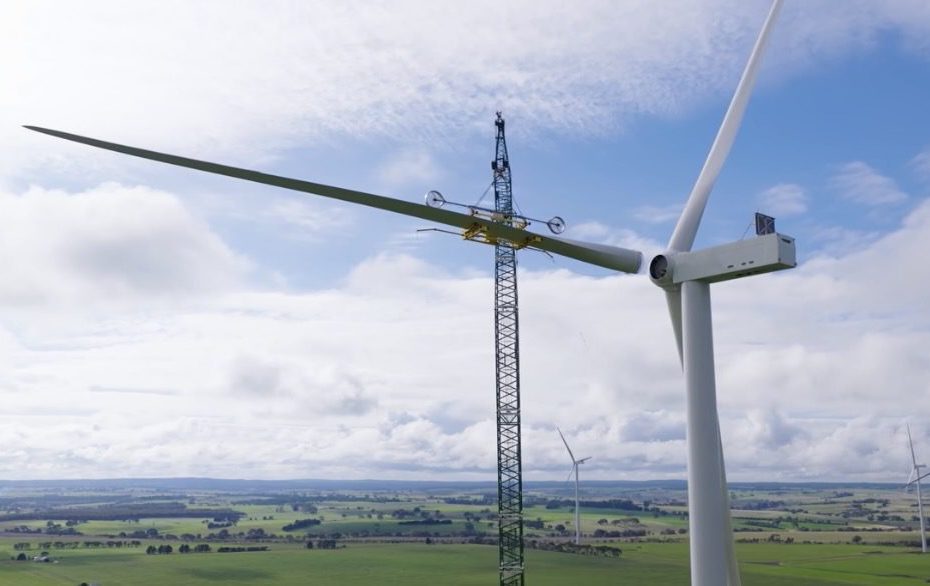
Australia has more than enough renewable energy and battery projects planned to meet its 2030 target, but it could still fall short unless construction speeds up, a report has found.
The Institute for Energy Economics and Financial Analysis (IEEFA) issued the warning on Wednesday in a renewable energy report card, which also found the nation could unlock another $44 billion in investment if approved projects moved to construction.
The findings come despite record levels of wind and solar power in the National Electricity Market, and widespread adoption of rooftop solar and battery systems among households and businesses.
The institute used data from Green Energy Markets to create the Australian Renewable Energy Scorecard, which analysed the number, size and status of large-scale renewable energy projects in every state and territory except the NT.
It measured the projects against Australia’s target to produce 82 per cent of electricity from renewable sources by 2030.
The report card found Australia had significantly more solar and wind projects in development than needed to meet the target, and enough projects with full approval.
Green Energy Markets chief executive Tristan says quite a large bank of those pipeline projects have both environmental and planning approvals: 33,993 megawatts (MW) of solar and 17,340 MW of wind with both approvals secured across both the main national grid and Western Australia’s main grid.
But only a fraction of those projects are being built, IEEFA electricity lead analyst Johanna Bowyer said, even though they could take up to four years to reach operation.
”Projects under construction will still fall far short of what must be built by 2030,” she said.
”In several states, less than one tenth of the required new wind and solar capacity is currently being built, and even the strongest states have, at most, around one third of new capacity required currently under construction.”
The biggest impediment was a lack of power purchase agreements, in which customers agreed to buy renewable energy from projects for up to 15 years, the report found.
Edis said government schemes were helping projects progress, but were not enough to underwrite them.
“The other bad news that this Scorecard reveals is that the Capacity Investment Scheme and NSW underwriting schemes haven’t been performing particularly well when assessed in terms of the renewable energy projects they’ve converted to construction or operation.
”Our analysis shows a key roadblock to getting projects to construction is the lack of long-term power purchase agreements,” he said.
”Without more contracts from large energy users, too many fully approved projects will stay stuck.”
The report said that if the approved renewable energy projects proceeded to construction, they could add $44 billion of investment to the economy.
One potential source of agreements could be data centres, as the Australian Energy Market Commission recommended developers invest in renewable resources to meet their energy demand.
The institute’s report card also found NSW and Queensland had the largest pipeline of proposed renewable energy and large-scale battery projects.
The two states, along with South Australia, also led the nation for the largest rooftop solar systems, although Tasmania caught up in the second quarter of 2026.
AAP, Jennifer Dudley-Nicholson, with additional reporting from staff reporter
AAP & Staff Reporter
Share this:
Facebook
X
LinkedIn
Reddit
Email
Print