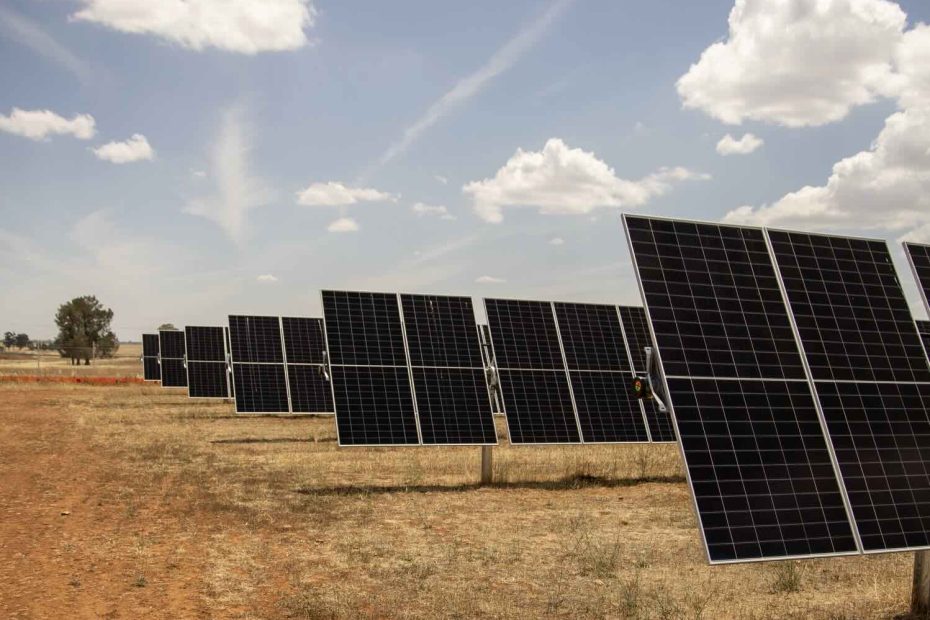
The pipeline of solar, wind and battery energy storage projects proposed for development in Australia is “running laps” around the amount needed to meet national renewable energy and net zero emissions targets – but the pace of delivery will need to pick up.
The country needs 200 gigawatts (GW) of extra capacity to meet its 2050 net zero targets, according to the Australian Energy Market Operator (AEMO). But according to data from RenewMap, there are 670 GW of large-scale on- and offshore projects currently somewhere in the development process.
“It sounds enormous, and it is a big number,” RenewMap cofounder Alex Thompson told the Clean Energy Investor Conference in Melbourne on Tuesday.
“If we strip it back to just what’s on land, we’re still looking at well over still looking at well over 450 GW in the pipeline.
“The constraint here has never really been ambition or the size of the opportunity. It’s the pace at which we can move these projects.”
According to RenewMap, that 450 GW contains 155 GW of onshore wind, 90 GW of large solar, 185 GW, 530 gigawatt hours (GWh) of batteries, and 26 GW of offshore wind.
If one thing could be improved, it is likely to be planning – and not just in places like Queensland, which is radically changing how that is happening, but also in New South Wales.
The RenewMap data shows that between 2010 and 2025, the east coast state took the longest to squeeze a project through planning, a process that has been hijacked by long distance objectors.
Nevertheless, the numbers show investment in new projects is “running laps” around net zero targets but Australia still needs to move at double speed and scale of the current rate, says Climate Energy Finance director Tim Buckley.
“This pipeline shows we absolutely still have the capacity to deliver in 82 per cent, we just need to get a move on,” he told Renew Economy.
On LinkedIn, Buckley said the best way to get Australian energy prices down sustainably is to get more net new supply of generation online ahead of demand growth.
“Rooftop solar and 250,000 [behind the meter] batteries really help solve this challenge, but we need a lot more utility scale projects – scale and speed!”
Meanwhile, in Victoria…
In Victoria, the Labor government is gearing up to declare its renewable energy zones (REZs) and an industry-focused roadmap of priority transmission projects.
“I’m very soon going to be formally declaring our REZs and Victoria Transmission Plan project delivery roadmap, and explain how the first of the priority projects will be mobilised and delivered in a clear and staged way,” state energy minister Lily D’Ambrosio told the conference.
“We know time is of the essence, and the sooner decisions are made and embedded gives you the confidence to be able to make the decisions that you need to now to get projects built.”
Victoria’s onshore renewables development pipeline is almost the smallest of the mainland states, according to the RenewMap data – wind, solar and battery projects total slightly more than 59 gigawatts (GW) compared to 150 GW or more in Western Australia, Queensland and New South Wales.
Only South Australia’s pipeline is lower, at slightly more than 45 GW, but that state is also meeting all or more of its energy needs at times with new generation.
The RenewMap data shows Victoria’s development pipeline is driven by large battery projects, and while there has been a slowdown in wind projects, more than a gigawatt of these received planning approval last year in the state.
Victoria is planning to add another 9 GW to that development pipeline with offshore wind by 2040 – and currently has 19.6 GW of projects still working on feasibility plans.
D’Ambrosio says the state needs another 25 GW of energy and storage by 2035 to meet its next target.
“I think in some ways a challenge is a little bit different for Victoria than other states,” she said during the conference.
“We need big, ambitious change to happen in a way that is practical, effective, and leads to the outcomes that we will design to decarbonize our energy system, to make sure that we can keep the lights on.
“And of course, do that in a way that tempers power prices, shifting from the historic fuel source of brown coal in Victoria which was a distinct economic advantage for us to grow our state going back more than 100 years to more diversified renewables.”
If you would like to join more than 26,000 others and get the latest clean energy news delivered straight to your inbox, for free, please click here to subscribe to our free daily newsletter.
Rachel Williamson
Rachel Williamson is a science and business journalist, who focuses on climate change-related health and environmental issues.
Share this:
Facebook
X
LinkedIn
Reddit
Email
Print