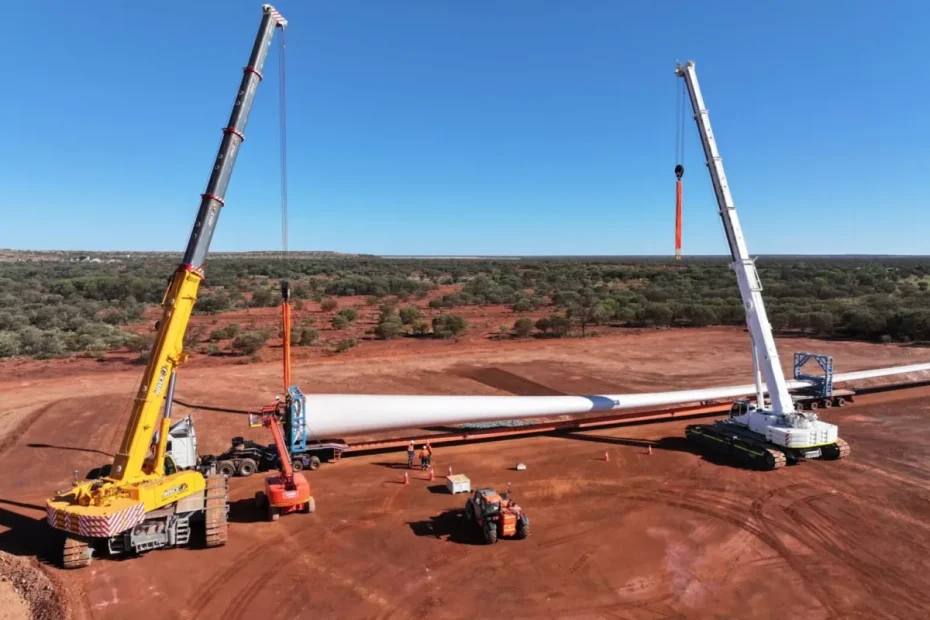
One of Australia’s leading gold producers has unveiled plans for a massive wind, solar and battery hybrid project – the biggest of its type in Australia – to help power its expanded mining operations around the country’s gold capital of Kalgoorlie-Boulder.
Northern Star Resources says its Kalgoorlie Regional Renewable Energy Project will combine 256 megawatts (MW) of wind capacity, 110 MW (ac) of solar capacity, and 140 MW and 300 MWh of battery storage.
It will be the biggest wind, solar and hybrid installation of its type in Australia, and will be rivalled – and eventually exceeded – only by the massive wind, solar and battery plans of the country’s biggest iron ore miners in the Pilbara to the north.
The Kalgoorlie grid has been notoriously vulnerable because it is located at the very edge of a long, stringy transmission line stretching out from Western Australia’s isolated main grid, and is vulnerable to storms, dust and other issues.
The W.A. government recently announced a tender for a $150 million vanadium flow battery to be built in Kalgoorlie to help stabilise the local grid, but Northern Star’s proposal – presented to the state’s EPA late last week – trumps that proposal both in size and scope.
Northern Star says it estimates the 32-turbine wind farm, with solar and battery storage, will account for 70 per cent of the electricity demand for its Kalgoorlie Consolidated Gold Mines (KCGM) operations, which includes one of Australia’s largest open pit gold mines.
The company wants to expand the facility and create one of the largest milling complexes in Australia.
It says the mining industry can play a key role in the transition to Net Zero in Australia “due to the unique position to develop large scale renewable energy projects with long term electricity demand and low associated transmission costs.”
“Industry also has a social licence to operate based upon playing a role in the transition to net zero and are expected by stakeholders to invest in renewable energy,” it says in its planning documents.
Northern Star has already invested in the Carosue Dam solar farm and a smaller wind, solar and battery hybrid at its Jundee mining operation (pictured above).
The company says its goal is to reduce its reliance on mostly thermal energy being sent out through the state’s main grid, and the local 105 MW, dual fuelled (gas and diesel) Parkeston facility in Kalgoorlie.
“Northern Star could not rely on the greening of the grid to achieve its emission reduction targets,” it says in its application.
“Without the renewables project KCGM’s demand for electricity can only be supplied with increased supply from PPS (Parkeston).
“Northern Star forecasts that once the Proposal is fully operational KCGM’s electricity supply from renewable energy will exceed 70% of its entire consumption.”
Other mining operations have had similar successes. The new Bellevue gold mine has been achieving monthly renewable penetration rates of more than 90 per cent at its mine further north, and run for several days with “engines off”, meaning no fossil fuels.
The country’s first underground lithium mine, Kathleen Valley, has also been achieving renewable run rates of more than 80 per cent over the past year, well above its expectations of just 60 per cent. Its biggest shareholder is Gina Rinehart, who has again spoken out against spending on net zero targets and renewables.
The most ambitious plan, however, remains with Andrew Forrest and Fortescue, which is aiming to reach real zero at its giant Pilbara iron ore mines, which means using only wind, solar and storage for its electricity supply and the full electrification of its mining operations, trucks and transport needs.
Northern Star says it has no choice, given the need to cut emissions and meet customer and shareholder expectations.
“Not implementing the Proposal will result in considerable increases in GHG (greenhouse gas) emissions associated with the KCGM mill upgrade and mine development,” it says.
“This will result in an inability for Northern Star to meet interim and possibly long term GHG reduction commitments and Safeguard Mechanism requirements, as well as make it more difficult for the Australian government to achieve its international GHG reduction obligations.
“Not implementing the proposal is considered unviable.”
If you wish to support independent media, and accurate information, please consider making a one off donation or becoming a regular supporter of Renew Economy. Please click here. Your support is invaluable.
Giles Parkinson
Giles Parkinson is founder and editor-in-chief of Renew Economy, and founder and editor of its EV-focused sister site The Driven. He is the co-host of the weekly Energy Insiders Podcast. Giles has been a journalist for more than 40 years and is a former deputy editor of the Australian Financial Review. You can find him on LinkedIn and on Twitter.
Share this:
Facebook
X
LinkedIn
Reddit
Email
Print