The owner of Australia’s two biggest operating solar farms has reported a significant jump in revenue in the latest quarter, helped by a large increase in new capacity and less curtailment, and despite lower wholesale prices.
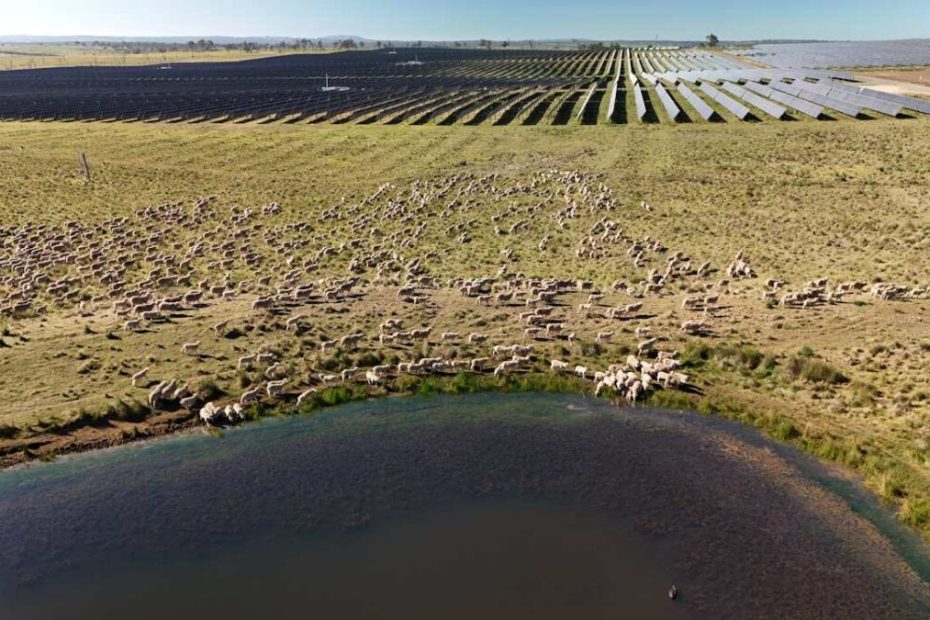
The Philippines-based Acen Renewables owns the New England and Stubbo solar farms in New South Wales, both rated at 400 megawatts (MW). New England is to be expanded to 720 MW and a 200 MW, two-hour battery is also being built at the site.
The company – which has operations throughout Asia – has reported a near doubling in Australian generation output in the March quarter, up 87 per cent to 528 gigawatt-hours – largely due to the first full quarter of operations from the newly completed Stubbo solar facility.
But it also reports improved solar conditions and reduced grid curtailment at New England solar.
This could be largely due to the fact that solar farms in NSW, according to the Australian Energy Market Operator’s latest assessment, have enjoyed less economic “offloading” from negative prices as the growing number of big batteries provides a floor during the day.
New England also dodged most of the network curtailment, which was worse in the south of the state because of the growing number of solar farms and issues around grid capacity.
And New England is also adding a 200 MW, 400 megawatt-hour (MWh) battery, which is 87 per cent complete on the construction side and started its commissioning process in February.
Acen Renewables says revenues also grew, but at a slightly lower pace, growing 76 per cent to P1.45 billion ($A32 million), as the average wholesale price received fell by around six per cent.
“In Australia, results reflected lower merchant prices and higher depreciation and interest expense following Stubbo’s start of commercial operations, partially mitigated by improved generation output at New England solar farm, driven by reduced curtailment and better solar resource,” the company said.
The company’s earnings grew at a slower rate than both generation and revenues, growing by 59 per cent to P994 million ($A24.5 million), largely as a result of growing depreciation and interest costs associated with the completed Stubbo project.
Acen has long term off-take agreements for New England with Zen Energy and Flow Power, one for industrial gas company BOC and the other for the University of Technology.
Acen Renewables has also begun construction of the 75 MW Jinbi solar project in Western Australia’s Pilbara region, a landmark project under the Yindjibarndi joint venture in Western Australia, commenced in March 2026.
It has a number of other projects in the pipeline, including the Valley of the Winds project in NSW, and the Phoenix pumped hydro project, and the Robbins Island wind project in Tasmania.
If you would like to join more than 29,000 others and get the latest clean energy news delivered straight to your inbox, for free, please click here to subscribe to our free daily newsletter.
If you wish to support independent media, and accurate information, please consider making a one off donation or becoming a regular supporter of Renew Economy. Please click here. Your support is invaluable.
Giles Parkinson
Giles Parkinson is founder and editor-in-chief of Renew Economy, and founder and editor of its EV-focused sister site The Driven. He is the co-host of the weekly Energy Insiders Podcast. Giles has been a journalist for more than 40 years and is a former deputy editor of the Australian Financial Review. You can find him on LinkedIn and on Twitter.
Share this:
Facebook
X
LinkedIn
Reddit
Email
Print