The biggest data centre in Australia – more than twice the size of anything that has come previously – is to be built in South Australia, because of the state’s “clean energy abundance,” and because it will have already reached its target of 100 per cent “net” renewables by the time of construction.
The US-based Iren – a specialist in industrial-scale data centres and AI – announced overnight that it planned to build its 800 MW data centre near the Bundey sub-station around 75 km north-east of Adelaide. Media reports put the cost of the centre at around $10 billion.
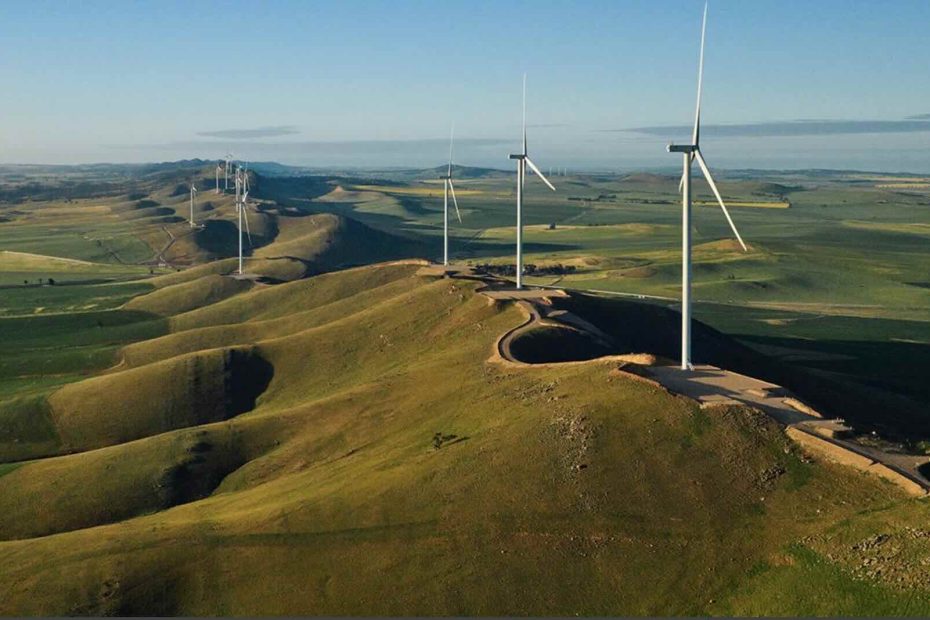
It has chosen the site because the area is unpopulated and because it sits at the crossroads of major transmission lines – and right in the heart of a maze of wind projects that is making the state grid the greenest in the planet.
For a number of reasons, it’s seen as a deeply significant announcement: for its implications for wind, solar and battery projects; the success of South Australia’s green grid; because it could have a “domino” effect on other players because of its size, and; its first-mover advantage at this scale.
The announcement vindicates the claims of the state government, and the state’s transmission operator, that its green credentials and low wholesale electricity prices are attracting multi-gigawatts of new industry enquiries.
In a statement, Iren specifically mentioned South Australia’s targets of reaching 100% net renewable energy by 2027, and the fibre connectivity into major regional demand centers including Singapore, Indonesia, South Korea, and Japan.
“South Australia offers what AI infrastructure at scale requires: abundant clean energy, the connectivity to serve the APAC (Asia Pacific) region, and a state government that understands the opportunity and is acting on it,” Daniel Roberts, the co-founder and co-CEO of Iren, said.
“The Bundey campus is able to serve global and regional AI demand, as well as South Australia’s own growing need for AI compute.
“We look forward to partnering with the government of South Australia, local communities and industry to expand domestic access to AI infrastructure, support research and innovation, and help build the skills and jobs the AI economy requires.”
The Bundey sub-station already serves as a hub for a number of major wind, solar and battery storage projects, including much of Neoen’s massive Goyder renewable energy park – the largest wind, solar and battery facility in the country – and a number of other projects.
Neoen has already committed to building two neighbouring batteries totalling 400 MW and 1,600 MWh at Goyder, right next to the Bundey sub station, to provide long duration storage for the government and supply part of a “firm renewables” supply agreement with BHP’s Olympic Dam mine.
It has already built a 412 MW wind farm at Goyder South and plans another 400 MW wind project at Goyder North. The entire Goyder complex could host 1,200 MW of wind, 600 MW of solar and more than 1,600 MW of battery storage.
A big customer like Iren will likely provide the opportunity to expand that project, and also give life to others looking for long-term power agreements.
Genaspi Energy has won a contract under the federal government’s Capacity Investment Scheme to build the 300 MW Bundey solar farm, along with a 300 MW, 1,200 MWh battery, also close to that sub-station.
Zen has also been developing its massive Solar River project in the same area, and there are several other projects also in the pipeline.
Bundey is also the entry point to South Australia of the new Project EnergyConnect, the new transmission line to NSW that will offer 800 MW of transfer capacity. The presence of Iren reduces the risk of bottlenecks, at least on the South Australia end of the line.
Iren’s statement says the company has secured a transmission connection agreement (with ElectraNet), which Iren says allows for four 330kV feeder exits at the utility’s substation, which is expected to support up to 800 MW without requiring network upgrades.
Iren expects to build the centre in stages, with the first energisation due to take place in 2028. The state says it is on target to reach 100 per cent “net” renewables by the end of 2027, although it may have to build more generation to maintain that percentage because of the size of the new load.
South Australia premier Peter Malinauskas welcomed the announcement, saying that data centres are a “significant economic opportunity, which can bring high-quality jobs, stronger renewable energy infrastructure,” and new opportunities for regional communities.
“South Australia’s leadership in renewable energy, our record investment in higher education, our unashamed pro-jobs and pro-business outlook and appointing the nation’s first dedicated Minister for Artificial Intelligence means we are uniquely placed to seize the opportunities of AI,” he said.
“Iren’s proposed Bundey campus represents a significant investment in our state, with the potential to create hundreds of construction jobs, support long-term skilled roles, and strengthen South Australia’s position as a technology and innovation hub for the Asia-Pacific region.”
The impact of rapidly emerging data centre demand has become the subject of significant debate in Australian energy circles, with some thinking it will create new demand and long-term contracts to finally get stalled large-scale renewables contracts over the line, and others worried it might end up being a boost to fossil fuels.
The Australian Energy Market Operator has announced strict new rules to govern the connection of the large and mostly inflexible loads from data centres, while state and federal energy ministers are recommending – but not yet fully enforcing – requirements that they bring or contract new renewable generation to meet their power needs.
Data centres also have onerous “up-time” requirements, forcing many to surround their centres with a number of diesel gen-sets that can be switched on in case of a wider grid outage. These are expensive, unsightly and polluting, but the argument is that these should rarely, if ever, be switched on.
Renew Economy understands the Bundey facility will rely on grid power and backup generators will be installed for redundant power in the event of grid emergencies or facility maintenance. The facility will look to write PPA’s as it grows.
The interesting aspect to this is the fillip it will give to renewable energy projects in the area, and the fact that adding 800 MW of near constant demand could likely eliminate the “negative” demand that the state often experiences because of it vast quantities of rooftop solar.
In a statement earlier this week, AEMO noted that data centres should consider locations in regions with abundant renewable energy resources that can help support lower-cost outcomes for consumers while maintaining system reliability and security.
Its most recent Quarterly Energy Dynamics report identified 11 large-scale data centre projects, representing 5.4 gigawatts (GW) of maximum demand, that were progressing through the transmission connection process, although CEO Daniel Westerman also said some projects were applying in different states.
“There are a few things to bear in mind when looking at the pipeline,” Westerman said in a speech to an energy users conference last week.
“First, the ultimate connection capacity is not required on day 1. Projects are built in stages and that ultimate capacity may be a decade away.
“Second, projects often pursue multiple connection options, which makes the overall pipeline look larger than it actually is – still sizeable, but manageable.”
Interestingly, AEMO said in its QED that around 60% of capacity was in New South Wales and 40% in Victoria, which suggests that the South Australia one may have been a recent addition. It also noted that data centres are likely to operate as relatively inflexible loads, prioritising uptime and reliability.
“Their effective integration will require strong operational visibility, clearly defined performance standards, and predictable behaviour during system disturbances.with most projects in early stages.”
If you would like to join more than 29,000 others and get the latest clean energy news delivered straight to your inbox, for free, please click here to subscribe to our free daily newsletter.
If you wish to support independent media, and accurate information, please consider making a one off donation or becoming a regular supporter of Renew Economy. Please click here. Your support is invaluable.
Giles Parkinson
Giles Parkinson is founder and editor-in-chief of Renew Economy, and founder and editor of its EV-focused sister site The Driven. He is the co-host of the weekly Energy Insiders Podcast. Giles has been a journalist for more than 40 years and is a former deputy editor of the Australian Financial Review. You can find him on LinkedIn and on Twitter.
Share this:
Facebook
X
LinkedIn
Reddit
Email
Print