Australia’s main grid may struggle to reach the federal government’s target of 82 per cent renewables by 2030, but the country’s biggest isolated grid looks like it is now very much on course.
Western Australia distinguishes itself by hosting the biggest isolated grid in Australia – and most likely the world – which means that it cannot rely on neighbouring states or countries to import or export power when needed.
That puts it at a theoretical disadvantage as it seek to quit coal and rely on renewables for a high percentage of the grid, particularly with no hydro, and given that the blueprint for the rest of the country relies on building big new transmission links. “There is no transition without transmission,” we are told.
But as dozens of smaller grids in the state have already found, being isolated is no proving no barrier to a high share of renewables.
Small mines are operating at up to 95 per cent renewables, with a mix of wind turbines, solar panels and batteries. And Andrew Forrest’s Fortescue is committed to doing better and reaching 100 per cent renewables, and “real zero” emissions at his giant iron ore operations by the end of the decade.
Maybe isolation helps! There are fewer competing interests, fewer regulatory barriers, and usually an overwhelming economic case to cut the ties to expensive and often unreliable fossil fuel generators.
Biggest wind tender
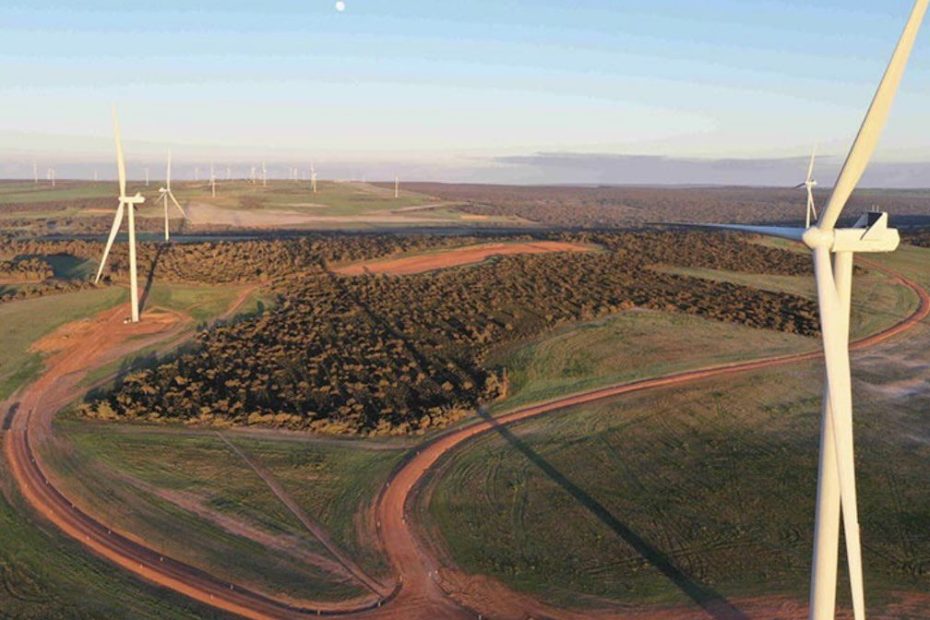
Western Australia and the federal government over the weekend announced the results of the state’s biggest tender for generation and battery storage, which says will keep it on target to close its coal fired generators – as promised – by the end of the decade.
See: Six wind farms, two solar hybrids and seven-hour batteries win key CIS tenders ahead of coal closure
It comes after a series of announcements over the last month, including off-take deals for three significant wind projects, fast-tracked approvals, and a $1 billion commitment to new transmission infrastructure to link them all to the main grid.
There is more to come.
“By 2030 we’ll be at about 80 per cent (renewables), if these projects come online, which we’re confident that they will with this investment,” the state’s energy minister Amber-Jade Sanderson said over the weekend, adding that more off-take agreements will be announced soon by the state-owned energy utility Synergy.
And therein lies the key. State ownership has allowed the government to control the narrative, and the investment – something that federal and state governments has struggled to do in the country’s main grid where private companies control the market and few developers are willing to take on the risk of them not coming to the party.
Of course, you do have to be careful what you wish for. When the Coalition was in power in W.A., nothing much happened in renewables, because the Coalition didn’t want it to happen.
The LNP government in Queensland, a state also dominated by government ownership, is now going down the same path, ripping up renewable targets and simply refusing permission for some projects to go ahead. That act of sabotage is clearly going to hamper the country’s ability to get to 82 per cent renewables by 2030.
Closing down coal
In W.A., however, despite some delays, the Labor government now seems firmly on board, knowing that delaying the closure of its ageing state owned coal generators in Collie is not acceptable, for the sake of emissions, costs, and grid security, and it needs to press go on the infrastructure and contracts to make the transition happen.
One of the features of the W.A. market is that it has always been heavily subsided by the state government, which has protected consumers from real costs of its historic dependence on coal and gas generation.
“The state government has always shielded households from those sharp bill increases because we own Synergy, and we always keep those bill increases below CPI,” Sanderson told journalists on Saturday. “So we are always subsidising and will continue to subsidise household bills for West Australian households.”
But she added the government expects to see a clear fall in wholesale prices as a result of the boost in wind, solar and particularly battery storage, and that this will benefit from industry.
Source: AEMO
According to AEMO’s latest quarterly report, that is already happening as the share of renewables leaped to 46 per cent over the first quarter, up from 41 per cent, and the state’s utility-scale batteries – the biggest in the country – took centre stage on the grid.
“What we’ve heard from industry consistently is that energy competitiveness is one of the key considerations when starting or expanding their businesses,” she said.
“So, by keeping these prices down, by expanding our renewable energy, we’re not only creating more jobs and a supply chain and making more things here, we’re actually creating an environment where we can get more investment and more jobs by keeping energy prices low.”
The results of the tender announced over the weekend means that 10 new projects – six wind projects, two solar and battery hybrids, and two standalone batteries with around eight hours of storage – will get added support from government, and comfort for investors and bankers, by receiving a floor price on their output.
That is considered important for projects seeking to raise a combined $5 billion in equity and capital. The advantage in W.A. is the Synergy has already stepped in to write power purchase agreements with at least two of these projects, and AGL has stepped in with another. The government can bank on them being built.
Some projects, like Frontier Energy’s Waroona, are having a second crack at the tender, having one in tender 2 but bowed out because finance looked too hard at the time. It is now boosted by being awarded lucrative capacity credits from the state government, and says it is close to getting over the line.
Is a formal renewable energy target needed?
Still, some observers insist that the government needs to do more.
Solutions for Climate WA is urging the state government to announce a formal renewable energy target, just to ensure that the goals are met, and coal can be closed on schedule.
“Today’s announcement is a big moment for WA’s clean energy transition, and it shows what is possible when federal capital backs WA’s shift from coal and gas to renewables,” said Solutions for Climate WA Director Jess Panegyres.
“The Cook Government should now commit to a strong 2030 Renewable Energy Target for the state’s main grid that locks this momentum into a long-term vision for our state.
“A formal Renewable Energy Target would build on this by signalling to investors, businesses and the community that WA is serious about leading the clean energy transition.”
Many think the federal government should do the same. It has the 82 per cent renewable target as a goal, but not a mechanism that penalises anyone should they fail to pull their weight.
Many now argue that the “carrot” of the CIS is not sufficient to cause the big energy utilities and big corporate buyers to act with the urgency requires, and there are too few developers with an appetite for risk, despite the success of TagEnergy in committing to the country’s biggest wind farm at Golden Plains in Victoria.
That project was committed and started construction without any long term power purchase agreements, but the developers reasoned that “build it and the buyers will come.” They were right. But for the rest of the industry it requires either a bigger carrot, or a large stick.
If you would like to join more than 29,000 others and get the latest clean energy news delivered straight to your inbox, for free, please click here to subscribe to our free daily newsletter.
If you wish to support independent media, and accurate information, please consider making a one off donation or becoming a regular supporter of Renew Economy. Please click here. Your support is invaluable.
Giles Parkinson
Giles Parkinson is founder and editor-in-chief of Renew Economy, and founder and editor of its EV-focused sister site The Driven. He is the co-host of the weekly Energy Insiders Podcast. Giles has been a journalist for more than 40 years and is a former deputy editor of the Australian Financial Review. You can find him on LinkedIn and on Twitter.
Share this:
Facebook
X
LinkedIn
Reddit
Email
Print