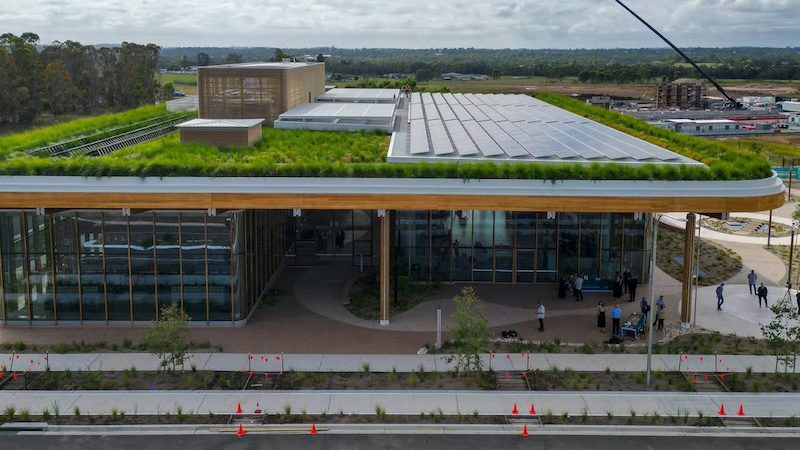
The brand new western Sydney suburb of Bradfield consists so far of just one building, but it’s no ordinary building. On its 1,300 square metre roof is a thriving native garden with 180 kilowatts (kW) of solar panels on top – a groundbreaking new system being dubbed “biosolar.”
The biosolar roof is part of a University of Technology Sydney (UTS) project that is testing the well-documented benefits of growing plants under solar panels – to boost generation efficiency and biodiversity – alongside the similarly well-documented benefits of green roofs in urban settings.
The latest assessment of the project by the UTS researchers is of how well it worked over the 2025 summer. And the results are startling.
The Bradfield project tests two options: a larger conventional set up on a non-plant bed and a smaller section where the panels are “integrated” with the plants.
UTS researchers Dr Peter Irga, Stephen Matheson and Ralph Fares at the Bradfield First Building. Image: Richard Downes
On extreme heat days – something western Sydney’s infamous heat island effect is known for – the temperaturd of the green roof was up to 28ºC lower than an aluminium roof.
Solar panels’ sweet spot is 25ºC, with efficiency dropping by 2 per cent for every degree above. The enormous temperature difference boosted power generation by as much as 23.25 per cent.
The integrated panels outperformed those on the conventional roof by 11.1 per cent on average over the four month study period, equivalent to 0.24 kilowatt-hours (kWh) per panel per day.
The other happy side effects were the creation of an ecosystem supporting 39 species of birds, such as kookaburras, insects, and pollinators, a system that retained three quarters of stormwater runoff landing on the roof, and a plant-based filter that removed almost all heavy metals from that water.
“The results at Bradfield were as good if not better for the area, and [the area has] got some more interesting urban heat island issues given it’s in that south-western corridor, so it does get hotter out there,” UTS project leader Peter Irga tells Renew Economy.
One hit wonder or repeatable plan
The Bradfield Development Authority requires 80 per cent of suitable roof space on new buildings to have either green or biosolar roofs.
But this is a brand new suburb, right next to the new Sydney airport, so it has scope to be more creative with its planning rules.
The question is whether the biosolar concept is possible elsewhere, even on established buildings.
Irga is anticipating its inclusion in the code that sets the minimum standards for buildings.
“At the moment we’re pushing for the National Construction Code to incorporate some form of framework to encourage green roofs and solar panels,” Irga says,
“And I think it may come to fruition in March or May [2027].
“They may be coming up with something in there to be like all available space should be considering PV or greenroofs.”
There is nothing per se in national rules to prevent a biosolar installation.
The Clean Energy Regulator says that rooftop panels need to be installed to Australian standards in order to get small-scale certificates under the small-scale renewable energy scheme (SRES).
“Should green roof requirements be introduced, installations seeking eligibility under the SRES would be required to comply with any applicable requirements in force at the time of installation,” said an emailed statement from the regulator.
Where big solar farms are subject to strict rules around what can grow under panels and how high it can get, Australian Installation standards – the AS/NZS 5033:2021 – doesn’t say anything about solar on a green roof.
But plants can catch fire, and the devil could be in the detail already set out in the installation standards.
Biosolar on a house or apartment building would have to follow rules requiring barriers between the “combustible material” and electrical equipment.
Other rules saying wiring needs to be clear of hazards, and around access so they can be maintained, suggest panels would need to be raised so plants can’t touch any parts of the module, and electricians don’t have to fight through a jungle to check them.
The final arbiter would not be councils but the inspector who signs off on solar panel installations, Renew Economy understands.
Makes money sense
On commercial and industrial buildings, Irga’s work has already shown that biosolar can be a smart financial move.
In 2020, the UTS team compared two rooftops in harbourside development Barangaroo where one building, International House, had solar and its twin Daramu House had solar panels on a green roof.
“The provision of renewable energy from both rooftops was substantial during the monitoring period (69 megawatt-hours (MWh) and 59.5 MWh for the green and conventional roofs, respectively),” the final report in 2021 says.
“After correction for a range of factors that differed between the two roofs, the green roof produced 9.5 MWh of electricity over the 8-month period more than the conventional roof, corresponding to a retail market value of $2,595.”
That’s based on a retail power price of $270/MWh, or 27c per kWh.
Irga calls the Barangaroo comparison a “watershed moment” that led to the commercial installation at Bradfield.
And that led to more funding to start trying out growing food under solar on rooftops, also known as agrivoltaics.
It would be less a rooftop petting zoo with sheep, but could include rabbits or low-growing crops such as herbs or strawberries, Irga says.
“If we’ve got enough concrete rooftop space and embedded solar panels, it’s useful to consider agriculture,” he says.
In space constrained regions such as Europe, Korea or Singapore, where farmers already have to think laterally for how to fit farms into urban environments, combining energy production with food production is already becoming a no-brainer.
“If you wanted to move into agriculture, the space is so limited. We could create a closed loop economy inside a building. Take the waste from a building, compost it on a roof, have solar panels but also some form of achievable crops.
“It might be strawberries, herbs and spice, but just something there.”
Basel, in Switzerland, has been allowing green roofs since the 1990s and mandated it for new builds and retrofits in 2002. It built the world’s first biosolar roof in 1999 on the Messe Basel exhibition complex.
Hamburg has mandated biosolar, with all new buildings with roof inclines under 10º required to have a garden roof from 2027, and at least 30 per cent of that space must also be used for solar panels.
But they can also be seen across Europe from Norway to Austria.
To join more than 29,000 others and get the latest clean energy news delivered straight to your inbox, for free, click here to subscribe to our free daily newsletter.
To support independent media, and help combat the spread of deliberate misinformation and disinformation about the energy transition, you can click here to make a one off donation or become a regular supporter of Renew Economy.
Rachel Williamson
Rachel Williamson is a science and business journalist, who focuses on climate change-related health and environmental issues.
Share this:
Facebook
X
LinkedIn
Reddit
Email
Print