One of the leading developers of battery storage projects in Australia, and the builder of the country’s most powerful battery, says Australia will reach its target or 82 per cent renewables, but likely not till 2034, four years after the current timeline.
The prediction by Akaysha Energy, the BlackRock-backed developer that is building the Waratah Super Battery, the most powerful in the country, and more than 6 gigawatts of project capacity, is contained in a briefing on the state of the battery storage market in Australia.
Battery storage has been the strong point of the green energy transition, driven by the plunging cost of battery storage, the relative ease for planning and construction, and the desire by the big incumbent utilities to invest in battery storage to protect their dominance and control of the market.
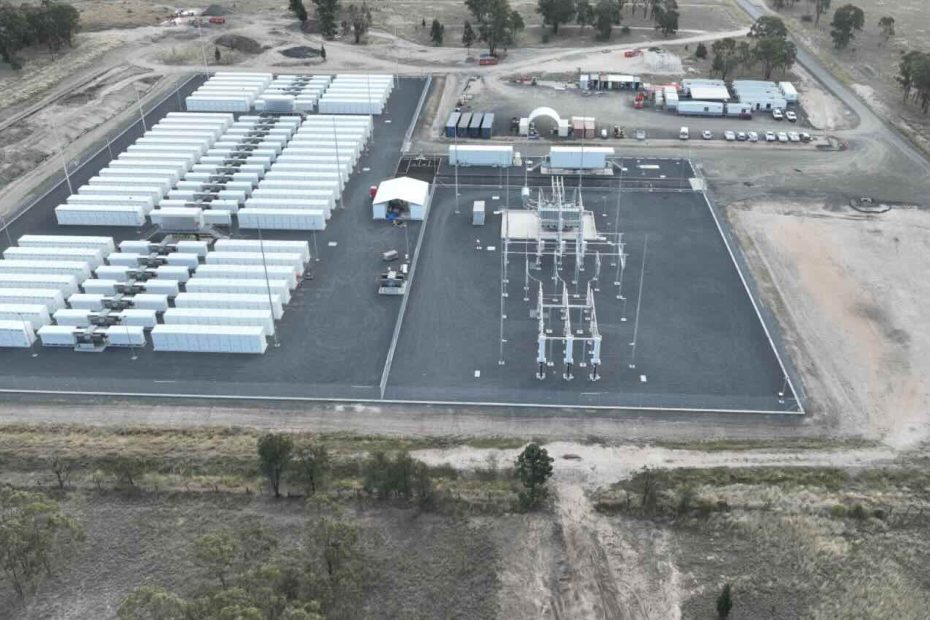
Akaysha has been prominent in this burst of activity, emerging from nowhere to secure the contract for the Waratah battery in 2021. It has also completed the Ulinda Park battery in Queensland, is nearing full commissioning of the Brendale battery, and is building the large Orana battery in NSW.
The 850 MW, 1680 MWH Waratah battery, however, is delayed – initially by weather issues that pushed back the original timeline of May this year, and then by a catastrophic failure of one of its transformers in October, in the final hours of full commissioning, that has now pushed back completion until May next year.
The battery is currently operating at around half its rated capacity, although it has been called upon to fill key roles amid the recent heatwave and coal plant outages.
In a report titled “Batteries included”, senior Akaysha executives including managing director Paul Curnow and head of policy Emma Fagan say Australia is currently “off-track” from its 2030 target because the current rate of large scale renewable installations – 2-3 GW a year – is well below the 10 GW needed.
“It is more likely that Australia will meet the target four years late – in 2034 after the closure of 11 coal plants across the NEM (National Electricity Market),” they write.
The transition from “baseload” will require a 3.6 times increase in wind capacity from 14 GW to 68 GW by 2040, a 2.2 times increase in solar capacity from 20 GW to 65 GW, and a 7.1 times increase in battery capacity from 7 GW to 52 GW. Underlying electricity demand will increase by 85 per cent out to 2045.
Akaysha’s modelling suggests a renewable energy mix of around 65 per cent by 2030, compared to just over 40 now, the Australia Energy Market Operator’s “constrained” forecast of 75 per cent renewables, and some bleaker forecasts of less than 60 per cent. The federal government insists that 82 per cent is still possible.
Akaysha says batteries will become the dominant form of battery capacity, with 17 new projects joining the grid in 2025, and the storage capacity moving from two to four hours, with six hour storage likely to be economic in the coming five years.
“Currently, four hour BESS assets are perfectly placed to capture intraday price spreads,” charging at low and negative prices in the middle of the day and feeding back into the grid in the evening peaks.
“Six-hour BESS will start to play an increased role in the early 203s at this price spread increases.”
But Akaysha says that while the initial burst of activity in battery projects was driven by government funding and government contracts, the fall in costs and the increase in value means there is now a shift to new projects based around purely commercial cases, including for capacity swaps, virtual toll and physical toll agreements.
Akaysha has also been using state and federal underwriting schemes to “revenue stack” for projects such as Orana in NSW, and Deer Park in Victoria and the expansion of Ulinda Park in Queensland.
It says these arrangements will remain critical to roll out sufficient battery capacity in time to fill the gap from coal closures, and says the new market design proposed by the Nelson Review will be critical to supporting that.
“The 7.1 times growth will see battery storage become the prime form of capacity in the NEM, critical for long term security and reliability,” the authors write.
“Australia’s energy only market structure is effective – but not currently creating investment signals sufficient to drive the level of new capacity investment needed. Without this we risk delaying coal closures which further impacts new build capacity.”
See Renew Economy’s Big Battery Storage Map of Australia for more information.
If you would like to join more than 28,000 others and get the latest clean energy news delivered straight to your inbox, for free, please click here to subscribe to our free daily newsletter.
Giles Parkinson
Giles Parkinson is founder and editor-in-chief of Renew Economy, and founder and editor of its EV-focused sister site The Driven. He is the co-host of the weekly Energy Insiders Podcast. Giles has been a journalist for more than 40 years and is a former deputy editor of the Australian Financial Review. You can find him on LinkedIn and on Twitter.
Share this:
Facebook
X
LinkedIn
Reddit
Email
Print