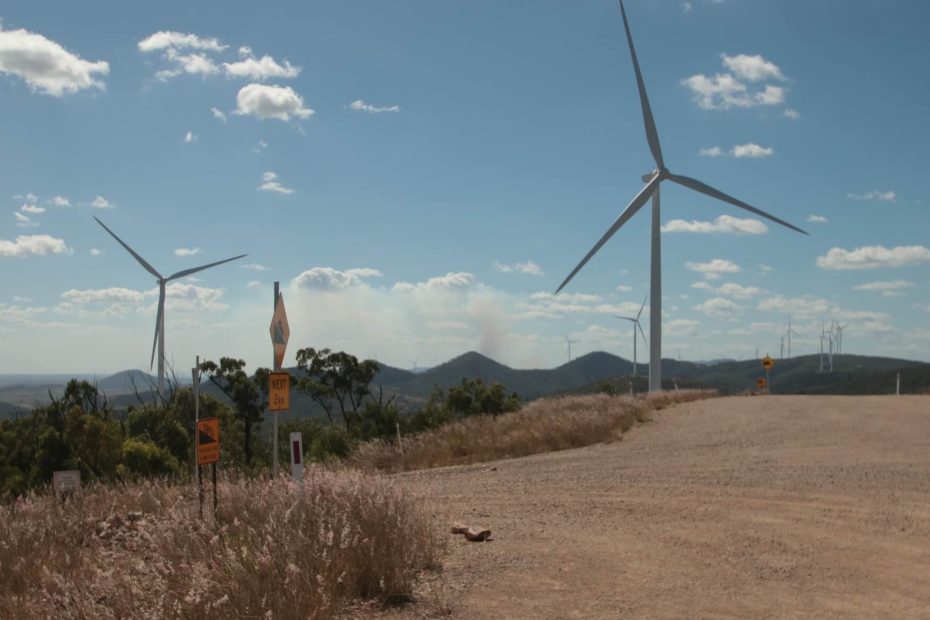
It’s the perennial question for critics of the renewable energy transition, and even those strongly committed to it: What happens when the sun don’t shine and the wind don’t blow?
Critics would like you to believe that the lights will go out, the economy will collapse, we’ll end up living in caves, Sky After dark commentators will do high fives, and we will all agree to drill, baby drill.
The reality is quite different. The lights stay on, the grid turns to back-up generators (batteries, gas, pumped hydro, and even diesel if necessary), and we continue on with the green energy transition – because it is cleaner, cheaper and more reliable. In short, it works.
Monday, according to keen market watchers, was the worst wind and solar drought on Australia’s main grid since 2022.
A massive cloud band across much of the eastern states suffocated solar, killing the so-called “solar duck” for a day, and low wind conditions meant there was not a lot of wind output.
Still, the sun always shines a little, and the wind blows somewhere.
A total of 85 gigawatt hours of wind and solar (variable renewable sources, or VRE) were produced during the day, amounting to 14.7 per cent of overall demand in the 24-hour period. Throw in hydro and a tiny amount of biomass, and the total renewables share over the day was just over 26 per cent.
Source: ITK Services.
According to David Osmond, a wind engineer at Windlab who keeps a close eye on wind and solar production and produces a weekly update of renewable generation and back-up needs, Monday was the worst VRE drought since 2022, and likely among the worst that could be expected.
“Normalised VRE generation on May 18 was 34 per cent (i.e. 66 per cent below average), and the previous day (May 17) was also terrible at 44 per cent,” Osmond wrote on LinkedIn, noting that the previous record low was 37 per cent on July 4, 2023.
The significance, he notes, is how it might rank in the pantheon of “terrible” days for wind and solar. He notes an authoritative 2022 study conducted by Griffith University’s Tim Nelson (he of the Nelson review), Joel Gilmore and Tahlia Nolan which suggested a 1-in-42 year bad VRE day would have normalised VRE of 32.8%.
Source: David Osmond.
“So Monday was almost as bad as this,” Osmond wrote. He also noted that the current fleet of wind and solar resources is not as geographically diverse as the Griffith analysis, which looked at a mostly renewable National Electricity Market, as per the country’s multi-decade blueprint known as the Integrated System Plan.
In particular, Osmond noted, the Griffith study would have factored in proportionally more wind in Queensland, which tends to be slightly negatively correlated to wind in the other NEM states, which means its wind likely blows when the others don’t.
(But the state LNP government is likely to ensure this doesn’t happen to the same extent, given their antipathy to new projects, apart from those destined to help power the state’s biggest energy users, the smelters and refineries around Gladstone).
So what happened on Monday? How much back-up did the greed need?
According to Watt Clarity, gas generation peaked at around 3.8 gigawatts in the evening demand peak around 6pm. That was a lot less than expected earlier in the day, and meant that prices were not as high as forecast earlier in the day, although they were higher than average over the day.
Generation on Monday, May 18. Source: ITK Services.
The slack was taken up by big batteries (and probably home batteries, as the market is still trying to get its mind around this), and by pumped hydro. Coal was “baseload” again (see the brown blob above in the ITK chart, it didn’t have to dance around solar) and was biggest contributor in the evening peak at 12 GW.
But what would have happened in a high renewable grid, with no coal, and 24 gigawatts and 120 gigawatt hours of storage?
That’s what Osmond’s weekly simulation looks at. And, according to his latest post, that would have required a peak of 8 gigawatts of gas backup on Monday night.
“The simulation was 92.6% renewable for this week,” Osmond wrote in a separate post. This week had 2 very challenging nights with up to 8 GW of ‘Other’ required on 18 May. It was the 6th most challenging day of the simulation, and the earliest in the year requiring this level of ‘Other’.”
The 8 GW needed on Monday night, Osmond says, was 2 GW less than the record high of 10.2 GW needed on 12 June 2025, mainly due to demand being much higher on that very cold winter day compared to Monday’s demand which was a little below average.
Indeed, we will need to see what a solar and wind drought in June holds for the grid, when temperatures are colder, and there is more electricity demand for heating.
But, as the market operator has already signalled, the high renewables grid will need a lot less gas capacity than previously thought. And those estimates are being constantly revised as more battery storage, and more long duration storage, is added to the grid.
To read more about Osmond’s weekly simulations, please see: Near 100 pct renewable electricity for Australia’s main grid is achievable and affordable: Year 4 update
If you would like to join more than 29,000 others and get the latest clean energy news delivered straight to your inbox, for free, please click here to subscribe to our free daily newsletter.
If you wish to support independent media, and accurate information, please consider making a one off donation or becoming a regular supporter of Renew Economy. Please click here. Your support is invaluable.
Giles Parkinson
Giles Parkinson is founder and editor-in-chief of Renew Economy, and founder and editor of its EV-focused sister site The Driven. He is the co-host of the weekly Energy Insiders Podcast. Giles has been a journalist for more than 40 years and is a former deputy editor of the Australian Financial Review. You can find him on LinkedIn and on Twitter.
Share this:
Facebook
X
LinkedIn
Reddit
Email
Print