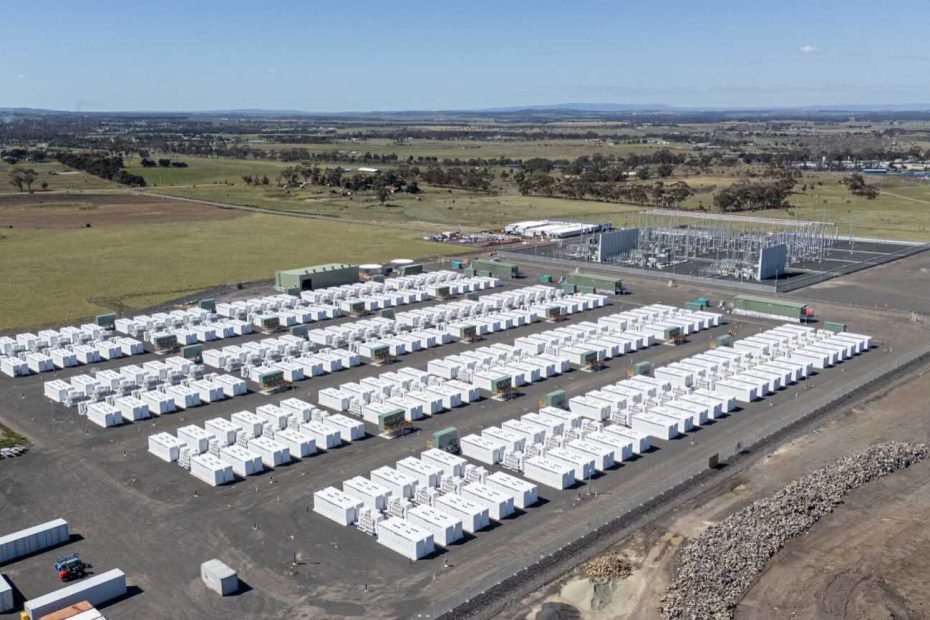
Australia has become the third-largest utility-scale battery market in the world, lagging behind only China and the United States, after a record 2 gigawatts of new big battery capacity was added around the country over the course of 2025 – a 233 per cent increase on 2024.
The Clean Energy Council’s Clean Energy Australia 2026 report, published Tuesday, details what was a “breakthrough year” for batteries – both big and small – in 2025, driven by surging investment, falling costs and supportive policy settings.
But it also highlighted the lack of investment in new wind and solar, essential to replace the country’s ageing coal generators – highlighting the fact that the federal government’s flagship Capacity Investment Scheme is yet to produce results, although the CEC pointed to state planning issues and grid bottlenecks.
For utility-scale batteries, however, the CEC says 12 new projects were added to the National Electricity Market (NEM) and Western Australia’s main grid, with a total capacity of 2 gigawatts (GW) and a total energy storage duration of 5.1 gigawatt-hours.
The CEC tally includes the AGL Energy-owned 500 megawatt (MW), 1000 megawatt-hour (MWh) – or one gigawatt-hour – Liddell Battery, although the first stage of that project – 250 MW and 500 MWh – technically started its commissioning process at the start of this year.
Another major contributor to the national battery fleet in 2025 was the 600 MW and 1600 MWh first stage of the Melbourne Renewable Energy Hub (MREH), jointly developed by Equis and the Victoria government-owned State Energy Corporation (SEC).
And mid-way through the year, Akaysha Energy’s Ulinda Park battery, near Millmerran in Queensland, started its journey through the commissioning process, with its 55MW/298MWh first phase becoming operational and trading on the NEM by December.
The CEC report says another 4.3 GW – and 13.5 GWh – of big battery capacity was financially committed over the year, worth $4.8 billion of investment – a 67 per cent increase on the investment level in 2024.
Source: CEC
Meanwhile, the capital cost of batteries fell by 20 per cent, according to the report, as economies of scale started to kick in.
“Batteries are playing an increasingly important role in Australia’s electricity system, shifting excess energy during peak generation periods to periods of peak demand,” the report says.
“Trend-wise, batteries are setting the wholesale price more frequently and closing the gap on gas peaker plants to set a spot price below that of gas. We expect this trend to continue as batteries start to compete more often with each other rather than with gas peakers.”
Big batteries also played a major role being paired with new renewable energy generators, mainly solar farms, in a trend towards project hybridisation that was identified in AEMO modelling as the primary tool for managing network congestion.
“Solar and wind developments were increasingly paired with battery storage, helping to manage price volatility, reduce curtailment risk and improve access to grid connections,” the CEC report says.
“In many cases, projects that were previously constrained as standalone generation in 2024 became viableagain in 2025 when configured as hybrids,” it adds, citing the example of Neoen Australia’s 412 MW Goyder South wind farm, which was paired with the 238.5 MW/477 MWh Blyth Battery, which started operations in April 2025.
At the other end of the battery spectrum, the CEC report shows that home battery installations surged 260 per cent year-on-year, with more than 268,000 units installed by the end of December – the vast majority of these through federal Labor’s hugely successful rebate scheme, which only launched halfway through the year.
“During the year, 268,675 home batteries were purchased, up from 74,582 in 2024,” the report says. “Household battery discharge levels more than doubled across all states.
Beyond batteries, other standout achievements in 2025 include renewable energy reaching a 42.7 per cent share of Australia’s electricity mix over the full year to December, up from 39 per cent the year prior.
“For the first time in Australia’s history and in the final quarter of 2025, clean energy generated more electricity than fossil fuels, easing wholesale electricity prices,” the report says
Less impressively, however, the report found just 2.3 GW of new renewable energy generation reached financial close in 2025, down 46 per cent compared to 2024. Onshore wind had a particularly tough time of it, with financial commitments to new projects falling 59 per cent.
“2025 was a year of new records. More renewable energy, more batteries, more households generating their own power,” said CEC chief Jackie Trad in a statement on Tuesday.
“But we need to be honest about where we are, and where we need to be. The number that demands attention is going in the wrong direction: financial commitments for large-scale wind and solar is at a decade low. That is a gap we must close.
“The next five years matter most. Our sector’s highest priority in 2026 must be to remove the barriers slowing investment in new large-scale wind and solar projects that will ultimately replace unreliable coal generators that threaten the security of our energy system,” Trad says.
“Critical government programs are in place and private capital is ready to deploy.
“But billions of dollars in projects are being held back by structural barriers, such as: connection delays and capacity, planning bottlenecks, curtailment, and gaps between policy signals and project economics. All are within the power of state governments and regulators to fix.”
If you would like to join more than 29,000 others and get the latest clean energy news delivered straight to your inbox, for free, please click here to subscribe to our free daily newsletter.
If you wish to support independent media, and accurate information, please consider making a one off donation or becoming a regular supporter of Renew Economy. Please click here. Your support is invaluable.
Sophie Vorrath
Sophie is editor of Renew Economy and editor of its sister site, One Step Off The Grid . She is the co-host of the Solar Insiders Podcast. Sophie has been writing about clean energy for more than a decade.
Share this:
Facebook
X
LinkedIn
Reddit
Email
Print