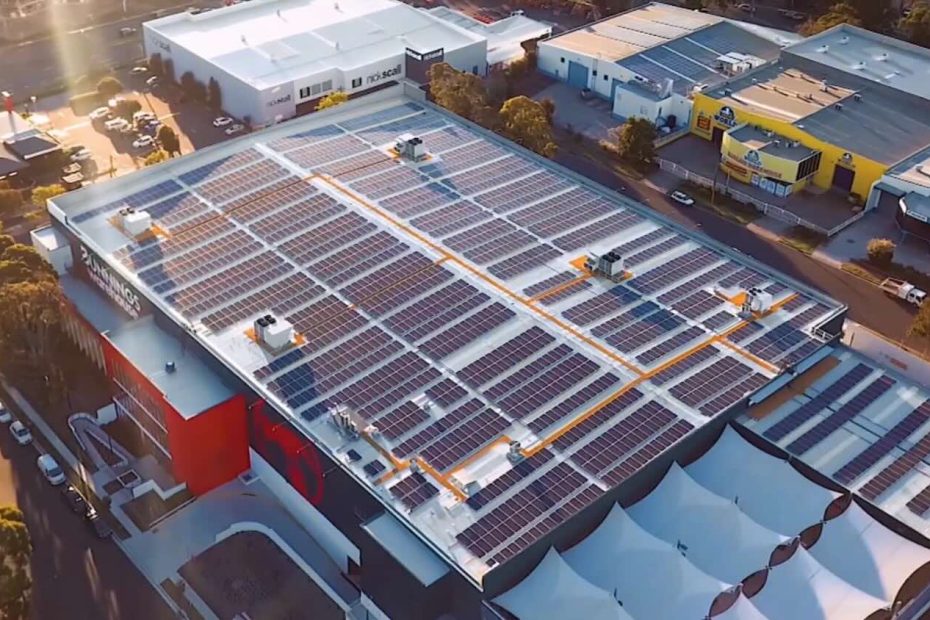
Ausgrid, Australia’s largest electricity network operator, has released new spatial energy planning data for three locations across its network which it hopes will help businesses identify opportunities to maximise their rooftop solar potential.
Unveiled on Wednesday, Ausgrid’s NSW Spatial Collaboration Portal now hosts data covering areas that have been identified for Ausgrid’s Community Power Network trial, including Mascot-Botany, the Northern Central Coast, and the suburb of Caringbah.
The trial is intended to investigate ways to better incentivise commercial buildings to install a solar system that covers their entire roof, instead of just enough to meet their own electricity needs.
The key targets are the underused roofs of warehouses, shopping centres, schools, and other large buildings, which the trial will then connect to a network of community-scale batteries.
Ausgrid says its NSW Spatial Collaboration Portal, which displays pilot areas for the company’s Community Power Networks, includes information on spare capacity to connect solar and batteries, areas where network limitations may exist, and places where future projects may be suitable.
Image Credit: Ausgrid
Tim Jarratt, Ausgrid group executive for external affairs and strategy, says the release of data for these three new locations is intended to test and refine the tools required to deliver this information at greater scale.
“Our Community Power Network trial is exploring how large commercial and industrial rooftops can be used to generate more solar energy, supported by community batteries, while sharing the financial benefits with households and businesses across local communities.
“As part of the trial, we’re making detailed information about the local electricity network publicly available to give businesses and energy providers a clearer picture of where new solar, battery and energy projects could work best.
“In Caringbah, the data will help the market to explore and test its own ideas. It’s a great opportunity to see what different approaches emerge and what we can learn from them.”
Ausgrid lodged an application with the Australian Energy Regulator (AER) in May of 2025, which was then put out for public consultation in August of that year.
Designed to harness unused rooftop solar in the existing network – particularly on commercial and industrial buildings – the trial aims to test Ausgrid’s hypothesis “that by unlocking current challenges in the existing market, communities will benefit from cheaper and more equitable electricity.”
The AER granted Ausgrid’s waiver in December, allowing the company to install and run neighbourhood-sized batteries and rooftop solar in two Sydney areas, Mascot-Botany in Sydney and Charmhaven on the Central Coast.
The project required a waiver from ring fencing rules that prevent distribution network service providers (DNSPs) from participating in competitive markets.
Fast forward to September of this year, and Ausgrid revamped its trial, swapping from a funding method which would have increased costs for customers to recover its $72.8 million investment, to securing alternative funding, with the company agreeing that it’s shareholders will now carry the trial’s financial risk.
If you would like to join more than 29,000 others and get the latest clean energy news delivered straight to your inbox, for free, please click here to subscribe to our free daily newsletter.
Joshua S Hill
Joshua S. Hill is a Melbourne-based journalist who has been writing about climate change, clean technology, and electric vehicles for over 15 years. He has been reporting on electric vehicles and clean technologies for Renew Economy and The Driven since 2012. His preferred mode of transport is his feet.
Share this:
Facebook
X
LinkedIn
Reddit
Email
Print