The Australian Renewable Energy Agency (ARENA) has made its biggest single investment yet into new solar technologies, lobbing $45 million to help iron ore giant Fortescue test a range of new technologies in the harshness of the Pilbara.
The funding will be used to help Fortescue establish a test bed for up to 10 different and new solar technologies across its Pilbara solar portfolio, which the company says is now stands at 1.5 gigawatts (GW) – a key part of its pursuit of achieving “real zero” emissions at the giant mines by 2030.
That portfolio covers the 190 megawatt (MW) Cloudbreak project, where testing of new technologies has already started, the 644 MW Turner project near Port Hedland, and the recently completed 100 MW North Star Junction project.
Fortescue has already launched two demonstration projects within the initiative, both at the Cloudbreak project which is being built to provide power to the company’s flagship iron ore mine.
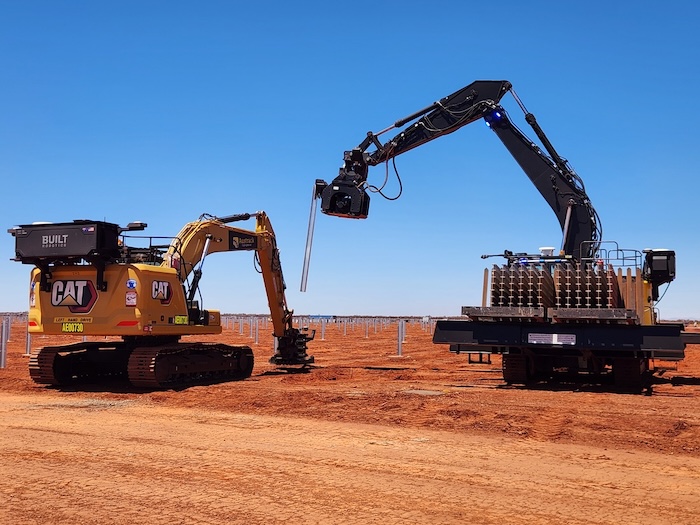
Built Robotics has already trialled its automated pile-driving technology and solar panel installer 5B will test its rapid-deployment Maverick solar technology next year.
“The Solar Innovation Hub will allow us to trial and refine new technologies that improve safety, speed up delivery and drive down costs,” said Fortescu’s Dino Otranto in a statement.
If these technologies prove to be technically and commercially viable in the harsh Pilbara environment and deliver on time saving and other promises, Fortescue will use them across its solar portfolio.
At issue is the high cost, complex logistics, and challenging environment posed by the Pilbara which makes very large solar deployments particularly difficult. See this report on the very first solar project to be built for Fortescue: Hot, humid, dusty and …. boring: Building solar farms in the outback is not piles of fun
From the ARENA perspective, this project will look at how to reduce those barriers in line with its Ultra Low-Cost Solar vision, a goal to bring the cost of installed solar down below $20 a megawatt hour and have 1 terawatt of solar installed in Australia by 2050.
It sees co-locating innovations within Fortescue’s Pilbara solar farms as an opportunity to evaluate the impact of those technologies within a single operational and environmental setting.
Focusing a grant on one company with multiple possible technology trials is also a new way for ARENA to spend its money to further that goal, says ARENA CEO Darren Miller.
He called it “maximising our impact” while helping collaboration within the sector.
“By creating a space where cutting-edge technologies can be tested and refined in real-world environments, we’re helping to deliver significant cost reductions as quickly as possible for the benefit of both industry and the climate,” Miller said in a statement.
“These advances are helping to lower the levelised cost of energy (LCOE) and improve commercial viability for the heavy industrial and hard to abate sectors.”
ARENA has already funded a series of solar technology companies over the last year, offering ways to speed up different parts of the construction process.
It funded trials by Build Robotics and panel installer robotics company Luminous at Engie’s Goorambat East solar farm.
And in July it launched a new funding target for its ultra low-cost solar goal with a $60 million round targeting innovation in the production of solar cells and modules and cheaper methods of installation and operation.
If you wish to support independent media, and accurate information, please consider making a one off donation or becoming a regular supporter of Renew Economy. Please click here. Your support is invaluable.
Rachel Williamson
Rachel Williamson is a science and business journalist, who focuses on climate change-related health and environmental issues.
Share this:
Facebook
X
LinkedIn
Reddit
Email
Print