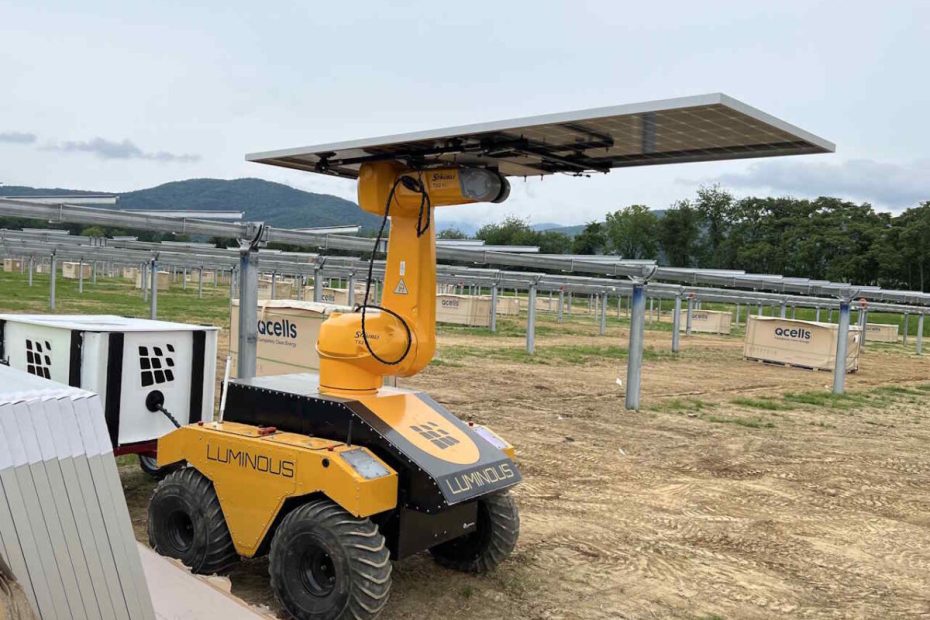
The Australian Renewable Energy Agency (Arena) announced on Tuesday that it will invest up to $31.1 million to establish manufacturing facilities for robotic technologies designed to facilitate the construction of solar farms.
Funded under the second round of Arena’s Solar Sunshot Program, the new investment will help to establish manufacturing facilities in Melbourne and Brisbane for two automated technologies – robots that install solar panels, and robots that drive foundation piles.
Robotics are increasingly being incorporated into solar farm construction to reduce the need for arduous and sometimes risky unskilled labor and to reduce the cost and time taken for certain construction and maintenance processes.
Robots have been involved in helping to build several solar farms across Australia recently, including the 250-megawatt (MW) Goorambat East solar project in Victoria and the 350 MW Culcairn solar farm in New South Wales, where US-based robotics firm Luminous Robotics put its Lumi robot to work installing solar panels.
Luminous secured $4.9 million from ARENA’s Solar ScaleUp Challenge last year to demonstrate its Lumi robot, which helps “pick and place” solar panels during construction.
Similarly, an autonomous electric robot that inspects the panels of utility-scale solar farms will soon make its debut in Australia, part of another ARENA-backed initiative to test and deploy new technologies.
“Installing foundations and placing panels are two of the most labour-intensive parts of solar farm construction,” said Darren Miller, ARENA CEO. “It’s hard work in the hot sun.
“Australia needs to install large volumes of solar quickly and cost-effectively. Local manufacturing and automation can improve the way solar farms are built by reducing construction costs and making installation faster, safer and more efficient; an important part of ARENA’s ultra low-cost solar vision.”
The new funding announced this week will be split between two companies, including Luminous Robotics, as well as Built Robotics Australia.
Luminous will receive up to $17.8 million to establish a Melbourne manufacturing facility for its Lumi robots. Once completed and operational, the facility is expected to support the manufacture and deployment of around 100 Lumi robots by 2029.
“We’ve proven Lumi on real solar farms in Australia, in the heat and dust, doing some of the hardest work on site,” said Tenzin Crouch, Luminous Robotics Australia general manager. “With ARENA’s support, the next step is to turn that into scale.”
“Building a production line in Melbourne, delivering our first hundred robots, and then growing from there. If Australia is going to build renewable energy at the scale and speed we need, robotics will have an important role to play and we are building it.”
Built Robotics Australia, a local subsidiary of California headquartered Built Robotics, will receive up to $13.3 million to establish a Brisbane manufacturing hub and operations centre for its autonomous piling systems used in utility-scale solar construction.
Unlike the Lumi robots, Built Robotics piling robots help automate one of the most labour-intensive stages of solar farm construction. The planned facility will manufacture and deploy 12 robotic piling systems.
“Australia has shown the world that construction robotics and physical AI work in the field,” said Paul Kelly, vice president of business development at Built Robotics. “Now we’re going to build that technology here.”
“Our Brisbane hub will make Queensland a home for autonomous solar construction, creating skilled local jobs and a supply chain that serves projects in Australia, building on nearly a decade of work we’ve done here.”
To join more than 29,000 others and get the latest clean energy news delivered straight to your inbox, for free, click here to subscribe to our free daily newsletter.
Joshua S Hill
Joshua S. Hill is a Melbourne-based journalist who has been writing about climate change, clean technology, and electric vehicles for over 15 years. He has been reporting on electric vehicles and clean technologies for Renew Economy and The Driven since 2012. His preferred mode of transport is his feet.
Share this:
Facebook
X
LinkedIn
Reddit
Email
Print