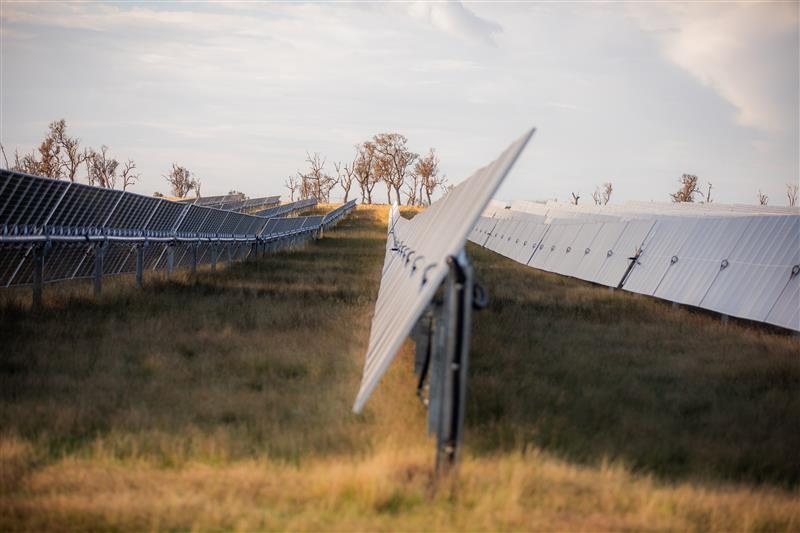
The era of ever cheaper solar panels may be over, at least for a time, as industry experts warn that prices will rise by one to two cents per watt from 2026, on the back of increasing materials costs and policy changes in China.
But these price rises are healthy and much needed as panel manufacturers have been selling at breakeven prices in Australia, says Charles Wang, head of distribution at solar manufacturer JA Solar.
“To be honest, in Australia previously, especially the big companies have been just breaking even, maybe a slim margin,” Wang told Renew Economy on the sidelines of the All Energy Australia conference in Melbourne last week.
“Now the upstream cost is increasing, ideally we should also increase [panel prices]. I think a decent margin for the manufacturer is at least a couple of cents more per watt.”
JA Solar has already begun to raise prices for future utility-scale solar projects, with Wang saying these have started with a 77c/watt hike but developers can expect this to jump over the next year depending on the timing of projects.
Not everyone is so bullish about solar module price rises occurring in Australia.
Trinasolar’s Andrew Percival says there is a potential correction in the market and a “slight” increased pricing trajectory for 2026.
“It’s based upon raw materials, supply chain and contracts changing, as well as a review of what China has implemented in years gone by in terms of rebates and subsidies,” Percival told Renew Economy.
“Potentially, in the future in 2026 we see there’ll be some slight increases in the pricing when it comes to modules, although the jury’s still out on that.”
The news that solar equipment is about to start getting more expensive may not be good news for the Australian Renewable Energy Agency (ARENA)’s goal to get large-scale solar prices down below $20 per megawatt hour (MWh).
The great consolidation
There are a few reasons for the price rise, one being China cancelling a 13 per cent VAT export rebate from October this year.
It had reduced the rebate 9 per cent towards the end of 2024 on solar and battery export goods, but has since cancelled the rebate altogether.
But industrial factors are also at play, as the Chinese polysilicon sector contracts after years of cut throat competition created massive oversupply, Wood McKenzie analysts said in a report last month.
In 2024, solar module prices hit a nadir of $0.11 to $0.14 per watt, said Yana Hryshko, a senior research analyst at Wood Mackenzie.
Government guidelines have stopped that unlimited expansion and demanded manufacturers scale back production, leading to a rise in polysilicon prices of 48 per cent in September, she said.
Add in rising prices for all of the materials that go into making a solar panel, from silicon to aluminium to glass, and Wood MacKenzie was predicting module prices spiking by 9 per cent this quarter alone.
Cuts to polysilicon production are coming just as obsolete production lines are being phased out.
“Everyone sees an opportunity then they start to build a new factory, and increase the manufacturing capacity,” Wang says.
“What’s happening now is everyone wants to use a high efficiency panel so the old manufacturing capacity is being phased out. The big players have enough capital to keep investing in new capacity [and new technology] and supply all of the jobs.”
Manufacturing lines for old passive emitter and rear cell (PERC) technologies are being shut down as the industry shifts towards the modern technologies customers are demanding.
If you would like to join more than 27,400 others and get the latest clean energy news delivered straight to your inbox, for free, please click here to subscribe to our free daily newsletter.
Rachel Williamson
Rachel Williamson is a science and business journalist, who focuses on climate change-related health and environmental issues.
Share this:
Facebook
X
LinkedIn
Reddit
Email
Print