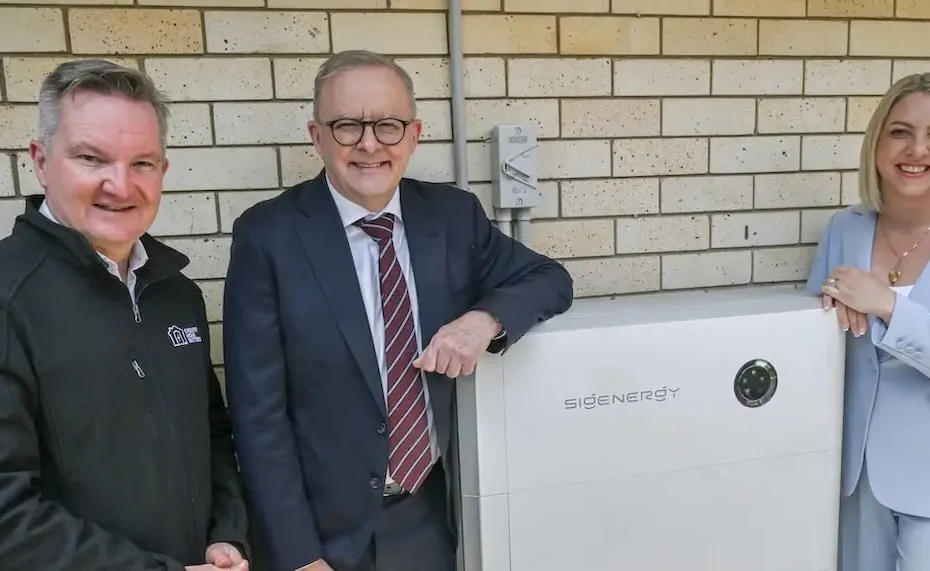
Australia’s home battery rebate is being eaten up by systems sized at 50 kWh and above, new data has revealed, amid rumours federal Labor is gearing up to change the policy’s settings, to stem the flow of its rapidly draining budget.
The stunning success of the Albanese government’s Cheaper Home Batteries scheme continues to defy expectations, with the Clean Energy Regulator last week forecasting it to hit 175,000 valid applications by the end of 2025.
At the same time, this success is making some in the industry nervous, as back-of-the-envelope calculations suggest the $2.3 billion budget for the four-year scheme will be exhausted as early as June, 2026.
“[The rebate] will probably run out by the middle of next year on this kind of run rate,” Origin Energy’s general manager of Electrify and New Connections, Chris Zondanos told AAP last week.
This week, Renew Economy has heard from a number of industry insiders that speculation is mounting that the scheme will either be wound up early – a highly unlikely outcome, according to sources close to the matter – or have its eligibility criteria changed to calm uptake and make it more sustainable.
Under current settings, the Cheaper Home Batteries rebate can be claimed for systems between 5 kilowatt-hours (kWh) up to a maximum usable capacity of 50 kilowatt-hours – or a maximum discount of around $18,500. But the 50 kWh discount also can be claimed for systems with a total installed size of up to 100 kWh – an allowance made to get small-to-medium businesses in on the action.
Most bets are on Bowen working with industry to make a number of adjustments to the scheme – a course of action that was clearly flagged when the scheme was launched.
“[The] discount of around 30% on the upfront cost of installing small-scale battery systems (5 kWh to 100 kWh)… is going to be reviewed at least annually and will gradually decrease until 2030, in line with reducing battery prices,” the department website says.
Whether one of these changes will be to cut the maximum capacity for eligible battery systems remains to be seen. But an adjustment like this might make good sense, in light of the latest monthly data on home battery uptake.
According to industry statisticians, SunWiz, the 50-75 kWh and the 30-50 kWh market segments grew the most over the past month – by 71 per cent and 58 per cent, respectively.
“In November, the smaller the system segment, the slower the growth,” SunWiz managing director Warwick Johnston says.
Source: SunWiz
Source: SunWiz
The SunWiz report shows that the national small-scale energy storage market grew by 42 per cent, all up, in November, hitting hyperdrive once again after slower growth of 17 per cent in October.
Johnston says total small-scale battery registrations hit 1,024 megawatt-hours (MWh) in November, marking the first time STC battery volumes have surpassed the 1 gigawatt-hour (GWh) milestone.
Among the states and territories, new registrations were led by Queensland, which charted 45 per cent market growth, month-on-month, followed by New South Wales, where the market grew 44 per cent.
If you would like to join more than 28,000 others and get the latest clean energy news delivered straight to your inbox, for free, please click here to subscribe to our free daily newsletter.
Sophie Vorrath
Sophie is editor of Renew Economy and editor of its sister site, One Step Off The Grid . She is the co-host of the Solar Insiders Podcast. Sophie has been writing about clean energy for more than a decade.
Share this:
Facebook
X
LinkedIn
Reddit
Email
Print